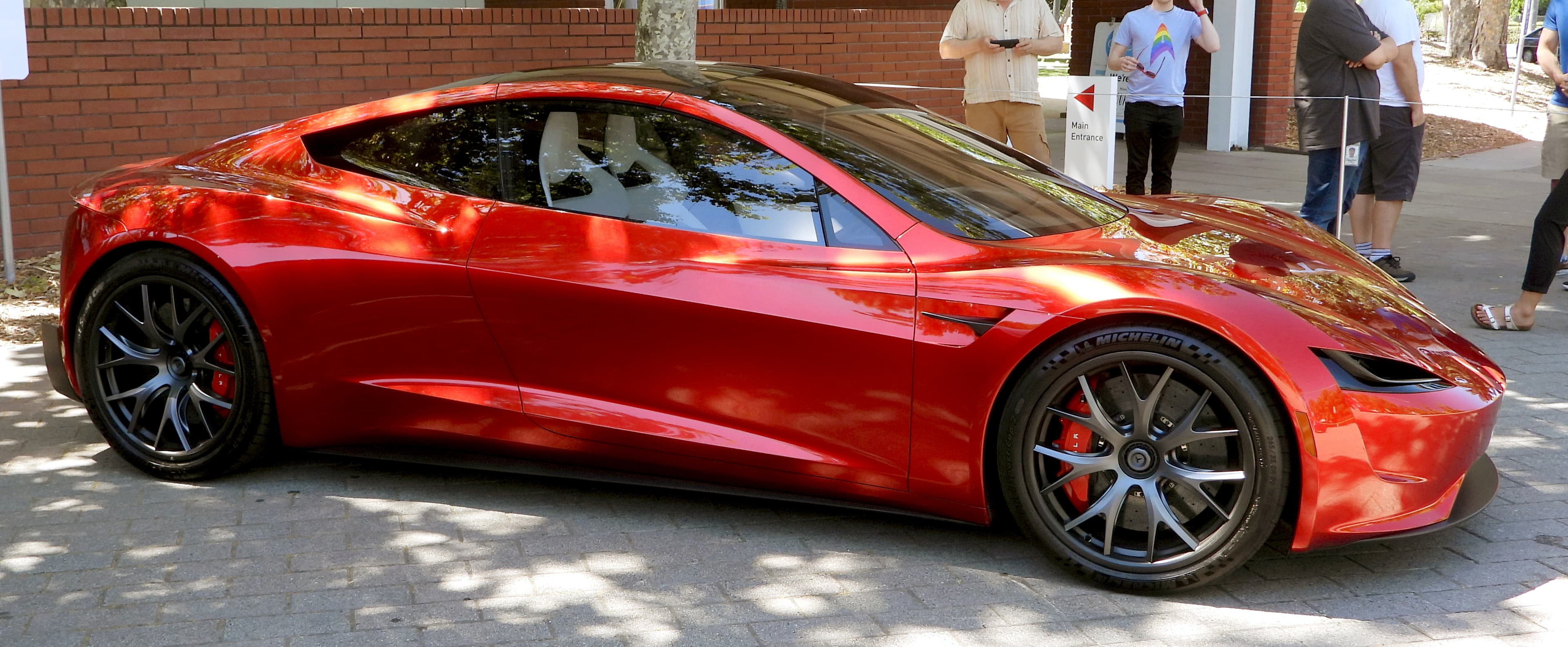
This is an opinion piece — the views are the author's own. Every specification and date cited is Tesla's own claim or a public statement, linked in the Sources below. Whether the car meets those claims is a separate question, and October 1 will start to answer it.
On Saturday night, Tesla posted one image: four rocket plumes rising from the rear deck of a low, wide car in near-darkness, a full-width red light bar, the words "Go for launch" and a date — 10.01. Lift the shadows in the image and a hidden line appears: "WHERE WE'RE GOING". It's the Back to the Future quote that ends "we don't need roads."
Nearly nine years after Elon Musk drove the second-generation Roadster out of the back of a Semi trailer, the car that has lived longer as a promise than as a product finally has a date. And I think its arrival matters for a reason almost nobody is discussing: the Roadster may be the first car that makes a mainstream audience learn the difference between a fast car and the experience of a car. They are not the same thing. We are about to find out how many people know it.
What Tesla is promising
- <1 s
- 0–60 mph design goal (2024)
- 400+ km/h
- Claimed top speed
- 1,000 km
- Claimed range
- 200 kWh
- Battery — twice a Model S
The numbers are the pitch, so here they are. When the prototype broke cover in November 2017, Tesla claimed 0–60 mph in 1.9 seconds, a quarter-mile in 8.88 seconds, a top speed above 250 mph and 620 miles of range from a 200 kWh battery — twice the capacity of the largest pack Tesla has ever shipped. Three motors, one front and two rear, drive all four wheels with torque vectoring, and Tesla quoted 10,000 Nm of torque at the wheels. In February 2024, Musk raised the acceleration design goal to under one second.
Then there is the SpaceX package: roughly ten cold-gas thrusters where the rear seats would be, fed by a 10,000-psi composite air tank derived from Falcon 9 rocket hardware. Musk has said since 2018 that it might let the car hover, and the October 1 event — teased for SpaceX's McGregor, Texas rocket site — is reported to be exactly that: a driverless car lifting off the ground while spectators watch from several hundred yards back. The thruster version is not expected to be street-legal. A conventional car is planned alongside it.
The event
- When
- October 1, 2026
- Where
- Reported: SpaceX's McGregor, Texas site
- Production
- 2027–28 (Musk, November 2025)
- Price
- US$200k base / $250k Founders (2017, since removed)
Nine years of waiting
- November 2017 — revealed at the Semi event; production promised for 2020. US$200,000 base, US$50,000 deposit, first 1,000 a US$250,000 Founders Series.
- July 2020 — "12 to 18 months" away.
- January 2021 — pushed to 2022. September 2021 — pushed to 2023. May 2023 — pushed to 2024.
- February 2024 — design goals "radically increased"; unveil by end of 2024, deliveries 2025, and the 0–60 target raised to under one second.
- October 2024 — 2025 or 2026.
- November 2025 — demo set for April 1, 2026, a date Musk said gave him "deniability because I can say I was just kidding"; production 2027–28.
- March to August 2026 — "hopefully next month", "late April", "a month or so", then August. None of them happened.
- September 12, 2026 — "Go for launch": October 1.
The people who paid US$250,000 for Founders Series cars in 2017 — Musk calls them "our long-suffering Roadster reservation holders" — have waited nine years. In that time the Roadster has existed almost entirely as expectation. That matters, because expectation has had nine years to grow into something no physical car could possibly satisfy. Whatever appears on October 1 doesn't just have to be good. It has to beat nine years of imagination.
This time, at least, there are signs it is real. Tesla's engineering chief Lars Moravy says cancelling the Model S Plaid Plus freed the engineering effort that brought the Roadster back into active development, and that alpha prototypes are "going around right now doing some work". Chief designer Franz von Holzhausen — the man who designed it — said in August it is coming "very soon".
Fast is not the same as felt
Which brings me to my actual point.
A sub-one-second 0–60 time is not an experience; it is something that happens to you. Human senses can't parse it. Between three seconds and two, acceleration is thrilling because your body can still read it. Below that, there is no reading — there is only holding on. You don't drive it. You endure it, once, and then it becomes a number you tell people.
| Feature | A fast car | A car you feel |
|---|---|---|
| What it gives you | A number | A sensation |
| Where it lives | The spec sheet | The road |
| What it asks of you | Hold on | Skill and judgement |
| Sound | Wind and tyres | Something worth listening to |
| What you remember | The first launch | Every good drive |
Speed you can feel is a relationship. Speed you can't feel is a statistic. And statistics are where the Roadster's headline talents will live for almost every owner, because there is almost nowhere on Earth to use them.
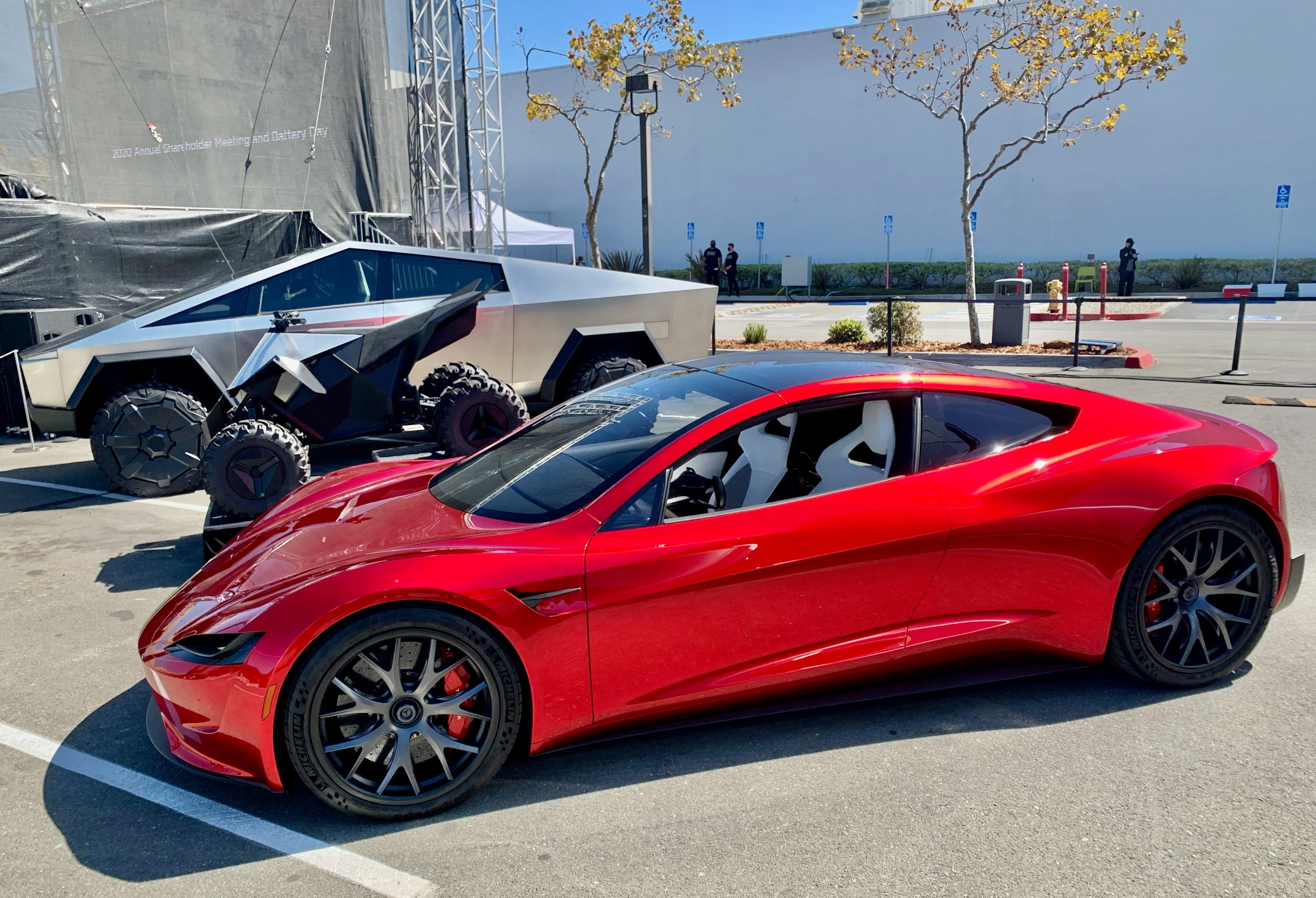
The perfection problem
That is the first half of my worry. The second is the opposite problem: the car may be too good.
It will be quiet. It will be smart. It will be seamless, instant and effortless — and if Tesla's track record holds, it will make very few mistakes for you to forgive. But forgiveness is part of attachment. The traits people call character are usually flaws: an engine that snarls, a gearbox that punishes a lazy shift, a chassis that talks back. Sand every edge off a car and you get something people admire, and nobody describes the way they describe an old 911, an MX-5 or a V8 ute. Perfection is impressive. It can also be boring, because there is nothing left for the driver to do.
Where would you even drive it?
And be honest: where does a 400 km/h car live? Not on Australian roads, where the fastest legal speed anywhere in the country is 130 km/h on parts of the Stuart Highway, and 110 km/h pretty much everywhere else. Not in any suburban street, where a sub-one-second launch is not a party trick so much as a hazard.
The honest answer is a racetrack — Phillip Island, Sydney Motorsport Park, The Bend. Wonderful places. Almost no $300,000-plus car ever sees one. The Roadster's natural habitat is a closed course, or a rocket facility with the public kept hundreds of yards away. A car you can only fully use where nobody is allowed to watch is not a car you experience on a Sunday morning down the Great Ocean Road. It is a car you watch — on a screen, like everything else.
The aim is to build the last best driver's car before autonomous driving becomes the norm.
A deciding moment
Read that quote again. Tesla's own engineering leadership describes the Roadster as "the last best driver's car" — before autonomous driving becomes the norm. The company leading the push to remove the driver is building a farewell to driving, and it knows it.
That is why I think this launch is bigger than a product reveal. It is a deciding time for the future of the car and how people experience it. Either the Roadster proves that a car can be perfect and still be loved — that speed, silence and software can add up to an experience worth having — or it proves the opposite: that somewhere between two seconds and one, between a steering wheel and steer-by-wire, between the road and the launch pad, the experience of driving was left behind.
My expectation? The Roadster will be astonishing. It will also be the car that makes ordinary people ask the question enthusiasts have argued about for years: is a fast car the same as a car you enjoy? On October 1, a lot of people are going to start learning the difference — and whatever the answer is, the cars that come after will be shaped by it.
FAQs
When is the new Tesla Roadster coming out?
Tesla teased an event for October 1, 2026 with a "Go for launch" image posted on September 12, 2026. At Tesla's November 2025 shareholder meeting, Elon Musk said production would begin in 2027 or 2028 — 12 to 18 months after the reveal.
How fast is the new Tesla Roadster?
Tesla's claims, none independently verified: 0–60 mph in 1.9 seconds originally, with a design goal of under one second set in February 2024; an 8.88-second quarter-mile; and a top speed above 250 mph (400 km/h). Claimed range is 620 miles (1,000 km) from a 200 kWh battery.
Will the Tesla Roadster really fly?
Musk has said the optional SpaceX package — about ten cold-gas thrusters fed by a high-pressure air tank — could let the car hover. Reporting on the October 1 event describes a driverless hover demonstration at SpaceX's McGregor, Texas facility. The thruster version is not expected to be street-legal.
How much will the new Tesla Roadster cost?
Tesla listed a US$200,000 base price and a US$250,000 Founders Series at the 2017 reveal, against a US$50,000 deposit. Prices have since been removed from Tesla's website. A straight currency conversion would put the base car above A$300,000 before Australian taxes and on-road costs.
Why has the Tesla Roadster been delayed so long?
The car was revealed in November 2017 with production promised for 2020. The date has moved at least eight times as Tesla prioritised other models and, by Musk's account, "radically increased" the design goals. Tesla executives say the programme accelerated after the Model S Plaid Plus was cancelled, and that alpha prototypes are now in testing.
Sources
- Tesla Roadster — official page
- Tesla — "10.01 Go for launch" teaser, September 12, 2026
- EV — Tesla announces Roadster unveil for October 1, includes hidden text
- Reuters — the 2017 reveal
- The Guardian — nine things we know about the "smackdown to gasoline cars"
- Electrek — Roadster demo delayed to April 1, production to 2027/28 (November 2025)
- Car and Driver — Musk's sub-one-second claim, February 2024
- Bloomberg, "Tesla's Newest Promises Break the Laws of Batteries" (2017) — the 200 kWh battery feasibility scepticism