Australia's new-car emissions rules have now produced their first scorecard, and if you read it per car rather than per brand, the people paying the most are the ones buying the fun cars. On the other side of the world, Britain is consulting right now on whether to soften its own electric-car mandate, and it already exempts small sports-car makers from its 2030 phase-out.
- $50
- per unit over target
- 620,947
- new vehicles covered, Jul–Dec 2025
- 1.22m
- units of liability
- 17.2m
- units of credit
In Australia
The New Vehicle Efficiency Standard (NVES) sets a fleet-average CO2 limit for every company that supplies new cars here. Beat your target and you earn units; miss it and you owe them. The regulator published the first results on 18 February 2026 (opens in a new tab), covering July to December 2025: 59 suppliers registered 620,947 covered vehicles, 40 of them beat their target, and those 40 generated a combined 17.2 million units.
The interesting part is in the regulator's per-supplier spreadsheet (opens in a new tab). A unit that isn't cleared becomes a penalty of $50 each (opens in a new tab), so here is what each shortfall would cost if it were never offset, divided across the cars that brand registered (our arithmetic):
- Mazda: 508,517 units across 38,465 cars, about $25.4 million, or roughly $660 a car.
- Porsche: 33,448 units across 1,653 cars, about $1.67 million, or roughly $1,010 a car.
- Aston Martin: 13,877 units across 105 cars, about $694,000, or roughly $6,600 a car.
- Ferrari: 15,785 units across 108 cars, about $789,000, or roughly $7,300 a car.
- Rolls-Royce: 4,497 units across 34 cars, about $225,000, or roughly $6,600 a car.
Nobody has actually been fined yet. Suppliers can buy units from compliant rivals or earn them in later years, the last date to clear 2025 is 31 December 2027 (opens in a new tab), and the first infringement notices won't go out until February 2028.
Meanwhile the credits pile up at the other end of the market. BYD's two supplier entities earned about 6.28 million units between them, Toyota 2.89 million and Tesla 2.21 million, according to the same spreadsheet. Not every exotic brand missed: Lamborghini, McLaren and Bentley all beat their targets.
And the bar keeps rising. The passenger-car limit dropped from 141 to 117 g/km in January 2026 (opens in a new tab), and the scheme tightens each year to 2029.
When the scheme was designed, the government's 2024 impact analysis (opens in a new tab) said "a low volume importer/manufacturer exemption would apply". Whatever form that took, it didn't keep Ferrari (108 cars) or Rolls-Royce (34 cars) off the liability list.
The world view
Australia's standard arrived just as several other countries stepped back. The UK government's consultation paper (opens in a new tab) notes that the United States repealed its federal greenhouse-gas vehicle standards in February 2026, that Canada announced plans the same month to repeal its EV sales standard and replace it with fleet-average rules, and that the European Commission has proposed cutting its 2035 target from a 100% to a 90% reduction in tailpipe CO2, which would leave a small role for plug-in hybrids, mild hybrids and combustion engines. That EU package is still being negotiated.
Another perspective: the United Kingdom
Britain runs a sales mandate rather than an Australian-style fleet average: a set share of each maker's new cars must be zero emission, rising to 80% in 2030. The ZEV Mandate Review (opens in a new tab), open from 14 August until 23 October 2026, tests lowering that 2030 target to 70%, 60% or 50%, or keeping 80% with extra flexibility. The government's own analysis says forecasts "point to ZEV sales in 2030 that are below the headline 80% target", even though 24.2% of new cars registered in the first half of 2026 were zero emission.
The same document confirms something Australia doesn't spell out as clearly: micro-volume makers (fewer than 1,000 cars a year) and small-volume makers (1,000 to 2,499) are exempt from the UK's 2030 phase-out of new combustion-only cars. Small-volume makers would face a modest fleet CO2 improvement instead, and micro-volume makers none at all. The stated reason is that small makers have "fewer model runs through which to incrementally improve".
Our take
We think the first NVES scorecard shows who really carries this scheme: buyers of low-volume, high-character cars. A family hatchback brand spread its shortfall over tens of thousands of cars; a Ferrari owner's share works out at around $7,300. That money flows, through traded units, to the brands with the biggest electric line-ups.
We're not arguing that Ferraris should get a free pass on physics. But a hundred-odd sports cars a year don't move Australia's emissions needle, and the people who buy them are usually the ones keeping them, maintaining them and driving them for decades. Britain looked at the same problem and wrote a small-maker carve-out into its plan. The NVES was always meant to be reviewed in 2026 (opens in a new tab). Our view is that this review should look hard at whether the enthusiast end of the market is paying a fair share or a disproportionate one.
The fair counterpoint is that the system is working as designed: the overall fleet beat its targets, two-thirds of suppliers earned credits, and nobody has paid a cent yet. True. But a regulation that only bites the small players at the margin is still a regulation that makes fun cars dearer, and that's worth saying out loud before the targets tighten again.
Related
Related reading
- The Porsche 911: the everyday exotic
Sixty years of refining the "wrong" answer: how the rear-engined Porsche 911 became the exotic you can actually live with, and how its bewildering family tree works.
- Supercar depreciation: the heroes and the craters
Some supercars shed half their value like any luxury car; a few refuse to depreciate at all. What separates the heroes from the craters, and how to read a model's fate.
- Porsche delivered 16% fewer cars in the first half of 2026 — and made more money
Porsche's own half-year figures show deliveries down 16.5% and revenue down 5.1%, while operating profit rose 33.9%. The company calls it a value-over-volume strategy.
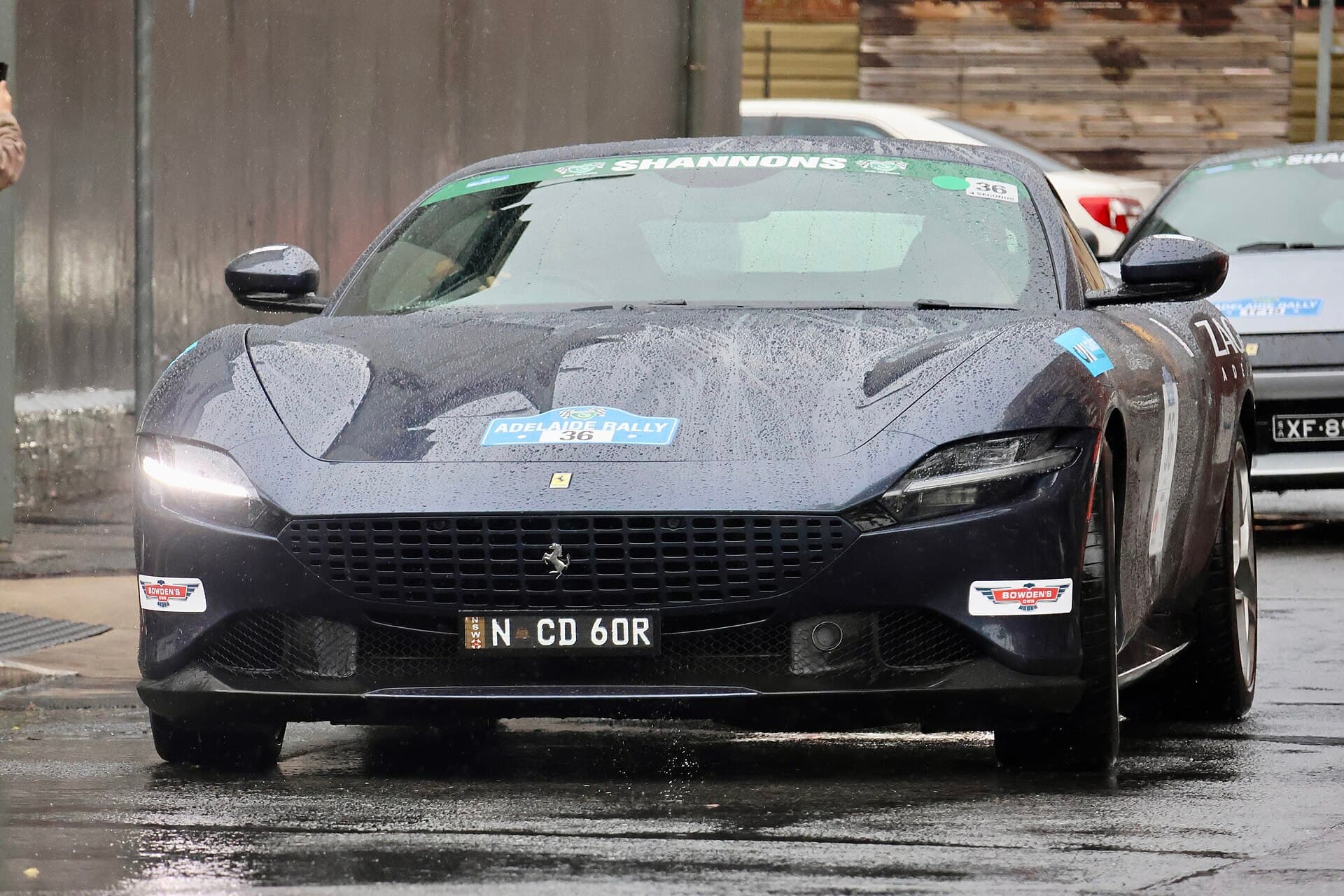
Photo: Ferrari Roma at the 2025 Shannons Adelaide Rally by Yu Chu Chin, CC BY 4.0 (opens in a new tab), via Wikimedia Commons (opens in a new tab).