Australia is still short of the people who fix cars. The federal government's 2026 Occupation Shortage List (opens in a new tab), released by Jobs and Skills Australia in October, rates motor mechanics, diesel mechanics, auto electricians, panel beaters and vehicle painters as in national shortage, and the number of new motor mechanic apprentices is falling (opens in a new tab). For owners, it shows up in repair bills rising faster than inflation and in workshops that cannot fill their bays.
The list itself is a spreadsheet anyone can download (opens in a new tab), and the automotive rows make for blunt reading. Motor Mechanic (General), Diesel Motor Mechanic, Automotive Electrician and Panelbeater are each rated "Shortage" with a "Clear" confidence label. Vehicle Painter is rated "Shortage" on an "On-balance" label, which means the evidence is closer to the line. Under the new occupation classification the list also runs, a separate Electric Vehicle Technician occupation is rated in shortage too.
This matters to buyers and sellers because the shortage is not spread evenly. A car that a busy suburban independent can service with ordinary tools is a different ownership proposition from one that needs a dealer's software, a high-voltage-trained technician and a calibration rig.
At a glance
- 2026 shortage list
- Mechanics, auto electricians, panel beaters, painters
- New motor mechanic apprentices
- 9,720 in year to March 2026, down 13.8% on 2022
- Six-year completion rate
- 60.2% for mechanics who started in 2019
- Repair and maintenance prices
- Up 6.2% in a year, vs 4.0% for CPI
- Germany
- 24,531 new Kfz apprentices in 2025, still short
What the 2026 shortage list says
Jobs and Skills Australia assessed 1,021 occupations this year and found 279 of them, or 27%, in national shortage, according to its 2026 Key Findings Report (opens in a new tab). That is down from 29% in 2025 and a 2023 peak of 36%, so the broader labour market is easing. Trades are not. The same report says 48% of Technicians and Trades Workers occupations were in shortage, the highest share of any major group, and it counts nine automotive occupations among the 127 that have been in shortage on each list from 2021 to 2026.
The list also covers the jobs around the workshop floor. Tyre Fitter and Motor Vehicle Parts and Accessories Fitter (opens in a new tab) are both rated in shortage this year. That is notable because the Motor Trades Association of Australia (MTAA) argued in September that tyre fitters were experiencing recruitment conditions consistent with significant workforce shortages (opens in a new tab) despite a "no shortage" rating at the time.
JSA's companion Occupation Shortage Drivers report (opens in a new tab) goes a step further and asks why. For motor mechanics it names an education and training gap as the main driver: not enough people are starting and finishing qualifications. A suitability gap comes second, meaning employers do get applicants but judge them not ready. Employers' most common reason for rejecting applicants was a lack of qualifications, with lack of experience a growing reason. The report also records employer concern about negative perceptions of automotive work among women and young people. For vehicle painters the main driver is different: retention, the report's shorthand for people leaving because of pay, conditions or better offers elsewhere.
The pipeline: apprentices in, apprentices out
The most useful numbers are in the National Centre for Vocational Education Research's March quarter 2026 apprentice statistics (opens in a new tab), published on 15 September. In its interactive table of the top ten trades, motor mechanics are the third-largest trade apprenticeship in the country, and the trend is going the wrong way:
- 9,720 motor mechanic apprentices and trainees started in the 12 months to 31 March 2026, down 3.1% on a year earlier and 13.8% below the 11,280 who started in the same period to March 2022.
- 28,995 were in training at 31 March 2026, down 4.8% on a year earlier.
- 6,715 completed in the year, up 30.9% on 2022, as the larger intakes of earlier years worked through.
- 6,040 contracts were cancelled or withdrawn in the same year. NCVER cautions that cancellations should be read alongside recommencements, because apprentices often change employers and sign a new contract.
- 9,720
- Motor mechanic commencements, year to March 2026
- -13.8%
- Change in commencements since 2022
- 60.2%
- Six-year completion rate, 2019 starters
NCVER's 2025 completion-rate release (opens in a new tab) shows how many of those starters finish. Of motor mechanic apprentices who began in 2019, 60.2% had completed within six years, up slightly from 59.5% for the 2018 group but below the 62.8% for those who started in 2015. Put the other way, roughly four in ten did not finish within six years. NCVER points to its outcomes research for the reasons, which found the main ones were dissatisfaction with pay or working conditions, and personal reasons.
The pay gap is visible in JSA's motor mechanics occupation profile (opens in a new tab). It puts median full-time weekly earnings at $1,622, against $1,852 across all occupations, with 112,600 people employed, a median age of 33 and a female share of 3%.
What the industry says
The peak bodies put the problem in starker terms, and their figures are their own survey results rather than official statistics. MTAA says its 2026 Industry Skills Shortages Survey, submitted to JSA, found more than 90% of automotive employers (opens in a new tab) describe recruitment as difficult or very difficult, an industry vacancy fill rate of 48%, and average applicants per vacancy falling from 8.2 in 2024 to three in 2026. The same release says 43% of employers believe current training pathways are not producing suitable workers. MTAA estimates a shortfall of 38,000 motor trades professionals and technicians (opens in a new tab).
Behind these sectors are automotive technicians, diesel mechanics, panel beaters and auto electricians making it all possible, and we simply cannot find enough of them.
What Canberra is doing
The main federal lever is money for apprentices. The Key Apprenticeship Program, which now includes the New Energy Apprenticeships stream, gives eligible apprentices up to $10,000 over the course of their training (opens in a new tab). The government says 26,826 apprentices have started under the new energy stream since 2023, 4,680 of them in automotive. When the scheme was broadened in 2024, ministers said they had made sure apprentice mechanics learning to work on EVs (opens in a new tab) could access it.
On the equipment side, the Australian Automotive Aftermarket Association (AAAA) reports that the federal DRIVEN program now lets eligible dealerships and independent repairers claim up to 80% of eligible spending on EV workshop equipment (opens in a new tab), capped at $50,000 a site, with the current round closing on 30 April 2027. The same AAAA statement says state investment in EV training is welcome but that initiatives and requirements "remain uneven across the country".
Modern cars need a different kind of mechanic
The skills problem is not only about numbers. Electrified cars are now a large slice of new sales: the FCAI says battery-electric vehicles made up 24.2% of the new-car market in September and 18.9% of 2026 so far (opens in a new tab), and plug-in hybrid sales in September up 122.7% on a year earlier. Those cars will pass to second and third owners who will want them serviced somewhere other than the dealer.
Australia's training system has adapted on paper. There is a dedicated Certificate III in Automotive Electric Vehicle Technology (opens in a new tab), built around the AS 5732 standard for EV maintenance and repair. A high-voltage safety unit, Depower and reinitialise battery electric vehicles (opens in a new tab), covers isolating the high-voltage battery before any work starts, but notes that no licensing requirement applied to it at publication. The Certificate IV in Automotive Electrical Technology (opens in a new tab), aimed at master diagnostic technicians, offers an elective in scanning and calibrating advanced driver assistance systems (ADAS), the cameras and radar behind features such as automatic emergency braking. Those are electives and specialisms, which is the point: each one is extra training on top of a trade that is already short of people.
The fair counterpoint
Technology cuts both ways, and the evidence on routine servicing is not on our side. The US Department of Energy says battery-electric cars typically need less maintenance (opens in a new tab) than petrol cars, because there are fewer fluids, far fewer moving parts and much less brake wear thanks to regenerative braking. Fewer oil changes means fewer workshop hours per car. Better information also speeds the work: Treasury says giving repairers electronic logbook access would help them diagnose and service vehicles efficiently (opens in a new tab).
Our answer is that less frequent work is not the same as simpler work. When an EV or a car full of driver-assistance sensors does need attention, the job tends to need more specialised training, equipment and software access, and fewer people hold the full set. A diagnostic tool only saves time if the workshop is allowed to use it. That is exactly what Australia's repair-information scheme is about, and in August the ACCC began Federal Court proceedings against Subaru Australia (opens in a new tab) over alleged breaches of it. We covered what the ACCC alleges and what it means for owners (opens in a new tab); those claims have not been decided by the court.
Where you feel it: prices and waits
Repair bills are rising faster than prices in general. The ABS monthly CPI shows the cost of maintenance and repair of motor vehicles rose 6.2% in the 12 months to August 2026 (opens in a new tab), against 4.0% for the CPI as a whole (opens in a new tab). Over ten years the gap is smaller but persistent: by our calculation from the quarterly ABS index (opens in a new tab), repair and maintenance prices rose about 40.7% between the June quarters of 2016 and 2026, against about 35.6% for overall CPI. Labour is only part of what that index measures, so it is a signal rather than proof of rising labour rates alone.
On waiting times, we could not find an official national measure of how long Australians wait for a service booking or a repair. The closest public evidence is the recruitment data above: a vacancy fill rate of 48% in MTAA's survey, and JSA's finding that shortage occupations as a group filled 57% of vacancies (opens in a new tab), compared with 78% for occupations not in shortage. A workshop that cannot fill a technician's bay cannot fill your booking either.
The world view
Australia's problem is not unique: fleets in many countries are becoming more electrified and more software-heavy, and information access is now treated as part of the skills problem. Treasury's February review of Australia's repair scheme linked it to a $2.4 billion annual increase in automotive industry turnover (opens in a new tab), and the government will consult on wider access for tool makers and data aggregators.
Germany is the country usually held up as the model for training tradespeople. The picture there is more mixed than the reputation.
Another perspective: Germany
How it works
Germany's car trade apprenticeship is the Kraftfahrzeugmechatroniker, usually shortened to Kfz-Mechatroniker. The Federal Institute for Vocational Education and Training (BIBB) lists its training time as 42 months, with five specialisations (opens in a new tab): passenger cars, commercial vehicles, motorcycles, bodywork, and system and high-voltage technology. High-voltage work is a named branch of the main trade rather than a separate qualification.
Training is shared between two places. Apprentices are employed by a company and also enrolled at a vocational school, and BIBB says they usually attend school one to two days a week, for at least 12 hours (opens in a new tab). The employer pays a training allowance, and BIBB says around half of Germany's school leavers (opens in a new tab) choose this route each year. Companies carry a major share of the cost, with the federal states, the federal government and the Federal Employment Agency also contributing, according to BIBB's page on legal framework and financing (opens in a new tab). There is a legal floor on apprentice pay: €724 a month in the first year for apprentices starting in 2026 (opens in a new tab). BIBB's occupation data sheet puts the average agreed first-year pay for Kfz-Mechatroniker apprentices at €936 a month in 2024 (opens in a new tab).
What happened
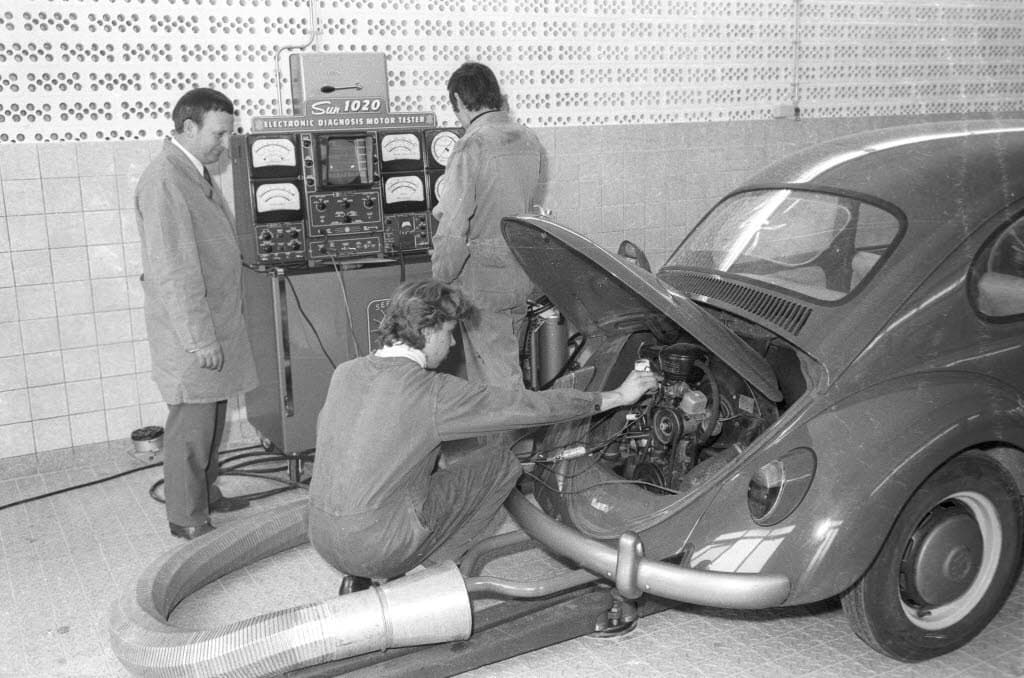
The trade is popular. BIBB's ranking of new contracts to 30 September 2025 puts Kfz-Mechatroniker in first place nationally with 24,531 new contracts (opens in a new tab), down from 25,230 the year before, and first among young men with 23,007.
It is also not a fix-all. The same BIBB data sheet shows a contract-cancellation rate of 34.8% in 2024, up from 16.1% in 2006, though the data sheet notes this is not a drop-out rate. The number passing the final exam each year fell from 18,330 in 2008 to 13,269 in 2024. And shortages persist: KOFA, a skills centre commissioned by the federal economy ministry, calculates that in 2025 there were 13,327 vacancies in motor vehicle technology (opens in a new tab) at journeyman level with no matching unemployed jobseeker anywhere in the country, the second-largest gap among the crafts. BIBB itself warns that many skilled workers will retire before 2035 (opens in a new tab) as the number of school leavers falls.
Here is the surprise. Germany's population was 83.5 million at the end of 2025 (opens in a new tab) and Australia's was 27.9 million at 31 March 2026 (opens in a new tab). By our rough calculation, Germany signs about 290 Kfz-Mechatroniker contracts a year per million people, while Australia starts about 350 motor mechanic apprentices per million. The categories are not identical (Australia's figure includes diesel, motorcycle and small-engine mechanics, and the two years are measured to different dates), so treat it as a rough comparison. It does suggest Germany's edge is not simply volume.
| Feature | Australia | Germany |
|---|---|---|
| New starts | 9,720 motor mechanics, year to March 2026 | 24,531 Kfz-Mechatroniker, year to September 2025 |
| EV skills | Separate Cert III in EV technology | High-voltage is one of five trade specialisations |
| Finishing | 60.2% complete within six years | 34.8% contract cancellation rate in 2024 |
| Shortage status | In shortage on 2026 list | 13,327 unfillable vacancies in 2025 |
What Australia can learn
Three things stand out. First, status: in Germany the car trade tops the national ranking of new apprenticeship contracts, while JSA's report records Australian employers worried about negative perceptions of automotive work. Second, structure: building high-voltage skills into the trade as a specialisation means an EV-capable technician is a normal outcome of an apprenticeship, not an add-on. Third, Germany shows that even a well-regarded system loses apprentices and still runs short when demographics turn. The lesson is less about copying the model than about fixing both ends of our own pipeline: Australia's data shows fewer people starting and roughly four in ten not finishing.
What it means if you're buying or selling
The practical response is to buy and keep cars that more people can fix, and to make your own car easier to look after.
- Choose cars independents already service. Ask two or three local workshops whether they work on the model and can access the maker's diagnostic information. Plentiful parts matter too; our guide to genuine, OEM and aftermarket parts (opens in a new tab) explains what each kind of part is and what to pay.
- Check who did the service history, not just whether it exists. In NSW, for example, the government says any licensed repairer can service a car to the manufacturer's standards (opens in a new tab) without affecting the warranty, and you do not have to use the dealer that sold it. A history from a workshop you can still ring is worth more than a stamp from one that has closed.
- Book early. If a workshop is short of technicians, the earliest slot goes to whoever asked first. Book the next service when you collect the car from this one.
- Learn the basic checks. Tyre pressures and tread, oil and coolant levels, wipers and washer fluid, and the battery's age cost nothing to check and catch problems before they become workshop jobs.
- For EVs and hybrids, ask about high-voltage capability. Ask whether a workshop's technicians hold EV training, and get the answer before you need it.
Our take
This is our view. The shortage is real and it is not going away quickly, because the people who will fix cars in 2030 should already be in training and the numbers starting are falling. Money for apprentices helps, but the data says a big leak is the four in ten who do not finish, and the main reasons they give are pay, conditions and personal circumstances.
There is also a part owners control. The simpler a car is, the more people can fix it, and the more of it you can look after yourself. A naturally aspirated petrol car with a standard diagnostic port, plentiful parts and no software lock is a car a good independent, or a handy owner, can keep on the road for decades. That is why we keep backing simple, repairable cars and a right to repair with teeth. Hybrids are a fair middle road for many buyers, and an EV can make sense, but check who will service it in year ten before you sign.
And if you want to learn, join a car club. Club members share tools, manuals and knowledge, and we suspect plenty of good mechanics started out helping someone else in a shed on a Saturday. Car culture is one of the better recruitment campaigns the trade has.
Header photo: Shixart1985 (opens in a new tab) via Wikimedia Commons, CC BY 2.0 (opens in a new tab).
Related
- The ACCC is taking Subaru to court over who gets to fix your car (opens in a new tab)
- Australia's repair information scheme, three years on (opens in a new tab)
- Genuine vs OEM vs aftermarket car parts: what should you actually pay? (opens in a new tab)
- China now builds more than a third of Australia's new cars. Who fixes them in 2036? (opens in a new tab)