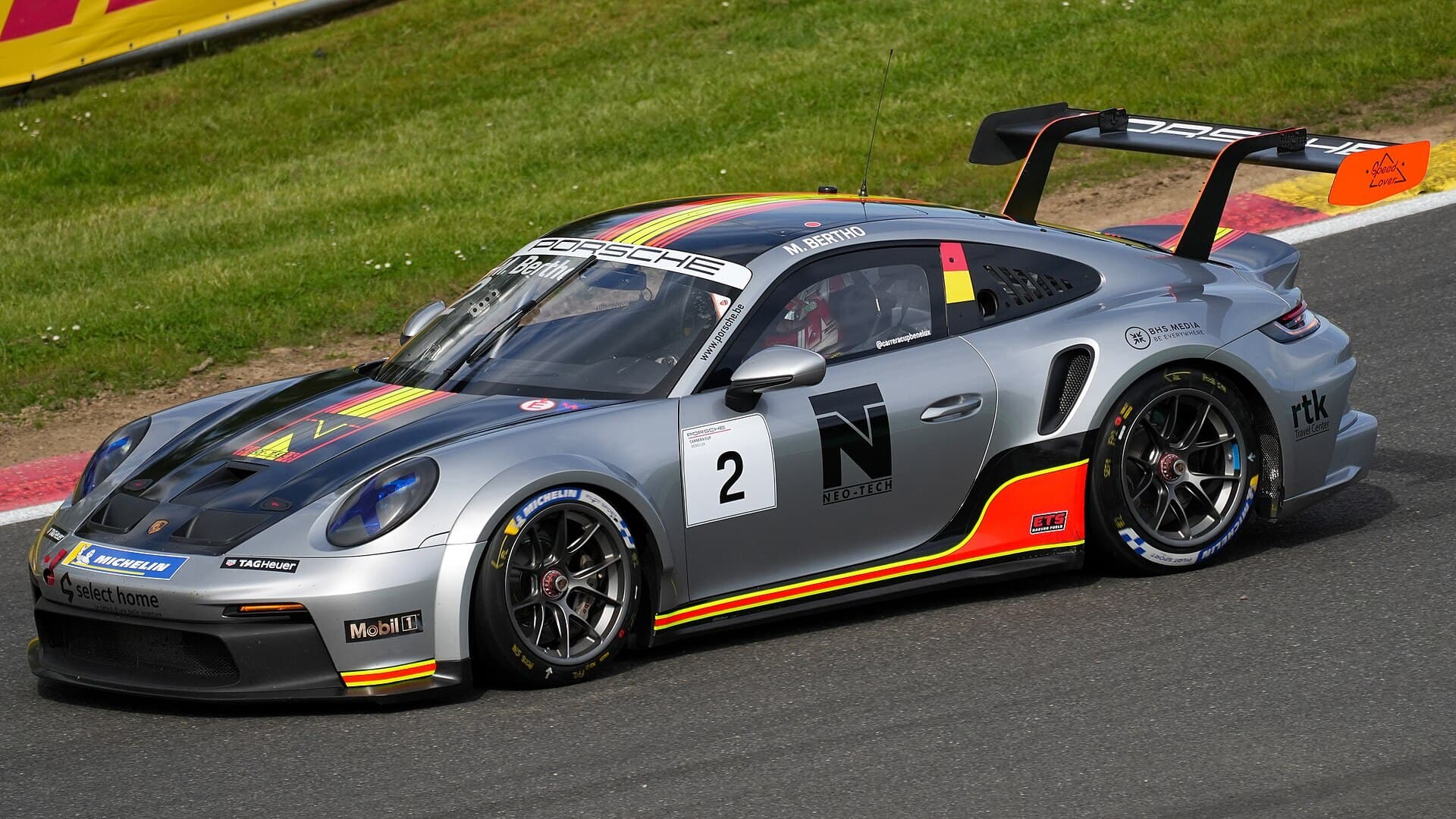
The Great Race gets the headlines, but some of the best noise at Mount Panorama this weekend won't come from a Supercar. Porsche Carrera Cup Australia runs Round 5 on the Bathurst 1000 bill from 8 to 11 October, and it is the last time the current Type 992 GT3 Cup car will race up the Mountain in this series. Porsche Australia confirmed (opens in a new tab) that 2026 is the 992's final year, with the second-generation 992.2 Cup car arriving for 2027.
That makes this a farewell lap for a car worth understanding — because under the wings and the roll cage sits something we think matters well beyond racing: a big, naturally aspirated six-cylinder engine that revs hard and asks nothing of a battery.
992 GT3 Cup at a glance
- Engine
- 4.0-litre flat-six, naturally aspirated
- Output
- 375 kW (510 PS)
- Rev limit
- 8,750 rpm
- Dry weight
- 1,260 kg
In Australia
Carrera Cup this year is a seven-round championship that rides on the biggest dates on the calendar. Porsche moved to seven rounds for 2026 (opens in a new tab), and its senior motorsport manager Craig Nayda said the shift "focusses the championship on some of the most popular and largest motorsport events". Bathurst is one of three run-home rounds, with the Gold Coast 500 on 23–25 October and the Adelaide Grand Final to follow.
Bathurst is one of the three events running the three-sprint format, rather than the two 45-minute races used at four rounds (Porsche (opens in a new tab)). On a 6.213 km circuit with 174 metres between its lowest and highest points (opens in a new tab), a 30-minute sprint up Mountain Straight and across the top is about as hard a test of a road-derived race car as Australia offers.
The title fight comes into the weekend with Harri Jones leading the Pro class on 477 points from New Zealand's Clay Osborne on 421, according to the championship table after Round 4 (opens in a new tab). Osborne also leads the Michelin Junior class, and the Pro-Am fight between Matthew Belford (297) and Jacque Jarjo (294) is separated by three points.
For the people in the stands, the useful thing to know is what they're watching. Porsche's own launch material for the car lists a four-litre, water-cooled, naturally aspirated flat-six making 375 kW (510 PS) and 470 Nm (opens in a new tab), revving to 8,750 rpm, through a six-speed sequential dog-type gearbox. No turbos, no hybrid system, no traction battery.
The world view
Carrera Cup is a global ladder, and the car is the same idea everywhere: a near-production 911 that a privateer team can run. Porsche says the 992 Cup car rolls off the production line in Zuffenhausen alongside the road-going 911 (opens in a new tab), and that by the time it launched, 4,251 Cup cars of earlier generations had been built since 1990.
The replacement keeps the formula rather than tearing it up. The new 992.2-based 911 Cup, already racing overseas, uses a naturally aspirated 4.0-litre six making 382 kW (520 PS) (opens in a new tab) — 10 PS more — and Porsche describes the engine as "now even closer to its series-production counterpart", with the car "largely derived from road-approved 911 GT models". It even gains an automatic engine restart function. In an era of downsized turbo engines and electrified everything, Porsche has chosen to keep its one-make racer high-revving and unassisted.
Another perspective: Germany
The more interesting signal comes from Porsche's home country, and it is about fuel. In Europe, the Porsche Mobil 1 Supercup — the top rung of the same Cup car ladder — has spent several seasons testing renewable fuels in exactly these engines. In 2024 Porsche said the Supercup would run exclusively on eFuels for the first time (opens in a new tab), using raw fuel from its Haru Oni pilot plant in Chile, for a field of up to 32 cars. Board member Michael Steiner described the cars as able to race "in a potentially almost CO₂-neutral way" when the whole value chain is counted.
Notice the hedging in Porsche's own wording — "potentially" appears again and again, and it should. The same release puts the season's fuel requirement at about 50,000 litres, from a plant Porsche itself calls a pilot. That is a rounding error next to what a country burns, and synthetic fuel is nowhere near the price of what comes out of a bowser today. Anyone telling you eFuels will replace petrol next year is selling something.
But that isn't really the point. The point is that a carmaker with every incentive to go all-in on batteries has decided the naturally aspirated six is worth keeping alive — and is spending real engineering money finding a fuel that lets the engine, the tank and the pump stay as they are.
Our take
We love this car, and we'll say why plainly. A Cup car is a 911 with the comfort removed: a flat-six you can hear from the top of the Mountain, a gearbox you work, and a driver who is busy the whole lap. It is the clearest demonstration on the Bathurst bill that fast and felt can be the same thing. Anyone who has only ever been in a quick EV doesn't know what they're missing until they've heard one of these go past at 8,000-plus rpm.
There's a second, quieter reason it matters. The engine in a Cup car is close kin to the one in a road-going 911 GT3, it runs on liquid fuel the world already knows how to store and move, and it is mechanical enough that teams across the world rebuild them between seasons. That's our view of a good car generally: simple at its core, serviceable, and not dependent on a software update or a battery pack to keep going. Porsche's choice to carry that formula into the 992.2 — and to look for a cleaner liquid fuel rather than abandon the engine — backs it up.
So when the Supercars take a break this weekend, stay in your seat. You're watching the last Bathurst for a car that proves the journey from A to B can still be the whole point.
Related
Related reading
- Repco Bathurst 1000 2026 — Mount Panorama, Bathurst
The Great Race returns to Mount Panorama on 8–11 October 2026 — the 66th running of the Repco Bathurst 1000, 1000 kilometres of Supercars endurance racing steeped in touring-car history.
- The Psychology of the EV vs the Naturally Aspirated Car: Why the Faster One Isn't the One You Remember
Why a naturally aspirated car can feel more memorable than a faster EV: what psychology says about sensory feedback, control, and the divide between A-to-B drivers and journey drivers.
- The V12's last stand: why the twelve-cylinder survives in supercars
Downsizing killed the twelve-cylinder everywhere except the very top. Why the V12 survives in supercars — the physics, the economics and the customers who insist.
Photo: "Porsche Carrera Cup Benelux 2024 Spa-Francorchamps Speedlover Porsche 911 GT3 Cup (992) No.2 Maxime Bertho" by MarcelX42, via Wikimedia Commons (opens in a new tab), licensed CC BY-SA 4.0 (opens in a new tab).