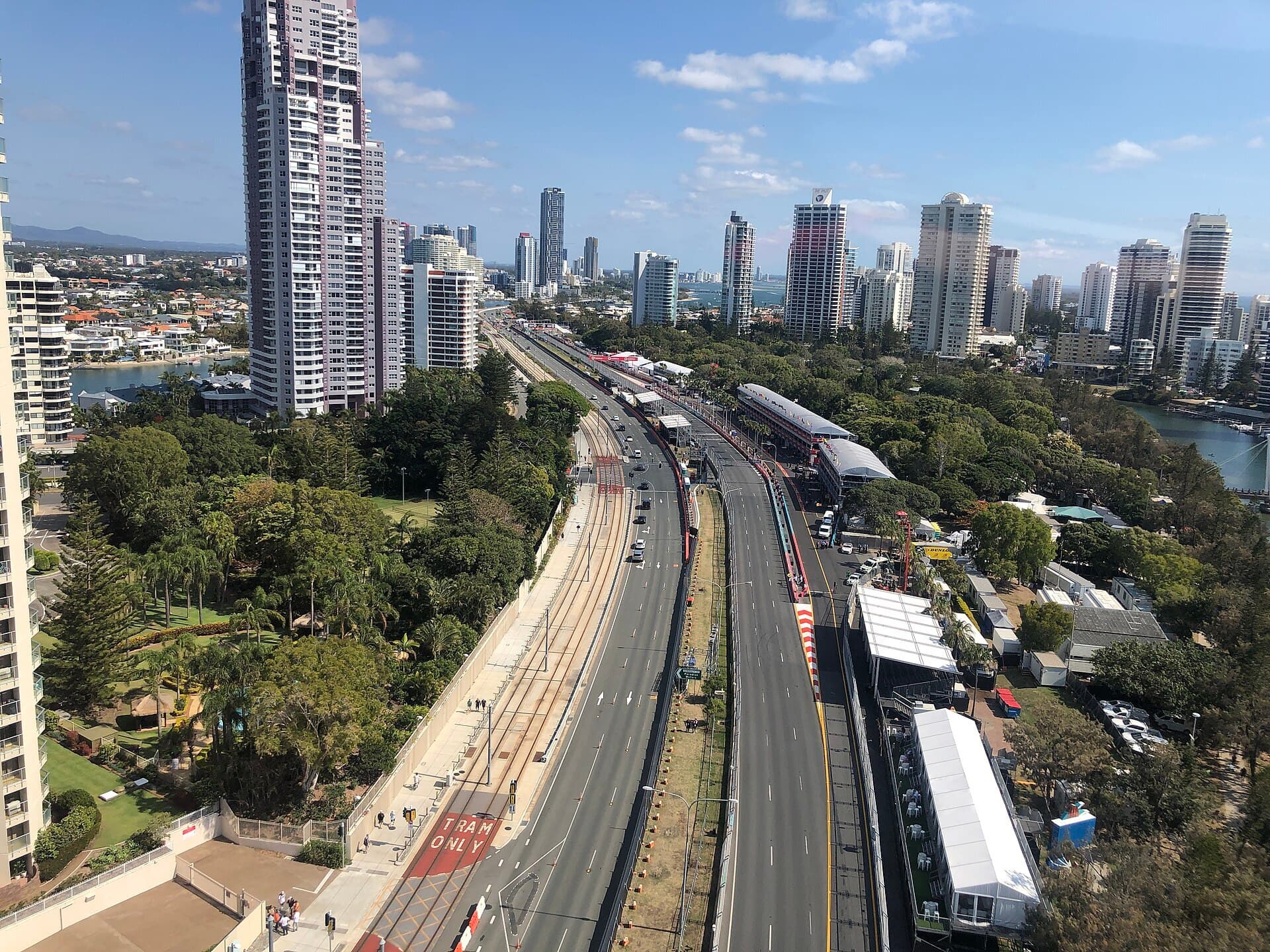
Supercars take over the streets of Surfers Paradise today. The 2026 Boost Mobile Gold Coast 500 (opens in a new tab) runs from Friday 23 to Sunday 25 October, and it opens the championship's Finals Series. Supercars calls this round the Elimination Final (opens in a new tab), with ten drivers still in the title fight. Practice and qualifying run today, then a 250-kilometre race on Saturday and another on Sunday, according to Supercars' weekend preview (opens in a new tab).
Last year 197,427 people attended (opens in a new tab) over three days. That number is the point of this piece. We'd argue street racing is the most public form of motorsport: a working beachside city hands its roads to loud combustion race cars for a weekend, and close to 200,000 people turn up to hear them.
For buyers and sellers there is a less obvious angle. The grid carries three road-car badges: Ford Mustang, Chevrolet Camaro and, new this season, Toyota GR Supra. The Mustang is still on sale new in Australia. The Camaro and the road-going Supra are not. We'll come back to what that means for your wallet.
At a glance
- When
- 23 to 25 October 2026, Main Beach and Surfers Paradise
- Circuit
- 2.96 km street circuit, 81 laps per 250 km race
- 2025 crowd
- 197,427 over three days
- Finals role
- Elimination Final, ten finalists
- Entry
- General admission from $79 a day; kids 12 and under free with a paying adult
What happens on the Gold Coast this weekend
The Surfers Paradise Street Circuit (opens in a new tab) is 2.96 kilometres of public road. Each race is 81 laps, and Cam Waters set the lap record of 1:08.573 here last year. The precinct sits on the Gold Coast tram and bus network, which is the sensible way in.
The event has deep roots. It was first held as an Indy car race in 1991 (opens in a new tab), Supercars first raced in Surfers in 1994, and the 2024 event was the 32nd on this circuit. That 2024 weekend drew 197,949 people, a fraction more than last year.
The Finals, briefly
Supercars introduced a finals format last season. Under the rules it published for 2025, the top ten drivers started the Gold Coast round with points reset (opens in a new tab) and the three lowest-scoring finalists were eliminated after Sunday's race. The 2026 Finals page (opens in a new tab) lists this year's ten: Matthew Payne, Broc Feeney, Will Brown, Brodie Kostecki, Kai Allen, Cam Waters, Anton de Pasquale, Chaz Mostert, Ryan Wood and Jack Le Brocq. The Semi Final follows at Sandown, and the Grand Final is in Adelaide.
Payne arrives as championship leader (opens in a new tab), Kostecki as Bathurst winner and Mostert as reigning champion. Mostert also won both Gold Coast races last year (opens in a new tab).
Two things could shake the order. The first is the track. Supercars has added tyre bundles at Turns 8 and 9 of the Beach Chicane (opens in a new tab), set just over two metres from the kerb, plus an electronic kerb-hop loop at Turn 10. Chief motorsport officer Tim Edwards said the bundles are needed for the circuit to meet its safety standards under its Motorsport Australia licence. The second is weather. Supercars' preview this week listed rain for all three days and noted that no Gold Coast Supercars race has had rain since 2018, when torrential conditions forced a race to be abandoned. Check the latest forecast before you pack.
A city that closes itself for racing
Street racing needs the law's help, and Queensland gives it. The Gold Coast 500 amendment regulation for 2026 (opens in a new tab), made under the state's major events legislation, sets a major event period from midday on 22 October to midday on 26 October. It also sets a temporary works period that opened on 7 September and, after the event, runs again to 21 November. That is weeks of barriers, grandstands and fencing going up and coming down on roads people use to get to work.
Supercars' community page (opens in a new tab) says the precinct across Main Beach and Surfers Paradise is secured from 12:01am Friday to 11:59pm Sunday, that resident access applications opened on 1 September, and that the organisers recognise the impact on residents' routines.
The economic case comes from the organisers and the government. At the launch event, Surfers Paradise MP John-Paul Langbroek said the race generates around 154,000 visitor nights and $64 million for the state economy (opens in a new tab) this year. Supercars said last year's event was expected to put around $60 million into the local economy. In 2024 the state extended its support for the Gold Coast and Townsville rounds (opens in a new tab) to at least the end of 2027, saying the two events together bring about $100 million a year and more than 280,000 visitor nights. Tourism and Events Queensland has backed both since 2010.
- 197,427
- Gold Coast 500 attendance, 2025
- $64m
- Claimed 2026 boost to the Queensland economy
- 154,000
- Claimed visitor nights, 2026
New for 2026 is a live-music precinct called Sound Track on Macintosh Island. Supercars' acting chief executive Barclay Nettlefold summed up the launch event plainly: "It's going to be fun, it's going to be loud and, most importantly, it's free."
The case against, and our answer
There are fair objections. The government's 2024 statement does not put a dollar figure on the state's own contribution, and we could not find one in the material we read, so readers are given the benefit without the cost. The disruption is real: the two works windows add up to roughly ten weeks around a three-day race. And the coastline itself is fragile. Supercars said corporate hospitality had reduced availability last year because of recent beach erosion (opens in a new tab).
Our answer is that the disruption is scheduled, published and temporary, and the precinct sits on a tram line. What we would like is the public contribution published beside the economic claims, so ratepayers and taxpayers can judge the trade for themselves. On sustainability, see the fuel section below: the race cars run a high-octane renewable blend made for these engines, not ordinary pump petrol.
The cars: three badges, one rulebook
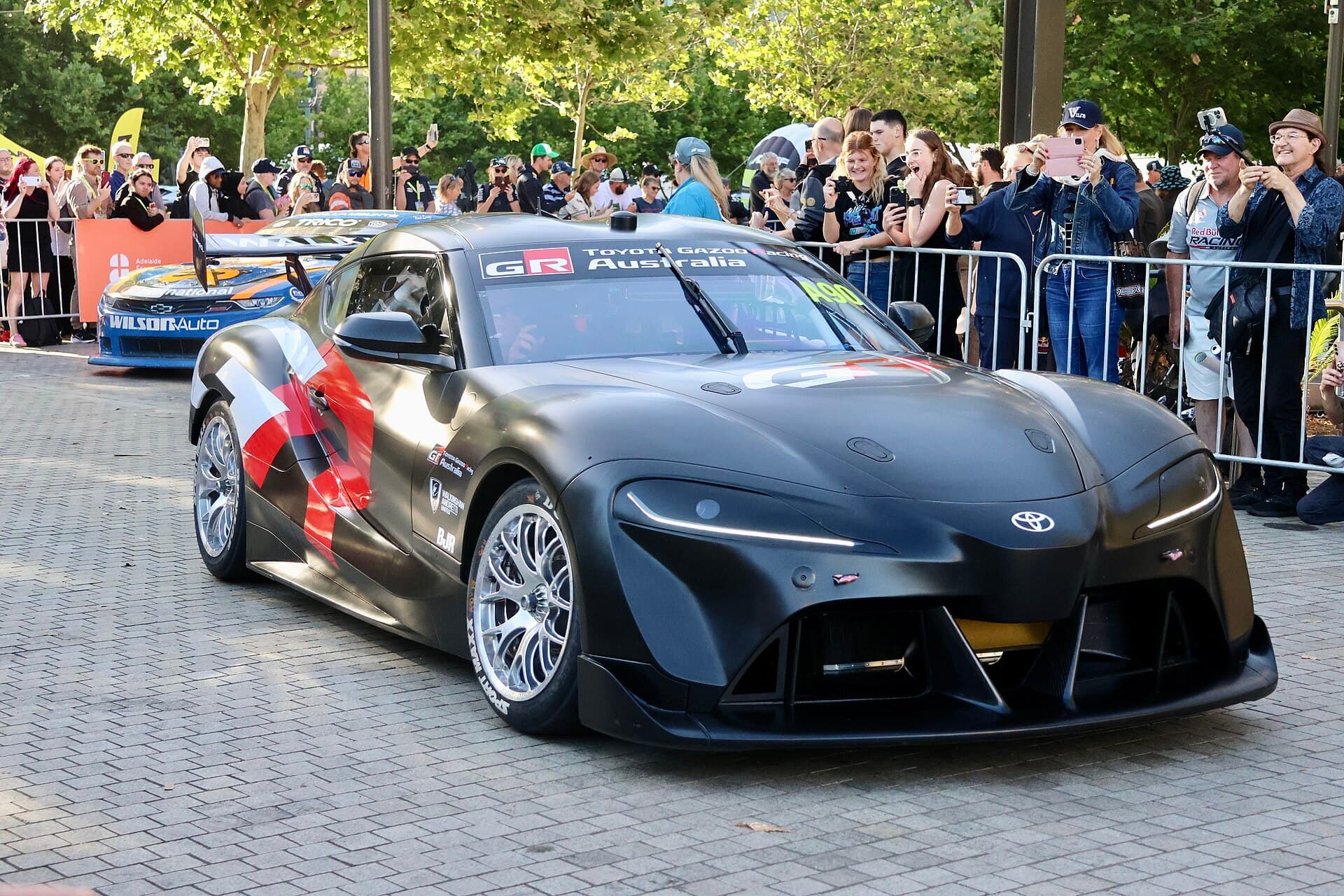
Supercars are now in the fourth season of the Gen3 era (opens in a new tab). When the rules were being developed, Supercars said the cars would take on the DNA of the road-going Mustangs and Camaros (opens in a new tab), and this year the grid gained a third manufacturer. Toyota announced in 2024 that it would join with the GR Supra from 2026 (opens in a new tab), committing for five years and to at least four cars. The race Supra's baseline engine is Toyota's 2UR-GSE, an all-aluminium quad-cam V8.
The other two use V8s of their own. When Gen3 was being developed, Supercars confirmed the Camaro would run a 5.7-litre pushrod engine and the Mustang a 5.4-litre (opens in a new tab). Teams have shuffled to fit the new arrival: Triple Eight moved from Chevrolet to Ford, Walkinshaw from Ford to Toyota, and Brad Jones Racing from Chevrolet to Toyota.
What goes in the tank has changed more quietly. For 2026, bp supplies a blend of 85 per cent ethanol and 15 per cent bio-gasoline made from waste (opens in a new tab), described as 100 per cent from renewable materials, based on third-party certified feedstock. The announcement makes no emissions claim, and we have not seen an independent lifecycle figure. Fuel has a sensory side too. When Supercars changed fuel in 2023, the flames on throttle overrun returned (opens in a new tab), and drivers were delighted that spectators could see them again.
Fast is not the same as felt
This is the heart of street racing's appeal, and it is our view rather than a measurement. A Supercar at Surfers is not the fastest thing on four wheels. It is a V8 bouncing its sound off apartment towers, a car you can smell as well as hear, flames on the downshift, and a crowd close enough to feel the kerb strikes. Supercars and its naming sponsor are not selling silence: Boost Mobile's chief executive Bobby Geldens said the aim was "bigger, louder and better for the fans" (opens in a new tab).
The concrete jungle here always puts a spectacle on for us.
The world view
Street racing is not an Australian quirk that the rest of the world has outgrown. The Gold Coast circuit itself began as an Indy car venue. In Asia, Macau's street race now carries the FIA's world cup titles for Formula Regional, GT and Formula 4 cars, and its touring-car race counts as the season finale of the Kumho FIA TCR World Tour (opens in a new tab). We think that tells you something: governing bodies still hand prestige titles to city streets, because a race in a city reaches people who would not drive to a circuit on the edge of town.
Another perspective: Macau
Macau has run a street race since 1954, and it shows how one stays relevant.
The first Macau Grand Prix (opens in a new tab) was held on 30 and 31 October 1954: 15 entrants, a four-hour race, and a circuit the stewards described as "mostly dirt and loose sand" at the back. The following year the back section was closed to traffic so cobbles could be replaced with asphalt. An Australian, Kevin Bartlett, won in 1969. In 1983 the race became the FIA Formula 3 World Cup, and the winner was a young Brazilian then known as Ayrton Senna da Silva. Today the Guia Circuit (opens in a new tab) is 6.2 kilometres with a minimum width of seven metres, and the event runs in November.
It has had its dark chapters. In 1959 an overloaded steel footbridge collapsed and injured 21 spectators, and the official history records the event's first fatality in 1967. Safety at street circuits is earned, which is why changes like the Beach Chicane bundles matter.
The 2023 edition, the 70th, drew a record 145,000 spectators. The 73rd Macau Grand Prix (opens in a new tab) runs from 19 to 22 November 2026 with seven races. What Australia can learn sits in the details of that announcement.
- It is built around the city, not just the track. There is a family carnival with a recreated Guia Circuit and a mini race track, an auto show at Tap Seac Square where the public can see the race cars up close, a city culture festival, and giant screens across the community so residents who don't buy a ticket still share the event. Residents have also run a lap of the circuit on foot: almost 4,000 did in 2023 (opens in a new tab).
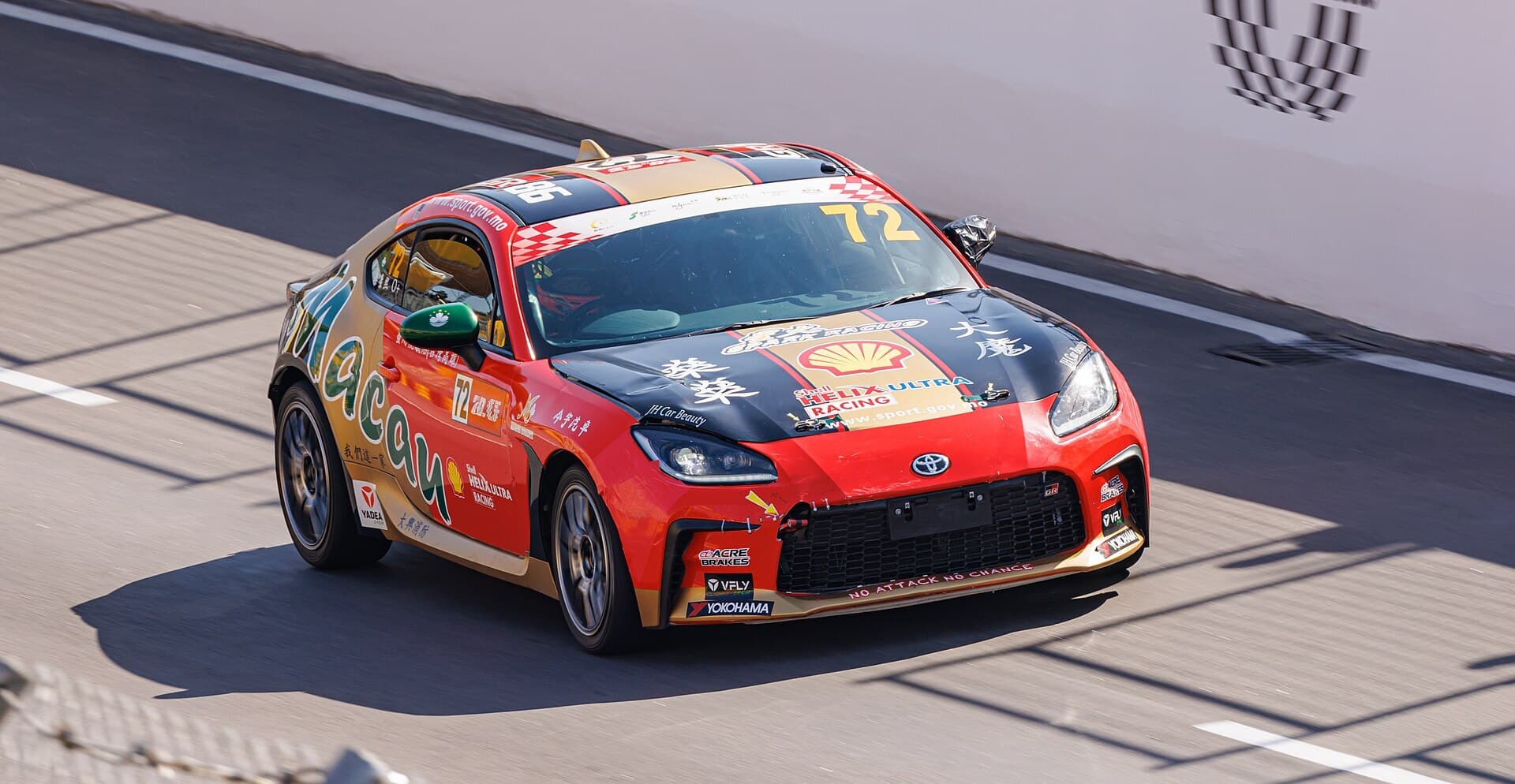
- It races cars people can buy. The Macau Roadsport Challenge is exclusively for Toyota GR86 and Subaru BRZ models, a showroom sports car on a world-famous street circuit.
- It is a launchpad. The Formula Regional race is billed as deciding the best junior single-seater driver of the year, and this year's Formula 4 entry includes an Australian, Noah Killion.
- It publishes the money. The organising committee named its six resort sponsors and their contributions: four at MOP20 million each and two at MOP10 million. Tickets range from MOP100 to MOP1,200, capped at ten per person.
| Feature | Gold Coast 500 | Macau Grand Prix |
|---|---|---|
| First held | 1991, as an Indy car race | 1954 |
| Circuit length | 2.96 km | 6.2 km |
| Biggest recent crowd | 197,949 in 2024 | 145,000 in 2023 (record) |
| Who pays, publicly stated | State support via TEQ; amount not in the 2024 statement | Six resort sponsors, named with amounts |
| Road-car racing on the bill | Three road-car badges on Gen3 race cars | A GR86 and BRZ series |
We think the Gold Coast already does the festival part well, with concerts, a new precinct and a free launch night. Macau's two lessons are transparency about who pays and a stronger thread from the showroom to the start line.
What it means if you're buying or selling
The race cars wear road-car names, so it's worth knowing which of those names you can actually buy.
Ford Mustang. Still sold new here. According to Just Cars (opens in a new tab), Ford Australia has confirmed a 2026 Mustang Dark Horse capped at no more than 500 cars, with a 350kW and 550Nm 5.0-litre V8, a six-speed manual as standard and a ten-speed automatic optional, at a list price of $104,990. A 250-car T8-Spec version, developed with Ford's Supercars team Triple Eight and offered with the manual only, lists at $138,888 before luxury car tax and on-road costs. We could not open Ford Australia's own page to check these figures, so confirm them with a dealer.
Chevrolet Camaro. Not sold new here. In 2023 GM's Australia and New Zealand chief said the Camaro would not return to Australia (opens in a new tab) but would keep representing the brand on track, according to carsales. The same report says HSV dealers sold about 1,200 Camaro 2SS and 320 ZL1 models, converted to right-hand drive by Walkinshaw, between September 2018 and early 2020. That is a small used pool, so condition and conversion paperwork matter.
Toyota GR Supra. Off sale new. Toyota Australia took final orders in August 2025 (opens in a new tab), according to Just Cars, which reported production of this generation was expected to end by mid-2026. Toyota told Supercars the Track Edition was the final Australian upgrade (opens in a new tab) of the A90 GR Supra, while the race car continues with the A90 design.
We have no data showing that a race weekend moves used-car prices, and we wouldn't plan a purchase around it. The bigger risk is personal: three days of V8 noise is a powerful sales pitch, and a performance car bought on the walk home is still a performance car, with the insurance, fuel and tyre bills that come with it.
The Queensland Government's cooling-off guide (opens in a new tab) also says a dealer's non-refundable cooling-off deposit cannot be more than $100, there is no cooling-off on new vehicles, and taking the car to an independent mechanic or on a test drive does not end the period. Buying privately, it is up to you to check clear title on the PPSR (opens in a new tab); a licensed dealer must guarantee it.
Supercars lists general admission from $79 a day (opens in a new tab), and kids 12 and under get free general admission all weekend with a paying adult. Fanstands start at $95 a day and undercover grandstands at $385 for three days. A pit lane walk upgrade from $30 a day needs both an event ticket and a Paddock Pass.
If the weekend leaves you wanting more, we think the better next step isn't a car. It's a club, where the enthusiasm and the expertise are shared, and you can find your way into Australian car culture through one (opens in a new tab). If you're selling a Mustang, a converted Camaro or a Supra, have the service history, compliance or conversion papers and a clean PPSR result ready, because enthusiast buyers ask. MotorLoop lets you buy, sell & show cars, and it's free.
Our take
This is our view. The Gold Coast 500 works because it is felt, not because it is fast. The cars are not the quickest machines in the world, and nobody in a Surfers grandstand needs them to be. They come for the sound off the towers, the flames on overrun and the sense that the ordinary road outside the hotel has become a racetrack for three days.
That makes street racing a strong argument for keeping combustion in motorsport, especially now the fuel in these cars is described as fully renewable in origin. We'd still like Supercars to publish an independent emissions figure, and we'd like the Queensland Government to publish what it pays, because a good case doesn't need to hide its costs.
We also think Supercars could learn from Macau's showroom thread. Two of the three badges on the grid are no longer sold new here. A support series for cars people can buy, or more track time for the road cars that carry these names, would connect the noise to the driveway. Some people want A to B, others enjoy the journey. This weekend is for the second group, and there are nearly 200,000 of them.
Header photo: MasterMind5991 (opens in a new tab) via Wikimedia Commons, CC BY-SA 4.0 (opens in a new tab).
Related
- Boost Mobile Gold Coast 500 2026 — Surfers Paradise (opens in a new tab)
- The Bathurst 1000 was decided by a fuel gauge, and that is why we still watch (opens in a new tab)
- Australian car culture is alive, and a club is the way in (opens in a new tab)
- The Psychology of the EV vs the Naturally Aspirated Car: Why the Faster One Isn't the One You Remember (opens in a new tab)