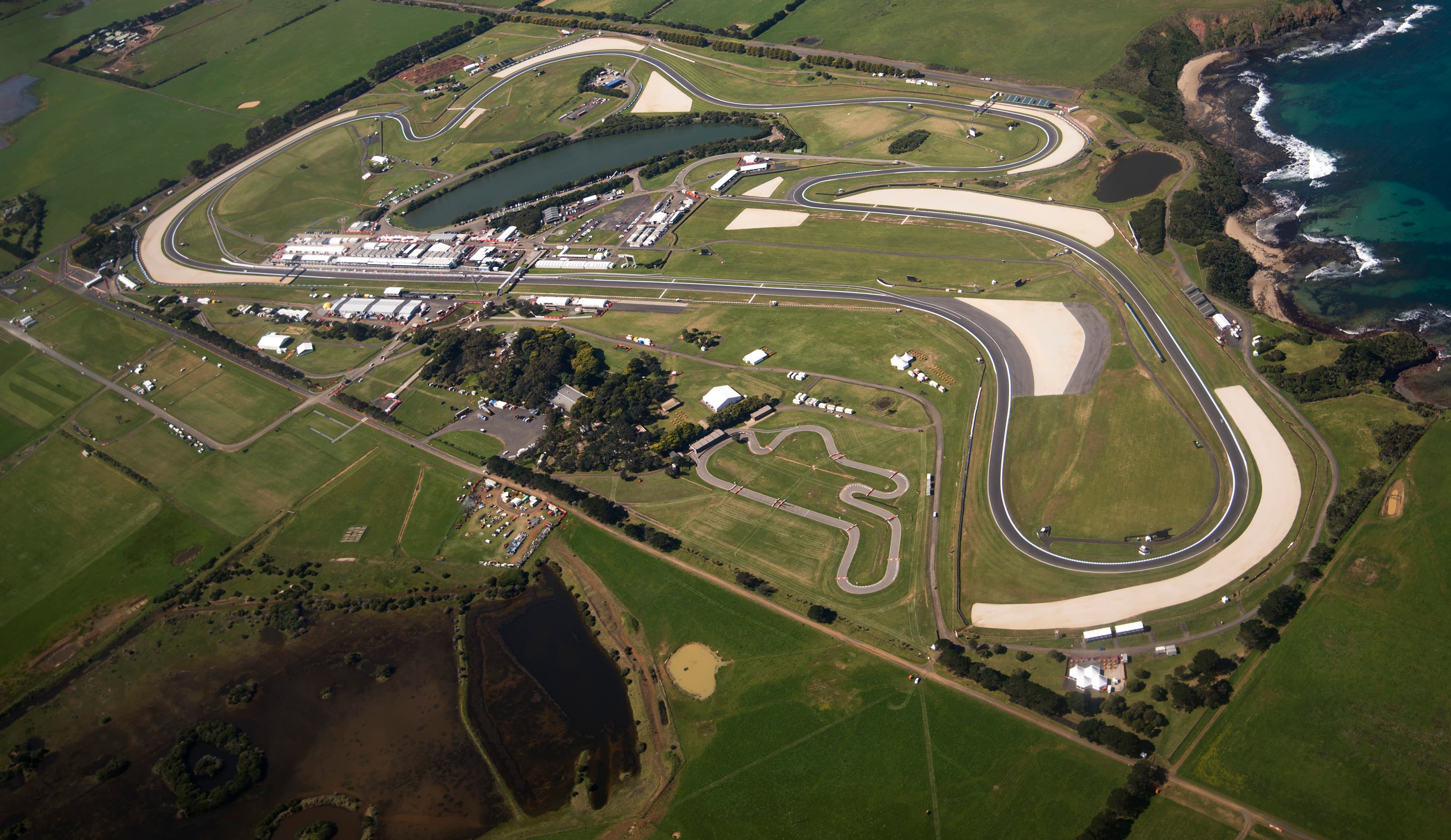
The last MotoGP race at Phillip Island never started. On Sunday 25 October, after fans had sat in the rain for hours, organisers cancelled the Moto3 race, then Moto2, and finally called off the premier-class race at 3.35pm local time (opens in a new tab), according to The Race. In place of a race, the MotoGP riders did a farewell lap behind the safety car and stopped on the main straight to wave to the crowd.
The official reason matters, because it is not the one most people assume. The Australian Grand Prix Corporation said the race was cancelled because poor visibility prevented the medical helicopter from flying (opens in a new tab), telling the ABC that "racing cannot take place without the medical helicopter able to operate". It was not a ruling that the track was too wet to ride.
That distinction is worth getting right, and then it is worth going further. Even if the helicopter had flown, rain changes motor racing far more for a rider than for a driver, and the same physics follows you home on the open road. This piece separates what happened from why it matters, and what it means if you ride, drive, or are weighing up one or the other.
At a glance
- Event
- Australian MotoGP, Phillip Island, Sunday 25 October 2026
- Cancelled
- Moto3, Moto2 and MotoGP races, plus the ASBK support race
- Official reason
- Poor visibility grounded the medical helicopter
- Refunds
- Full for Sunday tickets, partial for multi-day tickets
- Next Australian GP
- Adelaide street circuit, 14 November 2027 (subject to homologation)
What happened at Phillip Island
The weekend had started well enough. MotoGP got its Saturday sprint race in the dry, and Moto3 and Moto2 had already logged more than 1,400 laps each across practice and qualifying, according to The Race (opens in a new tab). Sunday was always expected to be the worst day. Crash.net's live coverage noted a forecast of 15 to 35mm of rain plus strong winds and cool temperatures (opens in a new tab).
The original programme had the MotoGP warm-up at 9.40am, Moto3 at 11am, Moto2 at 12.15pm and the MotoGP race at 2pm. MotoGP's official live update (opens in a new tab) put the delays down to "limited visibility affecting the operation of the medical helicopter". Track action was pushed back, the warm-up was dropped, the two support classes were cancelled and the MotoGP race was moved to the front of the queue, with hopes of a 4.30pm start. Those hopes went at 3.35pm.
The ABC reported that the trackside entertainment went too, including a legends lap with Mick Doohan, Casey Stoner and Wayne Gardner (opens in a new tab). The AGPC said Sunday ticketholders would get full refunds and multi-day ticketholders partial refunds, and MCNews reported (opens in a new tab) that it was working with its ticketing partners on the process.
The riders were plainly gutted. Marc Marquez called it "not the farewell Phillip Island deserved" (opens in a new tab), Fabio Di Giannantonio said he did the parade lap in tears, and Brad Binder said he felt sorry for the people who had sat in the rain from 8am, according to Motorsport Week.
Safety must always come first, and racing cannot take place without the medical helicopter able to operate.
Why the helicopter, and why not Saturday?
Phillip Island is a long way from a major trauma hospital by road. According to Motorcycles.news (opens in a new tab), race direction told MotoGP.com that the helicopter needs a weather window of around 60 minutes at both Phillip Island and Melbourne before a race can start, that the regulations require an injured rider to reach hospital within 45 minutes, and that the drive to Melbourne on a grand prix weekend takes close to two hours. The same report says race direction would not keep pushing the start later because temperatures fall quickly in the late afternoon, which matters for tyres. We could not open MotoGP.com's own interview, so treat those figures as reported rather than confirmed.
The obvious question is why the grand prix wasn't moved to Saturday, which MotoGP did here in 2023. That year, with gusting winds forecast for Sunday, organisers swapped the sprint and the main race on the Friday (opens in a new tab), and the Sunday sprint was later cancelled. In 2026 the problem wasn't predicted the same way. Motorsport Week reported that race direction stayed with Sunday because the dense morning fog and poor visibility were "not fully anticipated" (opens in a new tab), and Motorcycles.news quotes the organisation saying that as of Saturday, there was no information that visibility would be limiting.
A helicopter call, not a track call, and why that is honest
It would be easy to write this up as "too wet for bikes". The evidence doesn't support that. Several riders said they could have raced: according to Motorcycles.news (opens in a new tab), Francesco Bagnaia said they had raced in worse, and Moto2's Senna Agius thought the track was rideable without much standing water.
That is exactly why the call deserves respect. The medical helicopter is not decoration. It is what stands between a serious crash and a hospital when the road out of the island is clogged with spectators. A race director who runs without it is betting that nobody crashes badly, and in the wet that is a bet you shouldn't want anyone to take.
But the riders' confidence also opens the bigger question. Why does rain make a motorcycle race so much more fragile than a car race in the first place?
Two wheels in the wet: why rain is harder on riders
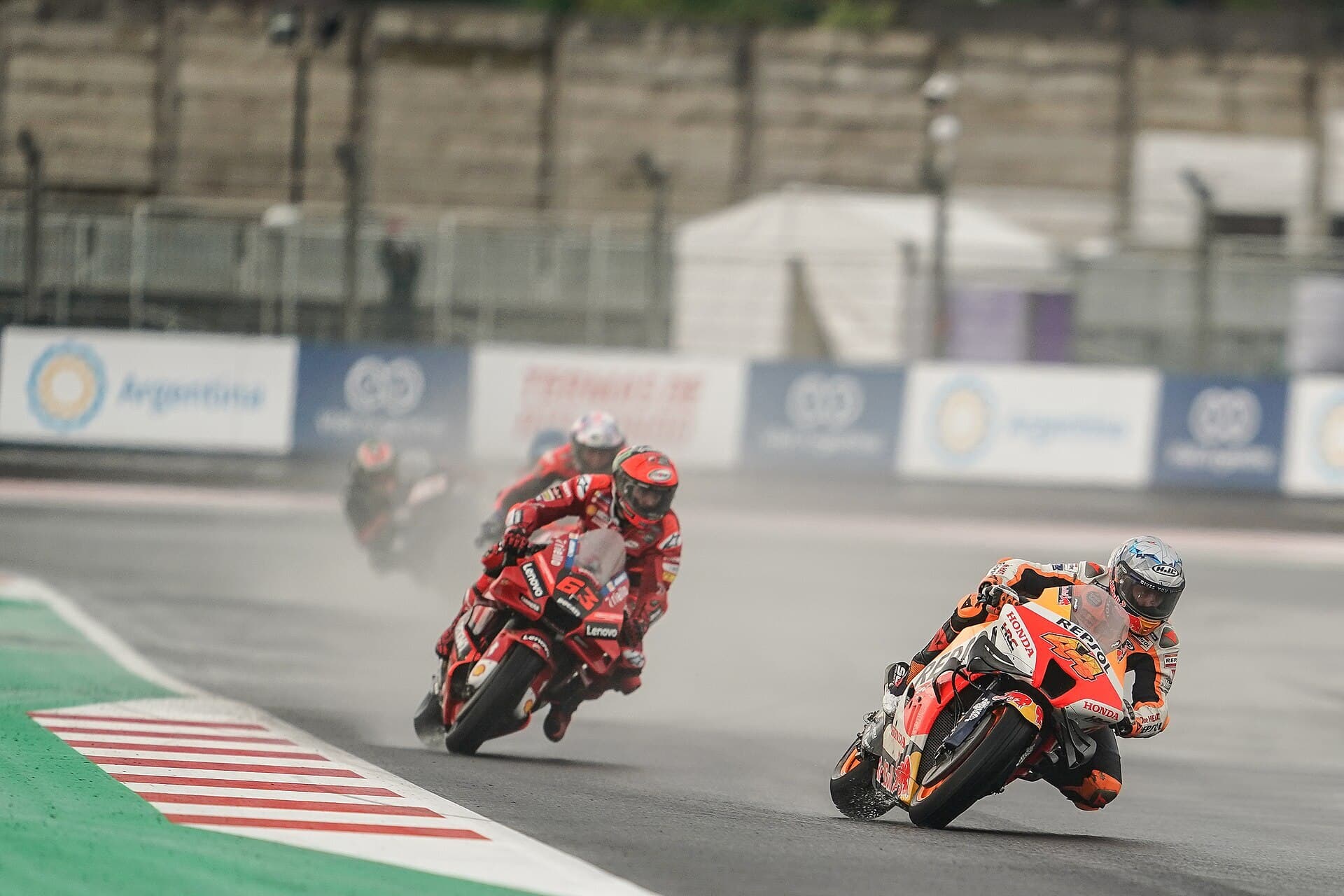
This section is our explanation of the engineering, built on what the sport itself says about tyres.
Two contact patches, not four. A car spreads its grip over four tyres. A motorcycle has two, and each is a small patch of rubber that has to brake, steer and carry the bike leaned over. MotoGP's own explainer says riders lean up to about 64 degrees (opens in a new tab), which is why keeping that patch working matters most in corners. Lose grip at one end of a car and the other three tyres often hold it. Lose the front of a motorcycle and it falls over.
Aquaplaning. MotoGP describes aquaplaning as the tyre literally floating over a thin film of water, and says rain tyres use deep grooves to channel water away from the contact patch. A tread can only move so much water. Dunlop's Supercars tyre boss made the same point about cars in 2021: the tyre "can only pump out what it can pump out" (opens in a new tab), and aquaplaning happens when cars go too fast for it to clear the water. The difference is what happens next. A car that aquaplanes slides on four wheels. A bike that aquaplanes usually goes down.
Cold tyres. Racing tyres work best in a narrow temperature window. MotoGP says slicks are at their best at roughly 80 to 120°C (opens in a new tab), and below that the tyre is underperforming. Rain and a cold afternoon pull heat out of the rubber, which is part of why race direction didn't want to keep sliding the start time later at Phillip Island.
No cage around the rider. A Supercar or Formula 1 car has a crash structure, a roll cage or survival cell, belts and an energy-absorbing seat. A rider has leathers, a helmet and, increasingly, an airbag suit. When a bike crashes, the rider is separated from it and slides, and in the wet the gravel traps and grass do less to slow either of them down.
Seeing and being seen. Riders look through a visor that can fog and bead with water. Behind another bike they are in the spray of a tyre throwing water at head height. Cars suffer too, and we come to that below, but a driver at least has a windscreen, wipers and a body around them.
The sport's own example of what goes wrong
The clearest illustration isn't from Australia. At Silverstone in 2018, Tito Rabat slid off on standing water in wet practice and was then struck by another rider's bike as he moved towards the barriers. MCNews reported (opens in a new tab) that he broke his right femur, tibia and fibula and was airlifted to University Hospital Coventry. That is the specific danger of a motorcycle crash in the wet: the rider is on the ground, and the next bike is aquaplaning too.
How car racing handles rain differently
Motorcycle racing has its own wet-weather system. Each MotoGP rider has two bikes, and under MotoGP's "flag-to-flag" rules (opens in a new tab) a race declared wet lets them swap between them as often as they like, at a 60 km/h pit-lane limit. If a dry race turns wet, race direction shows white flags to signal that bike changes are allowed (opens in a new tab). A red flag stops the race. Fittingly, MotoGP says the first flag-to-flag race was the 2006 Australian Grand Prix at Phillip Island.
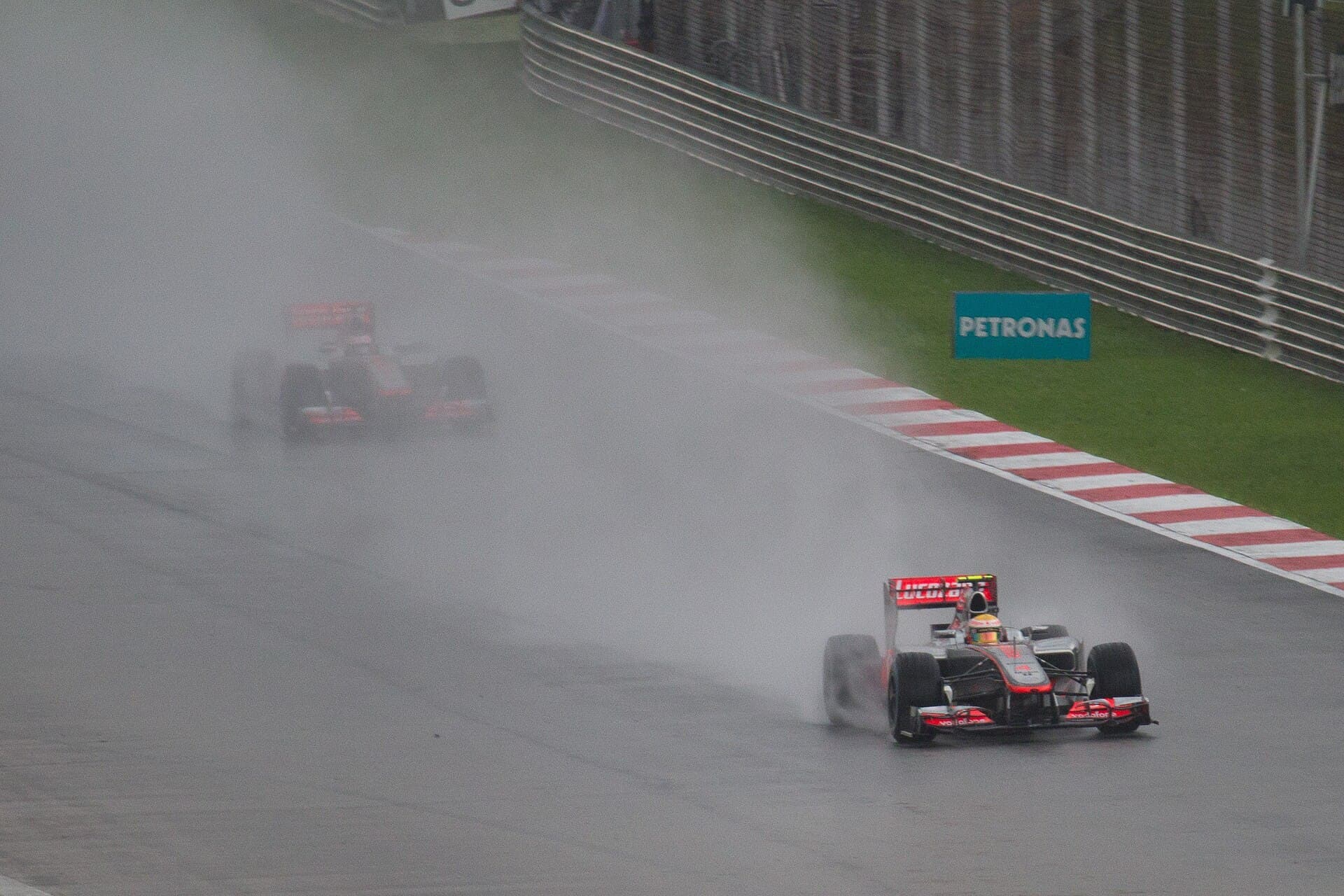
Car racing changes tyres rather than vehicles. In Formula 1, intermediate and full wet tyres may only be used once the race director declares the track wet, and teams have a fixed allocation, according to The Race (opens in a new tab). Races are routinely started or neutralised behind the safety car, and red-flagged if conditions get worse.
The striking thing is that F1's main wet problem isn't grip. In The Race's analysis, it is visibility. Spray thrown up by the car, much of it pumped out from under the floor by the diffuser, means a driver can't see a stopped car ahead. Ferrari team principal Fred Vasseur called the lack of visibility "the most dangerous" issue, and trials of wheel spray guards by the FIA and several teams in 2023 and 2024 did not fix it.
Supercars has the same tension in an Australian accent. Its control Dunlop wet is, in the words of Dunlop's Kevin Fitzsimons, "really an aggressive intermediate" (opens in a new tab), designed for mild Australian conditions because a full wet would cost more and rarely be used. At Sydney Motorsport Park in November 2021, the field ran laps behind the safety car, sat in pit lane for 35 minutes, and the race was abandoned because of standing water.
So car racing gets stopped by rain too. The difference is the margin. A car that loses grip at moderate speed can often be caught; a bike that loses grip usually can't. A driver who is hit is inside a structure designed for it; a rider is not.
| Feature | MotoGP | Formula 1 and Supercars |
|---|---|---|
| Wheels on the ground | Two | Four |
| Wet strategy | Swap to a second bike on wets (flag-to-flag) | Pit for wet or intermediate tyres |
| Rider or driver protection | Leathers, helmet, airbag suit | Crash structure, cage or survival cell, belts, helmet |
| Main wet-weather limit | Grip, aquaplaning and what happens after a fall | Visibility in spray, then standing water |
| Usual neutraliser | Red flag, or a delayed start | Safety car, then red flag |
The Australian road picture
The racetrack is an extreme, but the same imbalance shows up on public roads. In the 12 months to September 2026, 264 motorcyclists were killed on Australian roads out of 1,334 road deaths, according to BITRE's September 2026 bulletin (opens in a new tab). That is close to one death in five. BITRE's Road vehicles, Australia release (opens in a new tab) counts 985,056 registered motorcycles at 31 January 2026 out of 22.77 million motor vehicles, or about 4.3 per cent.
Victoria's figures look the same. The TAC said this month that motorcyclists make up about 4 per cent of registered vehicles but 21 per cent of road deaths (opens in a new tab) in the state. When the federal government mandated advanced brakes on new motorcycles, its impact analysis noted motorcycles were about 1 per cent of vehicle kilometres travelled but 18 per cent of road deaths (opens in a new tab).
What about rain specifically? Here the honest answer is that the data is thin and pulls both ways. A South Australian hospital study by the University of Adelaide's Centre for Automotive Safety Research found motorcycle crashes were, compared with car crashes, more common in dry weather and on dry roads (opens in a new tab). That almost certainly reflects exposure: far fewer people ride in the rain. Victorian in-depth research cited by the European Commission found the road surface contributed to about 15 per cent (opens in a new tab) of motorcycle crashes studied. We could not find a current national figure for how much riskier a wet kilometre is for a rider than a dry one, so we won't invent one.
Another perspective: Britain and the Silverstone washout
The best comparison for Phillip Island isn't a sunny country. It's Britain, which races motorcycles in some of the wettest conditions on the calendar and learned a costly lesson in 2018.
That August, the British MotoGP at Silverstone was cancelled on race day. Race director Mike Webb said the circuit was "still not in a condition where we can safely run races", and called the standing water "a direct result of the track surface" (opens in a new tab), which had been relaid before the season. Silverstone's managing director Stuart Pringle apologised to fans in a video statement: "I am so sorry." The decision followed consultation with riders and the Safety Commission, and Rabat's injury on Saturday hung over all of it, according to MCNews (opens in a new tab).
Silverstone's response was to dig it up again. Autosport reported (opens in a new tab) in March 2019 that the circuit would be resurfaced in June that year, and understood the work was needed to obtain the FIM Grade A licence required to host the 2019 MotoGP round. Two club meetings were cancelled to make room.
The difference from Phillip Island is useful. Silverstone's problem was a fixable engineering fault: water that wouldn't drain. Phillip Island's was weather and geography: a coastal circuit beside Bass Strait, reported to be close to two hours from Melbourne by road on a race weekend, relying on a helicopter that fog can ground.
What Australia can learn
- Drainage is a safety system. Britain shows that a surface which won't shed water can end a grand prix by itself. Adelaide's street circuit is public road, with camber, paint and service covers built for traffic, not racing. Its wet-weather drainage should be checked as carefully as its kerbs.
- Plan for the medical chain, not just the race. If a race can only start when a helicopter can fly at both ends, the weather at the hospital matters as much as the weather at the track. We'd expect a city circuit closer to major hospitals to make that easier, but it should be planned, not assumed.
- Build in a weather contingency day. Phillip Island moved its race in 2023 because the wind was forecast. Fog was not. A standing plan to run the grand prix on Saturday when Sunday looks marginal would cost organisers something, but less than a cancelled farewell.
There is also a climate argument for Adelaide. The Bureau of Meteorology's averages for Rhyll on Phillip Island (opens in a new tab) show 64mm of rain on 9.8 days in an average October. Adelaide's West Terrace station (opens in a new tab) averages 31.3mm on 5.3 days in November, when the 2027 race is scheduled for 14 November (opens in a new tab), subject to homologation. Averages are not forecasts, and a dry month can still deliver one bad Sunday.
What it means if you're buying or selling
If you ride, or are thinking about a bike
- Make sure the bike has ABS, and know what you're buying. Under ADR 33/01, advanced braking systems (ABS, or combined braking on smaller bikes) became mandatory on new motorcycle models from 1 November 2019 and on all new motorcycles from 1 November 2021 (opens in a new tab). The government's impact analysis estimated a 36 per cent effectiveness in reducing serious and fatal crashes (opens in a new tab). A bike built before those dates may not have it, so check the build plate and the spec sheet.
- Ask about traction control and lean-sensitive ABS. Many newer bikes adjust ABS and traction control for lean angle. It isn't a substitute for skill, but on a wet roundabout it is a better second chance than a skid.
- Tyres are the whole conversation. Two small contact patches carry everything. Check tread depth and the date code, and treat a used bike on old or squared-off tyres as a budget item, not a bargain.
- Rain changes your riding, not just your gear. Wider following distances, smoother inputs, and extra care over painted lines and metal covers. Riding through Victoria's spring, that matters more than any spec sheet.
If you drive
- Look twice for motorcycles in the wet. Spray, fogged windows and wipers all make a bike harder to see, and the TAC says (opens in a new tab) around 57 per cent of Victorian rider deaths in the past five years involved another vehicle.
- Check tyre condition and the safety ratings. Four contact patches only help if there is tread on them.
If you're selling a bike or car
Put the safety detail in the listing: ABS (and the build date that proves it), traction control, tyre age and any rider aids. Buyers who ride in the wet ask. Whatever you're selling, you can buy, sell & show it on MotorLoop, and it's free.
Our take
This is our view. The AGPC made the right call on Sunday, and it was an honest one. It didn't pretend the track was undriveable; it said the safety net was missing. A motorcycle race without a working medical chain is a gamble with someone else's body, and the riders' eagerness to go is precisely why someone else has to say no.
We also think the episode shows something car people sometimes forget. Rain is a nuisance in a car race and a genuine hazard on a motorcycle, because of two contact patches, no cage and a rider who becomes a separate object in a crash. Formula 1 and Supercars have their own wet-weather problems, chiefly spray and standing water, but they have a structure around the driver when things go wrong.
The sad part is that Phillip Island deserved a race. Its weather is the price of its beauty, and it has been part of the circuit's character since the first flag-to-flag race there in 2006. Adelaide in November should be drier and closer to hospitals, which is good for safety. We hope the organisers keep a Saturday contingency in the plan anyway. And if this weekend made you think about getting a bike, buy one with ABS, keep good tyres on it and learn to ride it in the wet before you need to.
Header photo: Tom Reynolds (opens in a new tab) via Wikimedia Commons, CC BY 2.0 (opens in a new tab).
Related
- Phillip Island's final MotoGP: the weekend schedule, why the race is leaving, and what to expect (opens in a new tab)
- Phillip Island's last MotoGP: why car people love the bikes, and what the circuit does next (opens in a new tab)
- Phillip Island from the 1928 road race to MotoGP's farewell: a circuit that keeps coming back (opens in a new tab)
- Safer cars, stubborn road toll: why Australia's road deaths aren't falling (opens in a new tab)