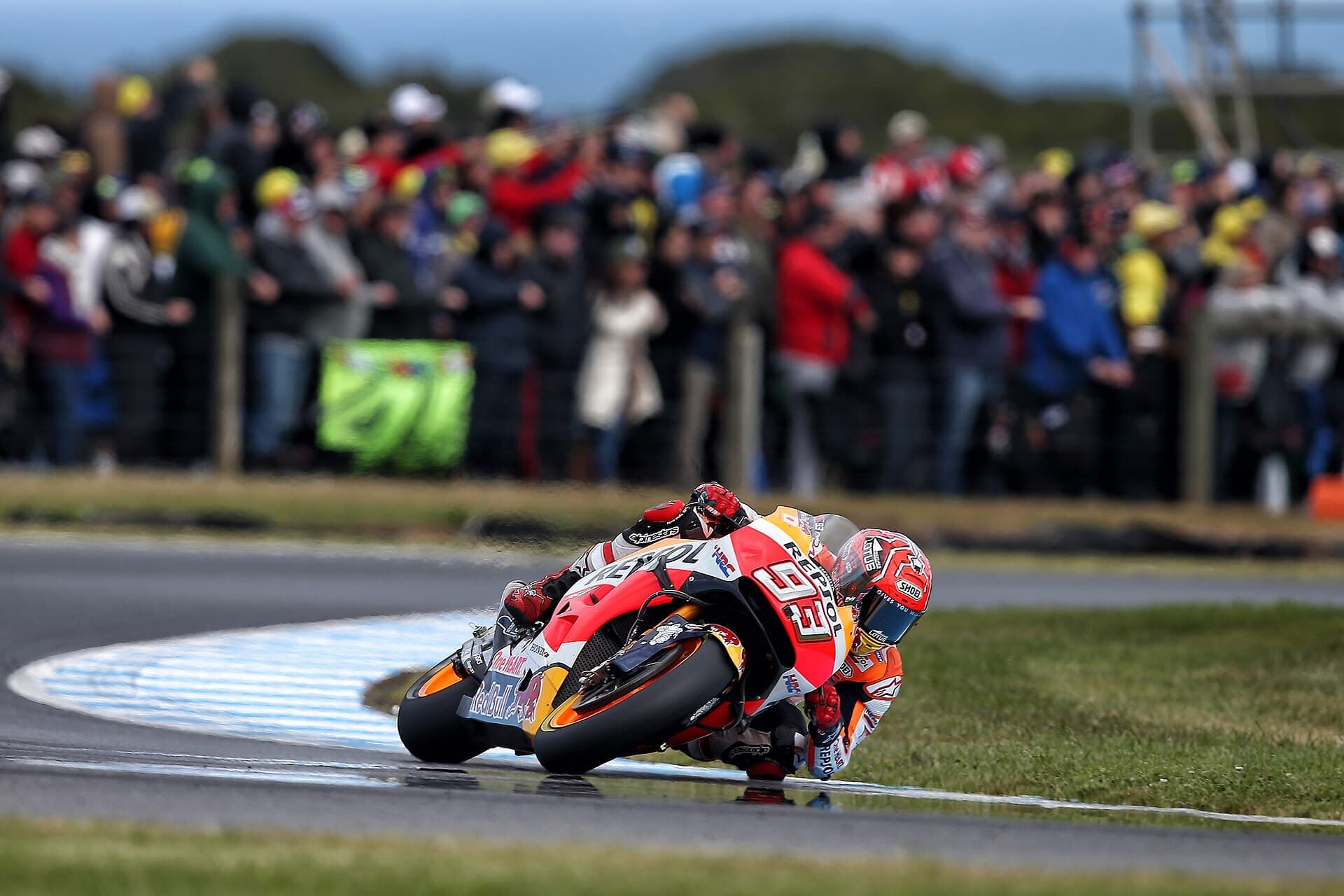
Tomorrow morning the MotoGP paddock opens at Phillip Island for the last time in the foreseeable future. The 2026 Australian Motorcycle Grand Prix runs 23 to 25 October (opens in a new tab), and from 2027 the race moves to a street circuit in central Adelaide under a six-year deal (opens in a new tab). If you are a car person who has never quite understood the bike crowd, this weekend is the moment to find out what you have been missing, and it is worth knowing what happens to the circuit once the bikes have gone.
The short version: a MotoGP bike is a 157 kg prototype making roughly 250 horsepower that has been timed at more than 350 km/h on the Gardner Straight, and the person on top of it is leaning further than physics seems to allow with no roll cage, no seatbelt and nothing but a glove between their knee and the tarmac. That is why the racing grabs people who think of themselves as four-wheel loyalists.
The longer version is that Phillip Island is not closing; it is changing tenants. Supercars returns from 2027, historic racing stays, the owners say the land will remain a racetrack, and the track-day calendar carries on.
At a glance
- Final Phillip Island MotoGP
- 23–25 October 2026, round 18 of the season
- Where it goes
- Adelaide street circuit, 4.195 km, 18 corners, from November 2027 for six years
- Supercars return
- A Finals Series round every year, 2027 to 2031
- WorldSBK
- Season opener 19–21 February 2027 at Phillip Island, then The Bend from 2028
- The circuit
- 4.448 km, 12 corners, top speed 358.8 km/h set in 2025
What a MotoGP bike actually is
Start with the machine, because the numbers explain the spectacle. The official series explainer describes the MotoGP class as "full prototypes" with a 1000cc four-cylinder engine making approximately 250 hp, a minimum weight of 157 kg with the rider not counted, and a recorded top speed of 366.1 km/h (opens in a new tab). The same page lists winglets, carbon brakes, holeshot and ride-height devices and seamless gearboxes, and caps fuel at 22 litres.
Most sports cars weigh well over a tonne for a similar or lower output, so the bike's power-to-weight ratio is in a different universe, and the rider is sitting on it, not in it, with no roll structure, belts or airbags.
Then there is the lean. During the 2019 Phillip Island tyre test MotoGP's own channel recorded Marc Marquez saving a crash at a 70-degree lean angle (opens in a new tab). A car tipped 70 degrees from vertical would be on its door. On a bike it was a Friday practice moment.
The explainer notes that Moto2 and Moto3 run standard throttle electronics to prepare riders for the "more complex systems in MotoGP", and that a rider must manage the stopping power of front carbon brakes and cornering at extreme lean (opens in a new tab). Traction control and anti-wheelie exist, but the electronics cannot lean the bike, pick the line or decide when the rear is about to let go. The human is the system.
That changes again next year. Reporting on the Grand Prix Commission's decision at Jerez, Crash.net lists the 2027 rules as 850cc engines with a 75 mm maximum bore, a 153 kg minimum weight, a 20-litre tank, every ride-height and holeshot device banned, smaller aero and 100 per cent sustainable fuel (opens in a new tab). In other words the sport is deliberately dialling back speed and gadgetry in favour of the rider. Car people who mourn the loss of the simple, naturally aspirated sports car will recognise the instinct.
Why car people get hooked
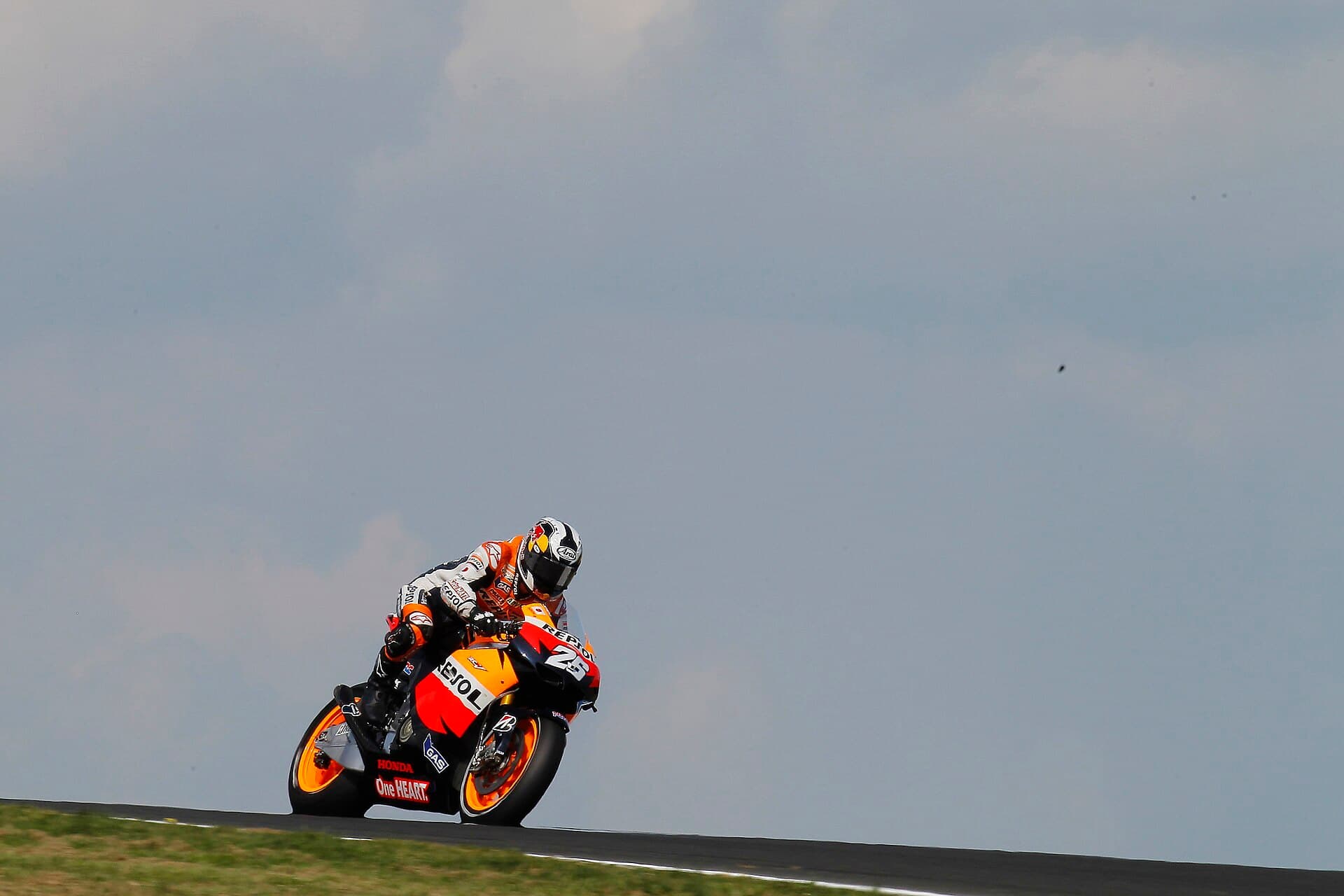
Phillip Island is a 4.448 km, 12-corner circuit with a 900 m main straight, and the top speed on it, 358.8 km/h, was set by Enea Bastianini in 2025 (opens in a new tab), according to the Tech3 team's track data. Fabio Quartararo's 2025 lap record on the same page is 1:26.465, an average of 185.1 km/h around a track that includes two slow corners. The World Superbike series calls the Gardner Straight an 835 m run that is the fastest sector on the lap, where Xavi Vierge hit 335.4 km/h on a production-based Honda in 2024 (opens in a new tab).
Those figures matter because the circuit is built for them. Alex Lowes, who has raced it for years, told WorldSBK that "the old-school layout of the track makes it unique" (opens in a new tab), with corners taken on the throttle that punish the rear tyre, and called it one of the highest average-speed tracks he rides. Turns 6 to 9, the Hayshed and the blind crest at Lukey Heights, were his favourite sector. If you have ever stood at Lukey Heights and watched a rider commit to a crest they cannot see over, you know why.
What hooks a car enthusiast, in our experience, is that nothing is hidden. In a modern race car the driver sits in a carbon tub behind a halo and the clever systems work where you cannot see them. On a bike the body is the suspension, the aero and the ballast at once: you watch the rider hang off, shift weight for the brakes, pick the bike up for the drive. The skill is visible from a grass bank, the passes happen at speeds you can see, and the consequence of a mistake is right in front of you.
Fast is not the same as felt. A MotoGP bike at Phillip Island is both, and you can see every part of why.
Australians also have a dog in the fight. Two of the circuit's corners carry the names Doohan and Stoner, and the WorldSBK round here was first won in 1990 by home riders Peter Goddard and Rob Phillis (opens in a new tab), according to Crash.net's history of the event.
Bike people and car people are mostly the same people
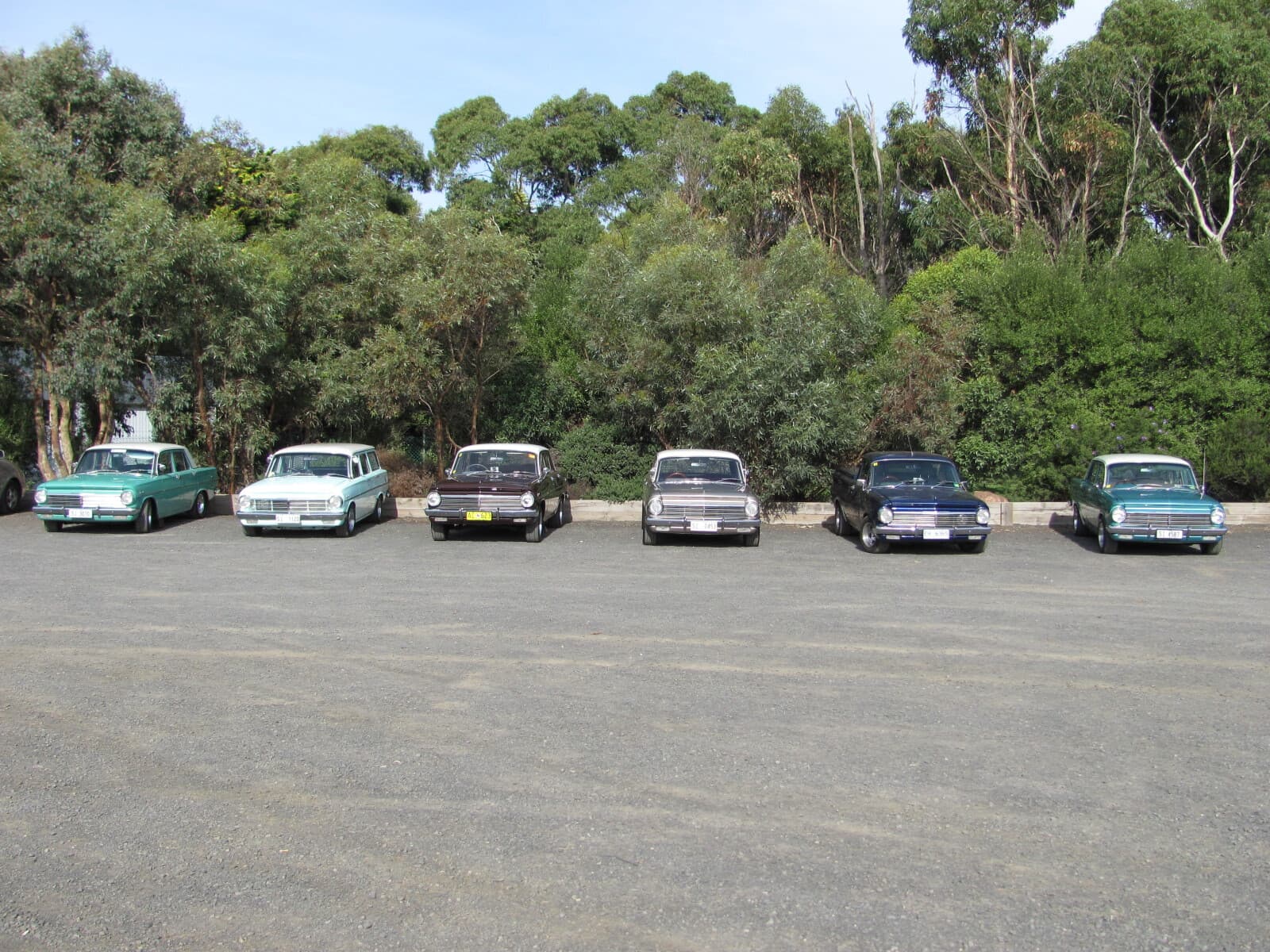
Walk the car park at any Phillip Island meeting and the overlap is obvious: a row of old Holdens outside a bike race, a 911 parked beside a Panigale. The same instinct, to own and understand a machine and to use it properly, runs through both camps. The Victorian government's Supercars announcement makes the point without meaning to, pairing the cars' return with a new Phillip Island Festival of Motoring on 12 to 14 March 2027 (opens in a new tab) alongside the existing Phillip Island Classic. Nobody there asks whether your passion has two wheels or four.
The club scene is the way in for both. Our guide to Australian car culture and why a club is the door (opens in a new tab) applies word for word to motorcycle clubs, and the national superbike championship now shares the Phillip Island paddock with MotoGP: Motorcycling Australia's new summer calendar opens the 2026–27 ASBK season at the Australian Motorcycle Grand Prix on 23 to 25 October, returns to Phillip Island in late February 2027 and finishes under lights at Sydney Motorsport Park in March (opens in a new tab), according to BikeReview's report of the announcement.
What else runs at the circuit
The honest answer to "is Phillip Island finished?" is a calendar.
Supercars, from 2027
On 16 October the Victorian government announced that Phillip Island will host one of the closing rounds of the Repco Supercars Championship each year for five years, from 2027 to 2031 (opens in a new tab), promoted by the Australian Grand Prix Corporation. It is the championship's first visit since 2019; Supercars chairman Barclay Nettlefold called it "fitting" in the series' 30th-anniversary year because the circuit was part of the championship in 1997. The release gives no dollar figure for the deal. Supercars' own circuit page lists Phillip Island at 4.45 km, anti-clockwise, with a top speed of 286 km/h and a layout "basically unchanged" since its 1989 redevelopment (opens in a new tab). The Canberra Times reports that about 60,000 fans attended the island's last Supercars race (opens in a new tab) and that the series grand final stays in Adelaide.
World Superbikes, one more time
The circuit confirmed that WorldSBK's 2027 season opener runs 19 to 21 February, with a two-day pre-season test on 15 and 16 February (opens in a new tab). After that the series has said The Bend in South Australia becomes the home of the Australian Round from 2028 under a multi-year agreement (opens in a new tab). WorldSBK says Phillip Island has hosted 70 of its races, more than any other circuit (opens in a new tab), and Australian Motorcycle News reported in June that the WorldSBK contract sits directly between Dorna and Linfox Property Group and expires because "the 10 years is up" (opens in a new tab) — a different situation from MotoGP, where the promoter is the state's Australian Grand Prix Corporation.
Historic racing and club events
The Phillip Island Classic returns on 12 to 14 March 2027 (opens in a new tab), according to V8 Sleuth, with the new Festival of Motoring built around it; event director Mike Herlihy calls the Classic "a living celebration of motorsport history". The Phillip Island Auto Racing Club's Island Magic, its 35th edition, features six categories including the IPRA Nationals, National Sports Sedans, Historic Touring Cars, Porsche 944 Challenge and Formula Vee (opens in a new tab); PIARC's March notice listed it for 22 and 23 November, and the circuit's later listings reportedly show 20 to 22 November, so check the club before you travel.
Track days
The circuit runs a Ride Days programme for motorcycles, and car clubs run supersprints here through spring and summer; Drive Events lists a Super Sprint on 14 and 15 November 2026 (opens in a new tab) and the MX-5 Club of NSW an Interstate Challenge on 6 December (opens in a new tab). We could not find a published 2026 Ride Days date list on an official page, so take the booking sites as the source for dates.
What we could not source
We found no official Asia Road Racing Championship page naming Phillip Island for 2026, so it is left out, and the circuit's own events page sits behind a bot check, so club-level dates above come from the clubs and promoters rather than the venue.
The future of the track
Three parties decide it: the owner, the state, and whoever pays for events. The owner is the Fox family through Linfox Property Group. After circuit designer Bob Barnard warned publicly that the venue could face redevelopment, managing director Andrew Fox told AMCN in July: "The track is definitely not for sale, and we have no interest in building a golf course on our land at Phillip Island. Nor is it on the market. It never has been. The land will definitely remain a racetrack." (opens in a new tab) That is a statement of intent, not a contract, but it is as plain as an owner gets.
The state has put money behind events rather than bricks. In February, according to Speedcafe's report of the Victorian government statement, Victoria ruled out Dorna's request to move the race to Albert Park and offered additional funding "only on the condition that the event remains at Phillip Island" (opens in a new tab), noting the island had hosted the race 29 times. The promoter went to Adelaide instead. Major Events Minister Anthony Carbines has since said the state would "step up and step in" (opens in a new tab) if the Adelaide move does not work out, and Destination Phillip Island puts the annual economic activity linked to MotoGP and WorldSBK at more than $80 million, per the same Canberra Times report. The Supercars deal and the Festival of Motoring are the replacement plan; we could not find any announced capital investment in the circuit itself.
MotoGP's promoter wanted the race at Albert Park from 2027. Victoria said no and offered more money to stay at Phillip Island. South Australia offered a city-centre street circuit. MotoGP's own announcement describes Adelaide as "the first MotoGP Grand Prix held in a city-centre location", with a 4.195 km, 18-corner layout based on the 1985–1995 Formula 1 circuit and speeds of more than 340 km/h (opens in a new tab). Whether a street circuit can give riders what the Island's sweeping corners do is a question nobody can answer until November 2027.
How Phillip Island compares to other tracks
Track data comes from each circuit's own site or the series that race there; where a figure is not on a page we read, it is not in the table.
| Feature | Phillip Island | Mount Panorama | Assen | Mugello |
|---|---|---|---|---|
| Length | 4.448 km | 6.213 km | 4.542 km | 5.245 km |
| Corners | 12 | 23 | 17 | 15 |
| Current layout since | Permanent track 1956, rebuilt 1989 | Current layout 1987 | Circuit built 1955, shortened since | Opened June 1974 |
| Top speed on record | 358.8 km/h, MotoGP 2025 | Supercars reach 300 km/h on Conrod | Not stated | Not stated |
| What runs there | MotoGP to 2026, WorldSBK to 2027, Supercars 2027–31, historics, club days | The Great Race (Bathurst 1000), Supercars | Dutch TT, WorldSBK | Motorcycle world championship, WorldSBK, 24H Series |
Table sources: Tech3 track data (opens in a new tab) and Supercars (opens in a new tab) for Phillip Island; Bathurst Regional Council (opens in a new tab) for Mount Panorama (23 bends, first raced 1938) and Wikipedia (opens in a new tab) for its 6.213 km length; Pirelli (opens in a new tab) for Assen; the 24H Series (opens in a new tab) for Mugello.
Bathurst is a public road with a 1.1 km Mountain Straight, lumpy and long; Assen a purpose-built twisting ribbon; Mugello a wide Tuscan speed bowl. Phillip Island is short enough to lap in under 90 seconds, fast enough to top 350 km/h, and has only twelve corners, nearly all of them fast. That is why riders talk about it the way drivers talk about Spa.
Another perspective: the Netherlands and Assen
Assen is the closest thing world motorcycle racing has to Phillip Island's problem, solved the other way. The Dutch TT began as a road race on 11 January 1925 over roughly 28 km of partly unpaved public road (opens in a new tab); the current permanent circuit was built in 1955, the start-finish straight was still a public road until 1992, the northern section was reworked in 2005–06 with grandstands for 64,000, and the Ruskenhoek changes cut the lap to 4.542 km and 17 corners. Each time the sport asked for something different, the Dutch rebuilt the track instead of moving the race. The result is that the TT has stayed at Assen for a century, and the venue's second big event, the WorldSBK round, is the only one that has hosted more Superbike races than Phillip Island, by a margin of two (opens in a new tab).
The lesson for Australia is not that Victoria should have spent more; nobody outside the room knows the numbers. It is structural. Assen's circuit, its events and its grandstands are one continuously reinvested asset. Phillip Island's circuit is privately owned, its headline event was promoted by a state corporation, and its second event was contracted separately with the owner. When the promoter wanted a different venue, nothing bound the three together. The Supercars deal is a five-year patch on that. A longer answer would tie facility investment to the events the state funds, so the next promoter has a reason to stay.
What it means if you're buying or selling
A track-day car does not need to be a supercar. Club supersprints at Phillip Island run everything from Hyundai Excels to Porsche 944s, which is the whole point of the Island Magic categories above. Our guide to taking a performance car to the track (opens in a new tab) covers the part that bites: most Australian road insurance policies exclude damage on a racetrack, including untimed days, so read the exclusion and ask in writing before you book.
Buying a car or bike that has been tracked is not a red flag in itself; an undocumented one is. Ask for the service history around track use, brake fluid and pad changes, tyre receipts and any scrutineering log; a seller who maintained a tracked car accordingly has a better story than one who says "never tracked" over harness marks. We would expect, though we cannot prove with market data, that a well-documented track-prepared car sells to a narrower pool of buyers and often for less than a standard example of the same model, because the modifications suit the buyer who made them. Price accordingly and be upfront in the listing; a MotorLoop listing is free, so there is no reason not to show the documentation.
Think about where the sport is going, too. MotoGP's 2027 rules, as reported, strip out ride-height devices and shrink the engines, and road machinery tends to follow racing's fashions a few years later. A simple, naturally aspirated machine with mechanical feel is unlikely to get less desirable.
Our take
This is our view. Phillip Island losing MotoGP is a loss, and the people grieving it are right to. It is also not the end of anything that matters to someone who actually drives or rides. The track stays. The historic meeting stays. The club days, where ordinary people lap the same tarmac Quartararo set a record on, stay. Supercars come back. The sport's governing body is about to make its own machines simpler, lighter and less electronic, which is the direction we have argued road cars should take for years.
Go this weekend if you can. Stand at Lukey Heights, watch a rider carry a lean angle no car could survive over a blind crest, and notice that nothing on the bike is doing it for them. Then come back for the Classic, for Island Magic, or on a weekday with your own car and a helmet. Some people want A to B, others enjoy the journey. Phillip Island is where the journey crowd meets, and it still will be after Sunday.
Header photo: Box Repsol (opens in a new tab) via Wikimedia Commons, CC BY 2.0 (opens in a new tab).
Related
- Australian car culture is alive, and a club is the way in (opens in a new tab)
- Taking your supercar to the track: track days, tyres and the insurance fine print (opens in a new tab)
- Supercars and Coffee 2026 — Fox Classic Car Collection, Melbourne (opens in a new tab)
- Repco Bathurst 1000 2026 — Mount Panorama, Bathurst (opens in a new tab)