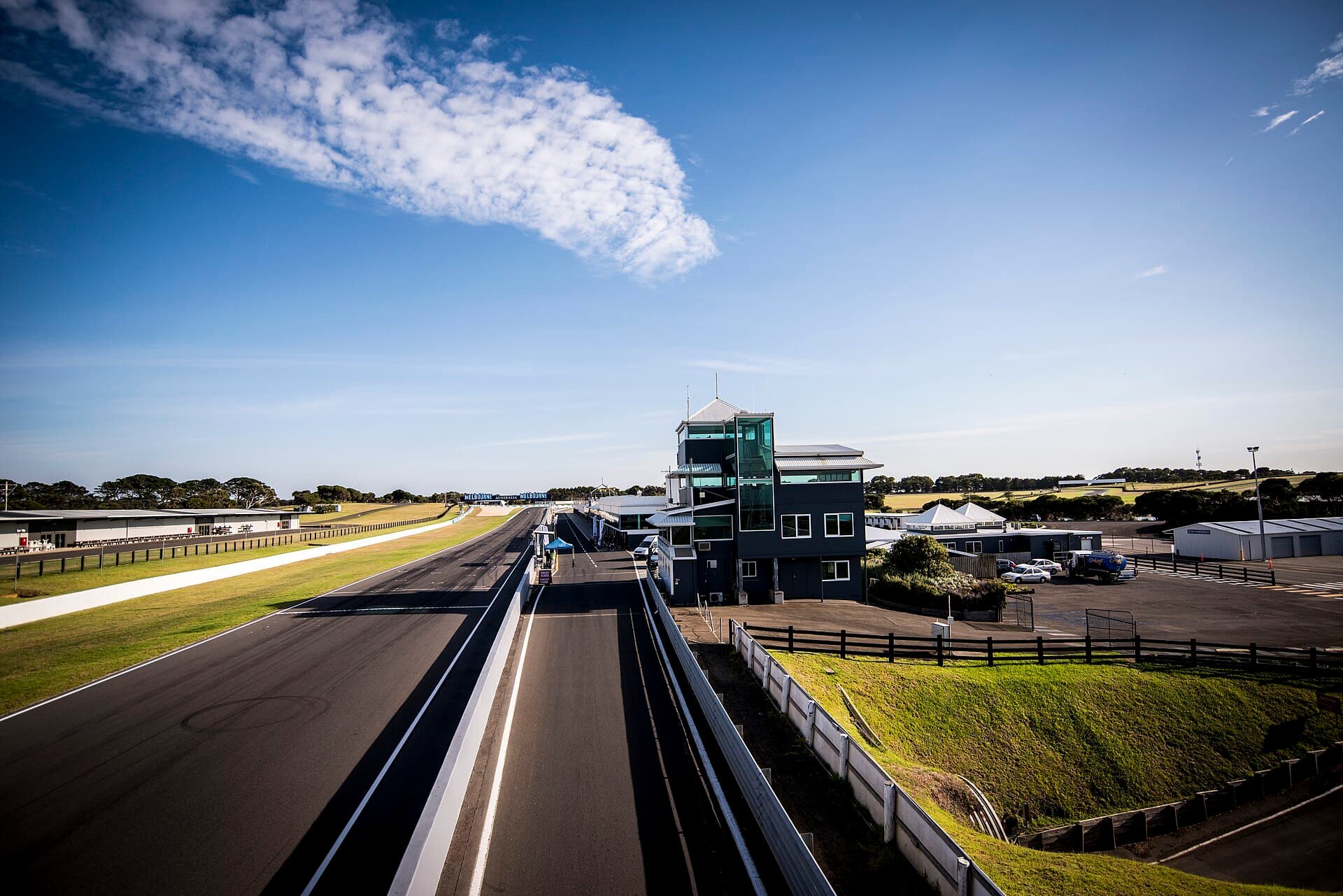
This weekend, 23 to 25 October, Phillip Island hosts the Australian Motorcycle Grand Prix for what MotoGP's own announcement makes clear is the last time: the championship's six-year agreement with the South Australian Government (opens in a new tab) "begins next season and will see MotoGP race at the Adelaide Street Circuit until 2032 inclusive", with the first Adelaide race set down for three days in November 2027.
For bike people that ends an era that started in 1989. For car people it should matter just as much: the race we now call the Australian Grand Prix was run on the island's public roads in 1928, the Armstrong 500 that became the Bathurst 1000 was born here in 1960 and left only because the track fell apart, and the circuit has been closed and written off twice and come back both times.
So before the 2026 grid forms up, here is the whole story: how a gravel-road race for Austin Sevens became one of the fastest circuits in world motorcycling, who kept it alive, what the Adelaide move does and does not mean, and what circuit heritage does to the value of the cars that raced there.
At a glance
- First race
- 31 March 1928, 100 Miles Road Race on public roads, won by Arthur Waite in an Austin 7
- Purpose-built circuit
- First meeting 15 December 1956; closed after the 1962 Armstrong 500; reopened 1967; dormant after 1978
- Modern circuit
- Rebuilt and reopened December 1988; 4.45 km, 12 corners; first world championship motorcycle GP 9 April 1989
- Owner
- Linfox Property Group, since 2004
- After MotoGP
- Adelaide street circuit from November 2027; Supercars return to Phillip Island 2027 to 2031
1928: a Grand Prix on gravel roads
The Phillip Island and District Historical Society sets the scene. The Victorian Light Car Club, founded in 1924 by members of the Royal Automobile Club of Victoria, was granted permission by the Woolamai and Phillip Island Shire Council in February 1928 to run a race on the island. It was scheduled for the Eight Hour Day holiday, Monday 26 March 1928, then postponed a week to Saturday 31 March after heavy rain (opens in a new tab). The society says around 1,000 people made the day trip anyway, a record for visitors to Cowes in a single day, and were entertained with speed tests while the race waited for the following weekend.
The event was billed as the "100 Miles Road Race", run over a 6.5-mile loop of public road, and the same society page says it was "later recognized as the Australian Grand Prix". That is the honest wording. Nobody on the day called it a Grand Prix; the title was applied afterwards, and the society describes it as "Australia's first" and "one of the few held outside of France, Sicily, and Spain at the time". The rules read like another century: every car carried a riding mechanic, only Australian-made tyres were allowed, and the field raced clockwise. Arthur Waite won in an Austin 7 in one hour, 50 minutes and 10 seconds, an average the society puts at nearly 54.5 mph.
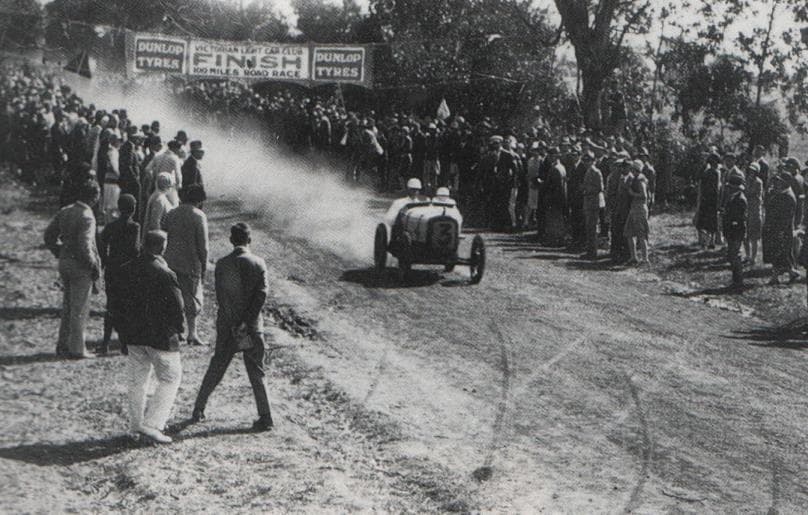
There was a legal problem too. The Motor Car Act prohibited councils from closing roads for racing, so in September 1930 a shire delegation led by the Shire President, A.K.T. Sambell, lobbied for an amendment, which the society says allowed the Australian Grand Prix to continue on the Phillip Island road course up to and including 1935 (opens in a new tab). The first eight Australian Grands Prix were all run here, on gravel roads.
1956: a real circuit, then the Armstrong 500 breaks it
Phillip Island Auto Racing Club's own history, published through its Shannons club page, records that after PIARC's inaugural meeting in 1952 the current circuit site was bought from a Melbourne motor dealer, Mr P. Whitlock, and rotary hoeing began in January 1953. The club spent "some 50,000 pounds" on the initial build, and the first race meeting on the completed circuit was on 15 December 1956 (opens in a new tab), with Lex Davison winning the feature race. Racingcircuits.info gives the same opening date and describes it as a combined car and motorcycle meeting organised by PIARC.
Then came the race that made and nearly unmade the place. Supercars' own history of the Great Race says the first Armstrong 500 "took place at Phillip Island in southern Victoria in 1960", and that the third edition in 1962 "caused such damage to the track that a full resurface was required". The resurface never happened, and the reason is pure Phillip Island: the bridge connecting the island to the mainland at San Remo was not strong enough to carry the hot-mix bitumen equipment (opens in a new tab). Sandown pitched for the race but wanted to sell half the naming rights, so it went to Bathurst, where the Australian Racing Drivers' Club had already run a six-hour production-car event in 1962; the 1963 Bathurst race had 57 starters and was won by Harry Firth and Bob Jane.
PIARC's account is blunter: the 1962 damage "was beyond the capability of the club to repair", it could not service its loans, and the track was closed and the property put on the market (opens in a new tab). The October Bathurst comparison is therefore the wrong way round. Bathurst did not beat Phillip Island; Phillip Island handed Bathurst its biggest race because nobody could get a paving crew across a bridge.
Len Lukey, dereliction and the long sleep
The circuit's second life came from a racer. PIARC's history says that in 1964 Len Lukey bought the property from the club on the understanding PIARC could rebuild the circuit and keep running meetings, and that by September 1967 the track was ready again. The venue settled into car meetings plus one combined car-and-bike event a year with the Hartwell Motorcycle Club. Then Lukey died in 1978, and with him went the agreement that let PIARC control the circuit (opens in a new tab). The last club meeting of that era, with a nice sense of occasion, was the Golden Jubilee Australian Grand Prix meeting commemorating the 1928 race, with events on the original road course in Cowes.
Racingcircuits.info's summary of what followed is that "for much of the following decade Phillip Island lay dormant" until a company called Placetac Pty Ltd, whose major shareholders PIARC names as island landowners Fergus Cameron and Peter Henderson, bought the property from the Lukey estate in the mid-1980s (opens in a new tab). The track was rebuilt to a shorter layout and, per the same page, "the rebuilt circuit reopened in December 1988".
Extensive track damage at the 1962 Armstrong 500 was beyond the capability of the club to repair.
1989: Gardner, the Island and the world championship
PIARC's history is specific: "On 9 April 1989, the circuit welcomed the involvement of Bob Barnard and his organisation with the running of the Australian Motorcycle Grand Prix there", and calls it the first major event of the circuit's fourth era (opens in a new tab). The Australian Grand Prix Corporation's own retelling says "Australia was hosting its first-ever world championship motorcycle Grand Prix race", that it was the second round of the season, and that "a huge crowd piled into the iconic Phillip Island Grand Prix Circuit to see history made in 1989". The race was a slugging match between Wayne Gardner and Wayne Rainey, with the AGPC counting 19 lead changes before Gardner held on over the final lap (opens in a new tab). Gardner's podium line, as quoted there: "I still think I'm dreaming now. I've got to keep pinching myself."
The Grand Prix did not stay. PIARC records a second GP on 16 September 1990, then "the demise of the Barnard companies in 1991 and the shifting of the Australian Motorcycle Grand Prix to New South Wales", with the owners setting up Phillip Island Motor Sports to run the venue on testing and domestic racing. The GP returned in 1997 (opens in a new tab), and MotoGP's own event page confirms the pattern: "MotoGP returned in 1989 and 1990 before becoming a regular fixture once more from 1997 onwards". World Superbike arrived in between; Speedcafe's reporting on the series' future says the Australian round moved "permanently to Phillip Island in 1990" and has visited every year since except 2021 (opens in a new tab).
What the riders rate
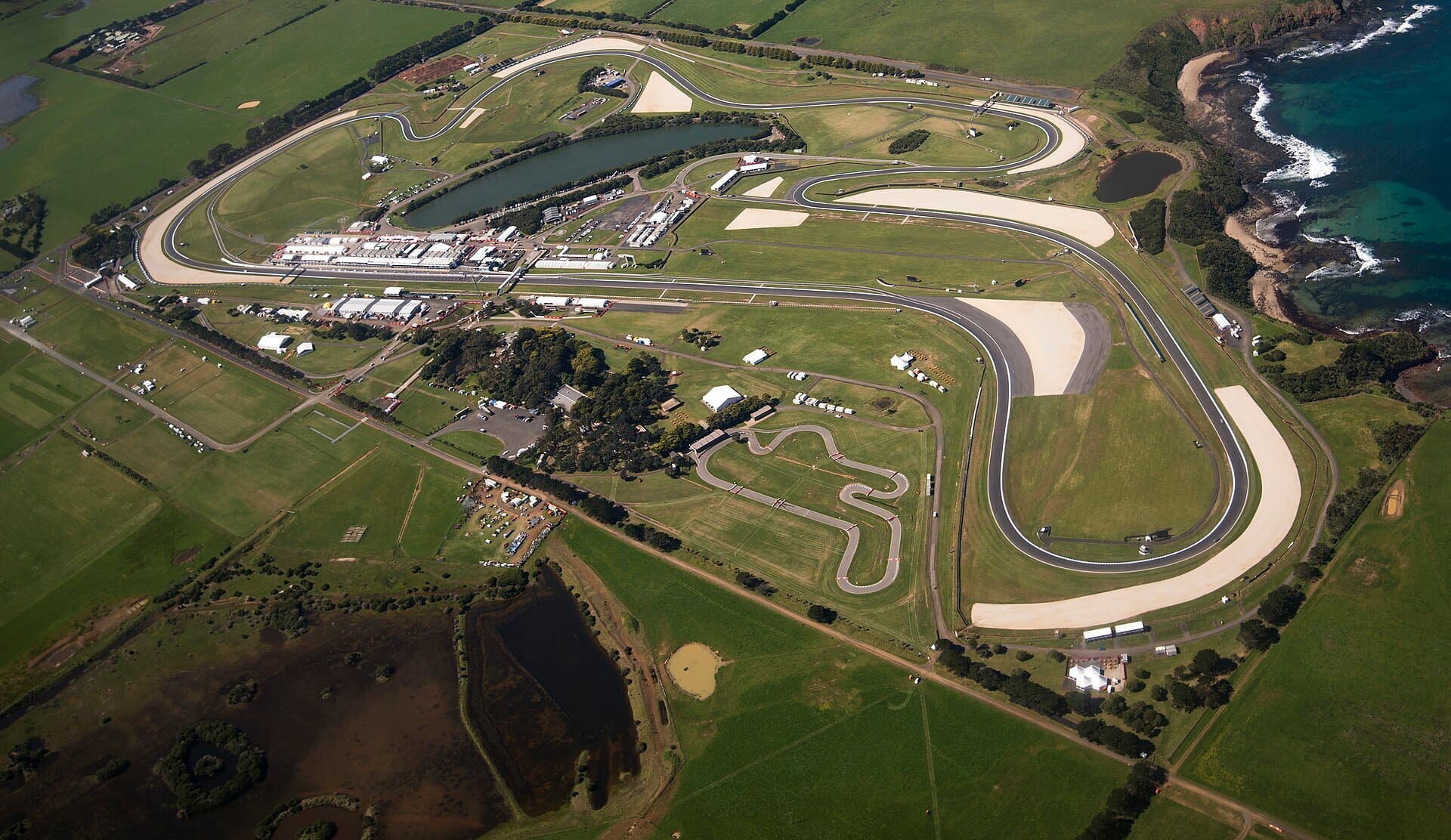
The circuit MotoGP races on today is 4.45 km with 12 corners, seven of them left-handers (opens in a new tab), and the thing that makes it special is not a corner count but speed and sightlines. Casey Stoner, when turn three was renamed in his honour before the 2012 round, picked that corner himself and called it "probably my favourite one in the world"; crash.net describes it as a fast downhill left-hander taken at over 250 km/h (opens in a new tab), and notes turn one was already Doohan Corner and the main straight already Gardner Straight. Stoner went on to win that 2012 race, which Cycle News reported as a record sixth time in a row at his home circuit (opens in a new tab), in front of a crowd the same report put at 53,000, in the season he retired.
For car people the speed is just as obvious on the record sheet. PIARC's current list of class records has the outright mark at 1:24.0607, set by Tim Slade in a Brabham BT62 in May 2022 (opens in a new tab) and a Supercars record of 1:30.9508 to Scott McLaughlin's Mustang in 2019. On a 4.45 km lap, a 1:24 is an average well over 190 km/h, which is why tyres suffer here.
The surface that bit back
That tyre point is not theoretical. Supercars reported in December 2012 that the 4.445 km circuit was being resurfaced and that the last resurface had been in 1998 (opens in a new tab); crash.net put the cost at three million dollars and quoted Andrew Fox of circuit owner Linfox calling the new surface as smooth as a baby's bum (opens in a new tab). Smooth turned out to be the problem. At the 2013 Grand Prix, Cycle News reported, Bridgestone found "some tires having their tread torn off and cracked", blamed "sustained periods of very high tire temperature", and the race was cut from 26 laps to 19 with a mandatory pit stop to change motorcycles (opens in a new tab). We saw reports of a further resurfacing in 2024 but could not open a primary page confirming it, so we leave that there.
The Fox years and the 2026 farewell
PIARC's history says it was announced in 2006 that Lindsay Fox, through Linfox, had bought the circuit, while racingcircuits.info dates the Linfox Property Group acquisition to 2004; both agree the existing managers were kept on and a capital works program began. Whatever the date, the family still owns it. When circuit designer Bob Barnard raised fears this year that the venue could be "closed and sold for a golf course", Linfox Property Group managing director Andrew Fox told crash.net "the track is definitely not for sale" (opens in a new tab) and "the land will definitely remain a racetrack".
He needs it to, because two of the three big international dates are leaving. The Adelaide deal was unveiled on 19 February, Australian time, by MotoGP's chief sporting officer Carlos Ezpeleta alongside South Australian Premier Peter Malinauskas; Cycle News reported a roughly 4.195 km, 18-corner street layout drawn from the 1985 to 1995 Formula 1 circuit, with this year "the last at Phillip Island before the shock switch to Adelaide" (opens in a new tab). BlackBook Motorsport reported that the promoter wanted the race moved to Albert Park, that Victoria offered more money if it stayed on the island, and that sports minister Steve Dimopoulos said "we were never willing to sell out Phillip Island" (opens in a new tab). World Superbike follows: The Bend in South Australia has been provisionally announced to host WorldSBK from February 2028 (opens in a new tab), with Phillip Island confirmed for the 2027 season opener first.
None of this is a story about a dying crowd. The AGPC reported last year's three-day attendance as 91,245, the highest since Stoner's final win in 2012 (opens in a new tab), with 38,645 on race day. And the cars are coming back: the Victorian Government announced on 16 October that Phillip Island will host the closing round of the Supercars Championship for five years, 2027 to 2031 (opens in a new tab), the first championship visit since 2019, plus a new Festival of Motoring on 12 to 14 March 2027 alongside the long-running Motorsport Classic.
- 1928
- First Australian Grand Prix, on public roads
- 1:24.0607
- Outright car lap record, Brabham BT62, 2022
- 91,245
- Three-day MotoGP crowd, 2025
- 2027-2031
- Supercars finals at the Island
Another perspective: England, and the circuit that did not come back
If you want to know what "closed and sold" really looks like, go to Weybridge in Surrey. Brooklands Museum's own timeline records that Hugh and Ethel Locke King began building the world's first purpose-built motor racing circuit on their estate in late 1906, that Ethel led the opening procession on 17 June 1907 in her Itala, and that the first official race was held on 6 July 1907 (opens in a new tab). Grace's Guide describes a 100-foot-wide, 2.75-mile banked concrete oval. Brooklands was also an aerodrome, which is what killed it as a racetrack: the museum says "the BARC held its last ever meeting at Brooklands on 7th August 1939", the Government requisitioned the site for Vickers and Hawker aircraft production (3,012 Hurricanes were built there), and in 1946 Vickers bought the entire site for £330,000 (opens in a new tab). Sections of banking were demolished for hangars; Grace's Guide says about two thirds of the original track remains (opens in a new tab), and it took a 1977 exhibition and a 1984 lease before a museum was founded.
Brooklands shows that a circuit's fame buys it nothing once the owner has a better use for the land; a world first became a factory within weeks of its last race. Phillip Island's difference is that every time it went quiet, someone bought it to race on: Lukey in 1964, Placetac in the mid-1980s, Linfox in the 2000s. Andrew Fox's "definitely not for sale" is intent, not a contract, but it comes with a five-year Supercars deal. What Australia can learn from Brooklands is simple: what preserves a circuit is a calendar, not a plaque.
What it means if you're buying or selling
Circuit heritage shows up in the classifieds in two ways, and only one of them is worth paying for.
The first is a car with a documented competition history at a famous track. Motorsport Australia's historic framework is built around paperwork for exactly this: a historic log book that the governing body says records a car's "competition history and its chain of ownership", and a Certificate of Description that applies to all cars with a competition history (opens in a new tab), covering the detailed technical specification "in words and in pictures". If a seller tells you a car ran the Armstrong 500 at the Island, or an early Castrol Classics meeting (PIARC dates the first to March 1990), the log book, the CoD and period entry lists and photographs are the evidence; a plaque on the dash is not. We think the sensible rule is that provenance adds value only to the extent it is written down by someone other than the seller, and that an undocumented "Phillip Island history" claim should be valued at zero while you negotiate.
The second is a road car with a tenuous link: a Cup-liveried 911 that never raced, a "Bathurst edition" that never saw Mount Panorama. They are road cars with stickers, and the market generally prices them that way. Pay for the car, not the story.
Practical points for anyone tempted by a historic racer this week:
- Ask for the Motorsport Australia log book and CoD before you ask for the price, and check the ownership chain against records you can see.
- If the car will be used, not displayed, agreed-value and laid-up cover are explained in our guide to insuring a classic (opens in a new tab).
- Expect everything with a Phillip Island story to be on the market this month. A farewell weekend is a seller's moment, which makes it a buyer's moment to be patient.
If you are selling a car with real competition paperwork, list the documents rather than the legend, and name the meetings and years. MotorLoop listings are free, and a buyer who can read the log book in the photos stops haggling.
Our take
This is our view. Phillip Island losing MotoGP is a bad outcome produced by a negotiation nobody on the island was part of, and the Victorian minister's line about refusing to "sell out" the place is the right instinct even if the result is a race in another state. A purpose-built circuit on a windswept coast is exactly the kind of simple, durable, owner-controlled thing we keep arguing for; it has outlasted two closures, a shire's legal problem, a bridge that could not carry a paving crew and a tyre supplier's miscalculation.
The 1928 race was run by a car club on public roads with riding mechanics and locally made tyres, and the 2027 Festival of Motoring will be run on the same island by people with much the same idea. The international stars will race in Adelaide and at The Bend, and we hope both work. But the Island's survival never depended on them; it depended on Len Lukey, two landowners in the 1980s and a trucking family that says it is not selling. That is a better guarantee than a six-year contract, and it is why the smartest thing you can do this weekend is go, and then keep going when the cars come back in 2027.
Header photo: Tom Reynolds (opens in a new tab) via Wikimedia Commons, CC BY 2.0 (opens in a new tab).
Related
- Australian car culture is alive, and a club is the way in (opens in a new tab)
- Club plates and concession registration: drive your classic for less (opens in a new tab)
- Porsche's 992 Cup car runs its last Bathurst this weekend. The flat-six is the point (opens in a new tab)
- The Porsche 911: the everyday exotic (opens in a new tab)