The summer holidays are about seven weeks away, and for a growing number of Australian families this will be the first long drive in an electric car. There are more of those cars than ever. The Electric Vehicle Council's State of EVs 2026 report (opens in a new tab) counts 612,000 EVs on Australian roads as of June, and 157,957 sold in the first half of the year alone.
The public charging network has grown too, and faster in the places that matter for a road trip than it was two years ago. But growth from a small base is not the same as coverage, and regional Australia is where the gap still shows. We think the honest summary is this: a well-planned EV road trip down the east coast is now routine, a trip into the inland or the Top End still takes the kind of planning few people do for a tank of diesel, and the busiest weekends of the year are exactly when regional chargers come under the most pressure.
If you're buying or selling a car with a summer trip in mind, that difference should be part of the decision. Here's what the numbers say.
At a glance
- High-power charging sites
- About 1,562 at 30 June 2026 (845 fast, 717 ultra-fast)
- Active fast connectors
- About 5,400
- BEVs per ultra-fast connector
- 144 nationally; 51 in the NT, 208 in Tasmania
- NRMA highway network
- 54 of up to 77 stations built by 30 June 2026
- Service stations
- 7,798, per the federal energy minister's office in March 2026
How big is the network now?
According to the EVC's full State of EVs 2026 report (opens in a new tab), Australia had about 1,562 operational high-power charging locations at 30 June 2026. The council splits those into 845 "fast" sites (24 to 99 kW DC) and 717 "ultra-fast" sites (100 kW and above), with around 5,400 active connectors between them. Ultra-fast locations grew 34 per cent in a year and ultra-fast connectors 55 per cent, and the average high-power site now has 3.5 connectors, up from 3.2 two years ago.
That last figure matters: a site with one working plug is a site where the second car waits. The EVC's charging fact sheet (opens in a new tab) says larger hubs are now appearing along highways and at airports.
Counting slow AC chargers too, the headline total is about 4,268 locations and 11,602 connectors. A motel AC charger is useful overnight, but it isn't what gets you from Wagga to Albury after lunch.
- 1,562
- High-power charging locations, June 2026
- ~5,400
- Active fast and ultra-fast connectors
- 7,798
- Service stations, March 2026
The national average hides the map
The EVC's own report warns against reading too much into ratios, and then offers one we find useful: battery EVs per ultra-fast connector. Nationally it was 144 at June 2026, holding steady because connectors grew 55 per cent while the battery-electric fleet grew 54 per cent. But the state figures (opens in a new tab) range from 51 in the Northern Territory to 208 in Tasmania, with WA at 207, Victoria 193, Queensland 153 and NSW 114. The report says South Australia and Tasmania added connectors at only around a quarter of the rate their fleets grew, and WA at roughly half.
The NT's low number is not good news, and the report says why: the ratio counts cars per plug, not kilometres between plugs. The Territory has few EVs, so its handful of chargers look generously shared. An independent analysis by EV Roadside, published by The Driven (opens in a new tab), counted six fast chargers (50 kW and above) across the NT's 1.35 million square kilometres, and a gap of roughly 625 kilometres with no public fast charger on the Stuart Highway between Katherine and Tennant Creek, which it calls the longest in the country. The same analysis found no gap larger than about 150 km on the Hume, Pacific, Bruce or Western highways, about 175 km on the Eyre Highway across the Nullarbor, and around 250 km on WA's North West Coastal Highway. EV Roadside's dataset is built differently from the EVC's, and The Driven notes the story was revised after readers pointed out missing government-funded sites, so treat its counts as indicative rather than exact.
Where the real progress is
The federal government announced its partnership with the NRMA in April 2023, promising $39.3 million from the Driving the Nation fund for 117 fast-charging sites on national highways (opens in a new tab), with a fast charger roughly every 150 km.
We're making range anxiety a thing of the past.
Three years on, the EVC reports that the National EV Fast Charging Network had delivered 54 of up to 77 NRMA highway stations by 30 June 2026 (opens in a new tab), with the remaining stations aimed at remote gaps and the program due to conclude at the end of 2026. We could not find a public explanation of how the original 117 sites became "up to 77" stations, and readers should note the two figures may not count the same thing. The EVC says more than $500 million has now been committed through Driving the Nation in total, but it also describes the programs as "discrete and time-limited initiatives rather than a consolidated long-term infrastructure pipeline".
The states have done real work as well:
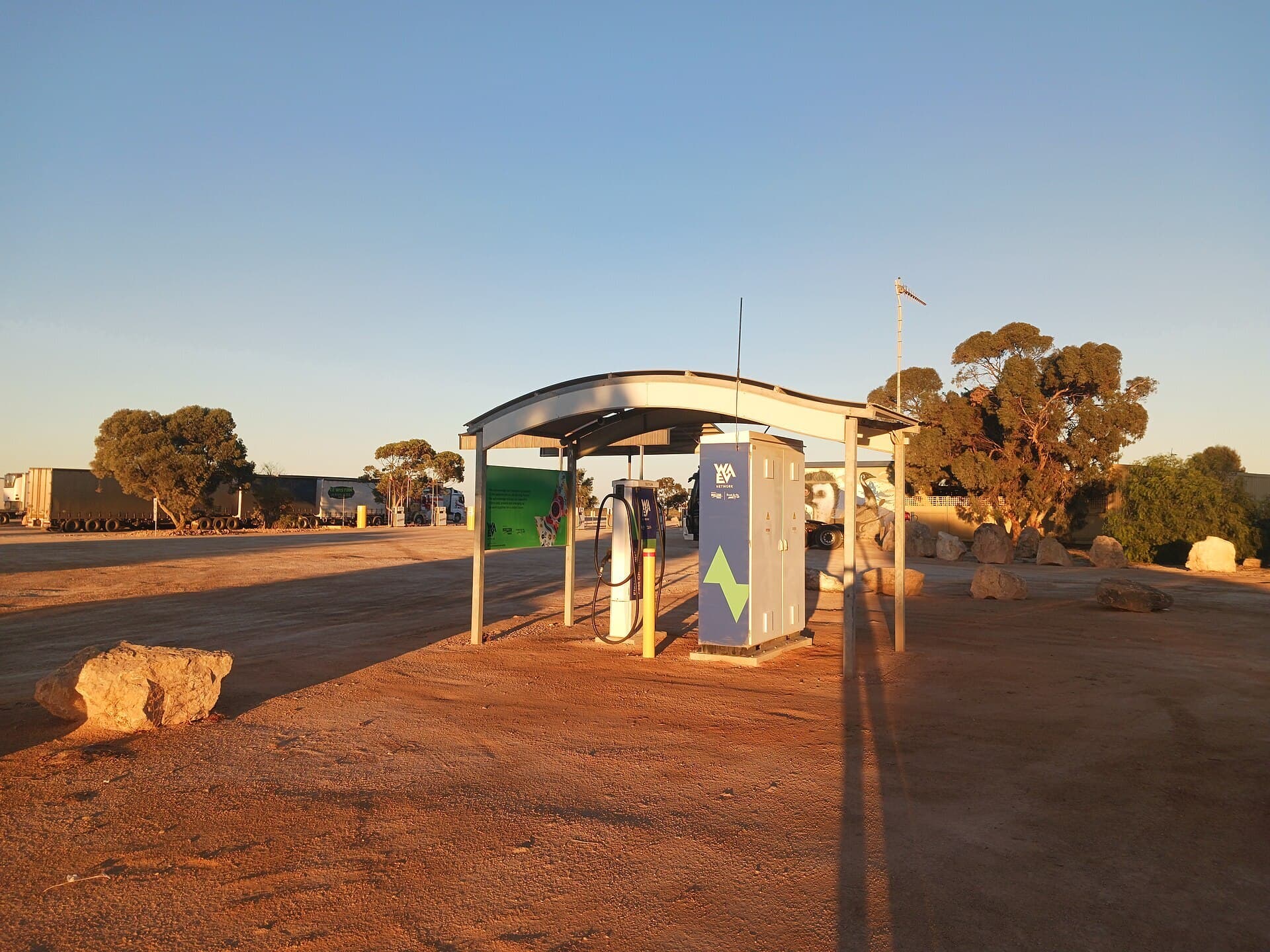
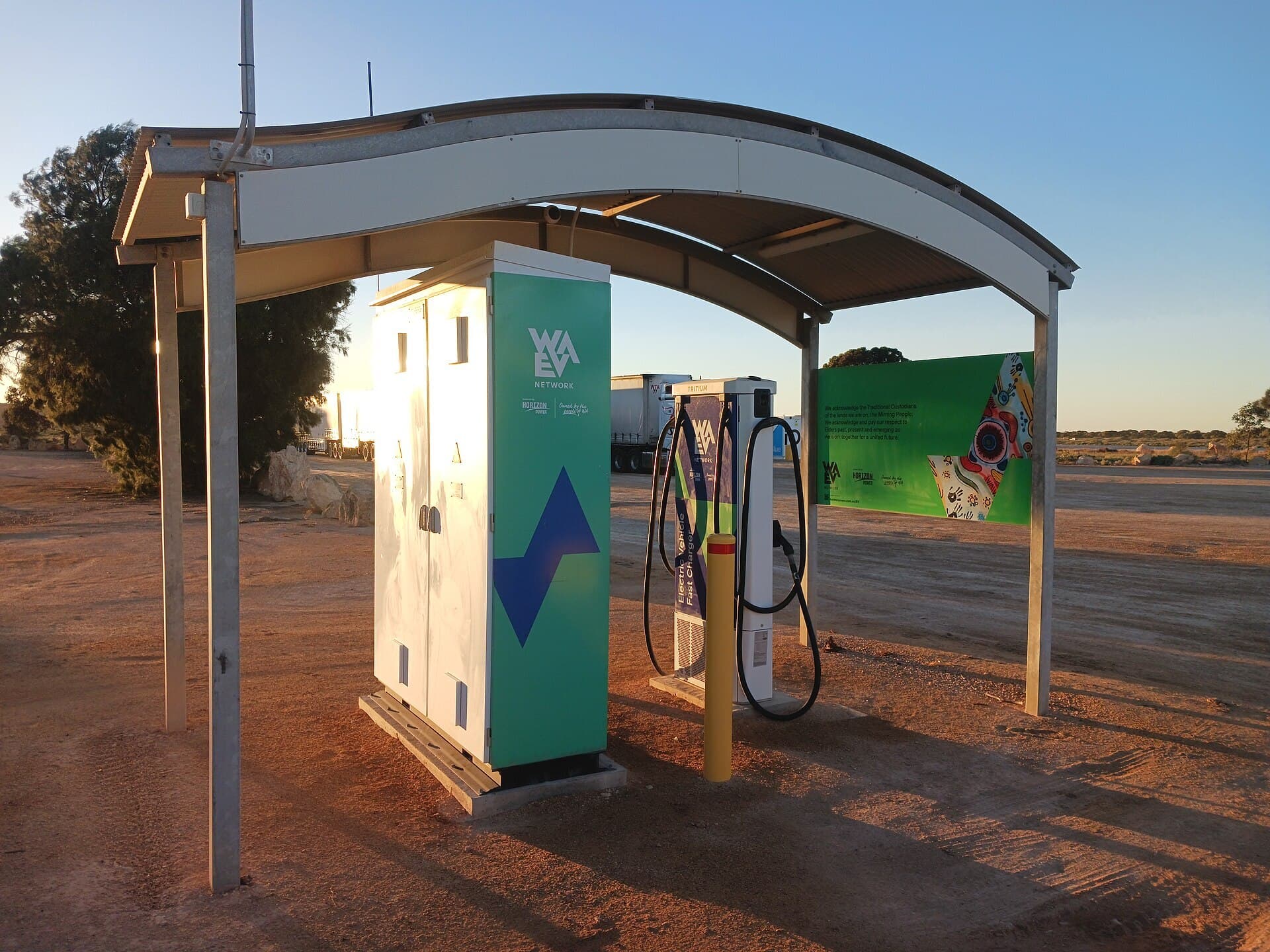
- Western Australia. The WA EV Network, built by Horizon Power and Synergy for the state government, runs about 7,000 km from Mundrabilla near the South Australian border to Kununurra, with 110 DC fast-charging points at 49 locations (opens in a new tab) about 200 km apart on average, according to Energy Source & Distribution News.
- Queensland. The state's Department of Transport and Main Roads says the Queensland Electric Super Highway (opens in a new tab) of 54 fast-charging locations is complete after its third phase, and that there are currently no plans to expand it.
- NSW. The state government and the NRMA split a $6 million cost to add 25 regional fast chargers (opens in a new tab), announced in November 2023, on the Newell, Barrier, New England and Kamilaroi highways.
The result shows on the ground. The EVC scorecard gave the federal, ACT and NSW governments 7 out of 10, while WA, Queensland, Tasmania, South Australia and the NT failed its 2026 scorecard (opens in a new tab). That is the EV lobby grading governments, so read it as advocacy, but it matches the connector numbers: the full report says NSW's ultra-fast connectors grew 83 per cent (opens in a new tab) in a year against fleet growth of 56 per cent.
Reliability, and the holiday crunch
On queues, the evidence is mixed and worth stating fairly. An ABC analysis of utilisation data (opens in a new tab) from the operator data platform Carloop found most fast-charging sites are not congested most of the time, and that regional and remote sites are almost never congested for most of the year. The same analysis found queues of up to five hours at Coolac on the Hume Highway on Good Friday this year.
The EVC's report tells the same story from NSW. Using live data from four operators across 25 council areas, it found Greater Sydney's chargers typically run about 11 points busier than regional NSW's, with typical occupancy of 28 per cent in Sydney against 17 per cent in the regions. In Easter week, regional chargers all but matched the city, at 28 per cent against 29 (opens in a new tab). That's a 65 per cent jump on a typical regional week. The city goes on holiday and takes its charging demand to towns with far fewer plugs. The Christmas and New Year break is the next big test of it.
On reliability, Australia has a rule but not much published data. The National EV Strategy expects government-funded chargers to achieve at least 98 per cent annual uptime, and University of Queensland researcher Kai Li Lim told SBS News (opens in a new tab) in April that the standard is "quite lax", amounting to about a week of downtime a year, and that a charger connected to the internet is assumed to be working. In August, Dr Lim and UTS's Dr Scott Dwyer wrote that the 98 per cent rule applies only to chargers built with taxpayer dollars (opens in a new tab), and pointed to a San Francisco study where only 73 per cent of chargers worked when tested against operator claims of 95 to 98 per cent uptime. They also noted that Chargefox runs 83 per cent of Tasmania's public chargers and 58 per cent of WA's, adding that "one company's bad month rapidly becomes a state-wide outage." We could not find any published, independent uptime audit of Australia's regional fast chargers, and that absence is itself the problem.
The network that's already there
When the Iran war disrupted fuel supply in March, the federal energy minister's office put Australia's fuel retail network at 7,798 service stations (opens in a new tab), according to The Nightly. That is about five times the number of high-power charging locations. A servo typically has several bowsers, a fill takes minutes rather than the half-hour or so (opens in a new tab) the ABC says a DC fast charge takes, and few drivers plan a Brisbane to Longreach run around which roadhouses have a working diesel pump. Our view is that this is what a mature network looks like: you stop thinking about it.
We should be straight about what that month showed, though, because it cuts both ways. At the peak, 608 stations, about 8 per cent, were missing at least one fuel, including 314 in NSW. Chris Bowen said "there are real shortages, particularly in regional areas, that need to be addressed." The servo network is vast, but it is fed by imported fuel, and when supply tightens, regional towns at the end of long delivery routes feel it first. We've argued before that the servo isn't the weak link, the supply chain behind it is (opens in a new tab), and March proved both halves of that sentence.
Even so, a supply shock that briefly left one servo in twelve short of a fuel is a different order of problem from a highway with no public fast charger for 625 kilometres. One is a stress test of a built, paid-for, working network. The other is a network still being built.
Another perspective: the United States and NEVI
The country that tried hardest to buy a highway charging network with public money is the United States, and its experience is a useful warning.
The 2021 Infrastructure Investment and Jobs Act set aside $5 billion (US) for the National Electric Vehicle Infrastructure (NEVI) formula program (opens in a new tab), according to Washington State's attorney-general. The rules were demanding. Under the federal regulation, corridor stations must have at least four networked DC fast-charging ports, each able to deliver up to 150 kW simultaneously (opens in a new tab), and each port must achieve average annual uptime of greater than 97 per cent (opens in a new tab).
Then politics intervened. The Federal Highway Administration froze the program in February 2025. A coalition of states sued, and in January 2026 Judge Tana Lin ruled the freeze unlawful, writing that "such capriciousness runs counter to the Administrative Procedure Act; it is simply not how things are lawfully done", and barred the government from withholding NEVI funds for reasons Congress hadn't authorised, per the Washington AG's office.
The bigger lesson is the pace. According to an analysis by the Eno Center for Transportation (opens in a new tab), only $94 million, about 2 per cent of the program, had been spent by January 2026. Citing EV States Clearinghouse data from September 2025, Eno counted 80 NEVI-funded locations with more than 370 open fast chargers, against 990 stations obligated, and put the open count at around 121 stations. A pending appropriations bill would move about $879 million out of NEVI into general highway programs. Eno also cites Paren data putting the privately funded US network at 12,375 stations.
| Feature | Australia: NRMA national network | United States: NEVI |
|---|---|---|
| Headline public funding | A$39.3m federal, announced 2023 | US$5bn under the 2021 infrastructure act |
| Uptime rule | 98% for government-funded chargers | Greater than 97% per port |
| Program frozen? | No freeze reported | Paused February to August 2025, ruled unlawful January 2026 |
| Delivery so far | 54 of up to 77 stations by June 2026 | About 121 stations open, per Eno |
What can Australia learn? Three things, in our view.
- Small and steady beat big and stalled. The US promised far more and has so far opened a small fraction of what it funded, partly because the program became a political football. We aren't aware of an Australian charging program being frozen mid-build the way NEVI was, and that continuity is worth protecting.
- Write reliability into the money. The US rule measures uptime per port and ties it to funding. Australian researchers are arguing for the same: extend the uptime standard to private chargers and fund performance, not ribbon-cutting.
- The market builds where the cars are. In the US the private network dwarfs the federal one. That's fine in cities. It is exactly why the public money matters in places like the Barkly and the Nullarbor, where the private sector won't go first.
What it means if you're buying or selling
Between now and Christmas, a lot of car buying will be done with a trip in mind. Here is how we'd think about it.
If you're buying an EV for road trips:
- Do the range maths at highway speed, in heat, loaded. Fleet telematics company Geotab's analysis of more than 3 million trips (opens in a new tab) at 30°C with the air-conditioning on found a sedan's estimated range fell 28 per cent between 50 mph and 80 mph (about 80 and 130 km/h), and a van's by 39 per cent. Speed, not the air-con, was the main cause. Geotab's Charlotte Argue said slowing down by 10 or 15 mph (roughly 15 to 25 km/h) can extend range by 20 to 30 per cent, depending on the vehicle.
- If you tow, halve your expectations. Germany's motoring club ADAC tested a Kia EV6 with a large caravan (opens in a new tab) and found consumption at 100 km/h rose 103 per cent compared with the car alone at 120 km/h, leaving about half the range. A caravan also makes many charging bays awkward to use, and the EVC's own report lists sites whose layout towing vehicles can't use as one way a network fails drivers.
- Check the charging speed, not just the battery. On a used EV, ask for a state-of-health report and, if you can, watch it fast-charge before you buy. Our used EV checklist (opens in a new tab) covers what to ask for. A car that charges slowly turns a 25-minute stop into an hour, and on a holiday weekend that hour is spent in a queue.
- Plan with live data. PlugShare's user reports, the operators' own apps (Chargefox, Evie, NRMA, Tesla) and your car's route planner each show part of the picture. Keep a backup site in mind for every planned stop. Our guide to public EV charging in Australia (opens in a new tab) explains the plugs and networks.
Arrive at each charger with enough charge to reach the next one if it is broken or busy. On the Hume, Pacific, Bruce and Western highways, The Driven's analysis found no gap above about 150 km. On the Stuart and Barkly highways, that buffer is much harder to keep.
If you live in the regions or tow: a full hybrid or a diesel still makes a strong case. Neither depends on charger placement, both refuel in minutes at any of those 7,798 servos, and neither halves its range behind a van in the way the ADAC test showed for an EV. That is our analysis, not a measurement, and it comes with the March caveat: liquid fuel has its own supply risk, and it hits regional towns first. A hybrid that sips fuel softens that risk too.
If you're selling: where you sell matters. A city buyer with a garage and a 30 km commute may value an EV's running costs and shrug at road-trip range. A regional buyer, or a grey nomad looking at a tow car, will ask harder questions. We have no reliable dataset showing a regional resale discount for EVs, so we won't put a number on it, but expect to be asked about real-world highway range and fast-charging speed. Have a recent battery health report ready. Selling a hybrid or diesel tourer? Lead with range and towing capacity. MotorLoop is where you can buy, sell & show cars, and it's free.
Our take
This is our view. Regional EV charging in Australia has genuinely grown up in the past two years. The east coast is well served, the WA network has made the Nullarbor crossable, and many EV owners do long trips without drama, provided they plan.
But the network still isn't a servo network, and we don't think it will be by Christmas. Ratios look fine while the inland has gaps of hundreds of kilometres, the busiest regional sites hit city-level demand on exactly the weekends families travel, we could find no independent published figures on how often regional chargers actually work, and the flagship highway program looks set to finish with fewer stations than the 117 sites first announced, though the two counts may not measure the same thing. Meanwhile, close to 7,800 service stations already exist, already built and already paid for.
We'd like three things from governments before the next big summer push: independent, published uptime figures for every publicly funded charger; the remaining NRMA sites switched on in the remote gaps the program was announced to close; and clear plans for holiday peaks at known pinch points like Coolac. And we'd tell buyers what we tell ourselves: pick the car for the trips you actually do, and if those trips go west of the Divide with a van on the back, there's no shame in still choosing the tank.
Header photo: Calistemon (opens in a new tab) via Wikimedia Commons, CC BY-SA 4.0 (opens in a new tab).
Related
- Public EV charging in Australia (opens in a new tab)
- The Grid Problem Isn't National. It's Your Street. (opens in a new tab)
- The Electric Car Irony: When EV Charging Runs on Diesel (opens in a new tab)
- Australia holds weeks of fuel, Japan holds months. The servo isn't the weak link (opens in a new tab)