- 2 kW
- the peak-time load each EV may add, in the studies informing AEMO
- 67%
- of Australian EV owners have not upgraded their home's electrical system
- 1,344
- public EV charging locations in the whole of Australia, September 2026
I live on an ordinary suburban street. If every house on it switches to an electric car, I do not believe the wires already in the ground were built for what happens at six o'clock on a hot summer evening.
That is not a guess about some distant future. It is a question about copper that was put in the ground decades ago, sized for a world in which nobody parked a second household's worth of electrical demand in the garage overnight.
The Coming Chaos
Start with the number that matters: how much load one car adds at exactly the wrong moment.
The Electric Vehicle Council — the industry's own body, not a critic — puts it at up to 2 kW per vehicle during peak times, citing work by the CSIRO and Melbourne University that has been used to inform AEMO's forecasting. Their report is blunt about what that means if the charging happens when people get home from work:
A relatively small level of EV transition has the potential to cause serious problems for networks if the majority of EV charging occurs when people return home from work in the evening.
That is my argument, written by the people selling the cars. Their report is here.
The engineering problem is not national. It is the street. Several EVs charging on the same road, on the same phase of the same local transformer, inside the same evening window, is a completely different operating condition from the same cars spread evenly across a state. The industry term for it is clustering, and it is compounded by phase imbalance and by how much headroom that particular transformer happens to have left. An industry analysis of the low-voltage problem sets this out.
Two more findings from the same Electric Vehicle Council survey tell you how ready the household end of this is. Sixty-seven per cent of EV owners have not upgraded their home's electrical system. And more than half charge from an ordinary power point on the garage wall rather than dedicated charging equipment. Where owners do install a 32-amp charger, the report notes, it often triggers a determination that the connection to the network itself needs upgrading — at the owner's cost.
The number everyone quotes back at me
I want to deal with the obvious rebuttal, because it is a real one and I would rather answer it than pretend it does not exist.
The same report concludes that if EV uptake hits the government's 50-per-cent-of-new-sales target by 2030, EVs will contribute about 1 per cent of total grid peak demand. One per cent. On that number, there is no crisis at all.
That figure rests on an assumption stated in the report itself: that current charging behaviour continues — owners on time-of-use tariffs, deliberately charging off-peak, late at night. It is an average across an entire market.
An average is not what trips the transformer on one street. The same report says clustering "will occur", that some regions will take up EVs faster than the average, and that where those owners also charge at peak more than average, "networks will see localised clustering problems."
It then recommends that network operators "improve LV network visibility" — for example, monitoring hardware on transformers. Read that plainly: the distribution businesses are being advised to install the equipment that would let them see this coming. The reassuring national number and the admission that nobody can currently see the local picture are in the same document.
So my position is narrower than the headline, and I think stronger for it. The national generation mix is not what I am worried about. I am worried about the last hundred metres of wire, in the places where uptake runs hottest, measured by nobody.
Summer is the stress test
Everything above describes an ordinary evening. Now add 42 degrees.
The system is already tight on the worst days, before mass EV charging arrives. In the first quarter of 2026, AEMO declared an actual Lack of Reserve condition in South Australia during a heatwave, and spot prices passed $17,000 per megawatt-hour across six dispatch intervals in a single evening. AEMO's quarterly report records it. Queensland set an all-time operational demand record of 11 GW at 5pm on a heatwave day — 9.3 per cent above the previous record.
Five o'clock. Air conditioners at full load, sun dropping, rooftop solar falling away, and — on the street I am describing — cars plugging in as people get home.
To be fair to the data: on that Queensland record day, households on EV time-of-use tariffs were drawing less than households without solar or an EV. The system held, and solar did a great deal of the work. The ABC covered how the grid came through that heatwave.
But it held with roughly one in twenty-five cars electric. The question is what the same afternoon looks like at one in four — and it is worth noting that EVs and plug-in hybrids were already running at about one in four new vehicle sales in April 2026. The fleet turns over slowly. The sales mix does not.
The Environmental Paradox
This is where my original objection sits. How can EVs be sold as clean when the system feeding them is not ready, and when what is feeding them is still substantially coal and gas?
I will not relitigate the generation mix here, because MotorLoop has already gone through it in detail with the numbers attached.
Related reading
- The Electric Car Irony: When EV Charging Runs on Diesel
EV charging can be backed by diesel, coal and complex supply chains. This evidence-led editorial asks whether an EV is really a climate choice or a consumer narrative.
- Electric cars aren't as green as the brochure says
The carbon spent building the battery, the coal behind the plug, the cobalt mines and the batteries nobody recycles. What the electric car brochure leaves out.
My point is the narrower one those pieces leave open: even granting that an EV is cleaner per kilometre on today's grid, cleaner per kilometre is not the same as the network can deliver it to every driveway on my street at 6pm in February. Those are two separate claims, and only one of them is being argued in public.
The push is coming from above the manufacturers
I said originally that this was being driven by mandates rather than by carmakers. That is now concrete and dated.
Australia's New Vehicle Efficiency Standard took effect on 1 January 2025, with the first reporting period opening 1 July 2025. It sets a fleet-average CO2 limit for every importer: 141 g/km for passenger vehicles in 2025, tightening to 58 g/km by 2029. Miss it and the penalty is $100 per gram over target, per vehicle. The regulator explains it here and the department's industry guidance is here.
A 58 g/km fleet average is not reachable by making petrol engines better. It is reachable by selling enough zero-emission vehicles to drag the average down. The standard is technology-neutral on paper; in practice it prices one compliance path far below the others. That is a policy decision about what gets built, made upstream of every showroom in the country — and it is being made at a pace the distribution network was never consulted about.
Why proven fuel infrastructure still looks better
I originally wrote "aspirated cars" here. That was the wrong word — naturally aspirated means an engine without a turbocharger, which has nothing to do with petrol versus electric. What I meant is the ordinary internal-combustion car, and the point stands on its own.
It works. It is everywhere. It refuels in four minutes in any town you can name, with no account, no app, no question about whether the site has three-phase power.
Against that, Australia had 1,344 public EV charging locations as of 1 September 2026, of which 750 offer DC fast charging — for a continent. EV Roadside publishes the count from Open Charge Map. That is a real network and it is growing quickly. It is not yet a substitute for the one it is being asked to replace.
The Real Question
Here is the part I feel most strongly about, and researching it has made me more confident rather than less.
I originally wrote that car efficiency "has hardly changed in decades." That was too loose, and the true version is worse than what I claimed.
Australia did not have a mandatory fuel efficiency standard at all until 2025. Voluntary fuel-economy targets were adopted for new petrol cars in 1978 and were simply not met. For most of the intervening half-century Australia sat alongside Russia as one of the last developed economies without a binding standard, while the United States, Japan, the European Union and China introduced theirs — some of them decades ago. The Conversation set out how far behind we had fallen.
So it is not that engine efficiency was tried here and stalled. It was never required. For forty-seven years this country asked nothing of the fuel economy of the cars sold in it, and then jumped in one step to a standard whose cheapest compliance path is electrification.
That is the sequencing failure. We skipped the efficiency era entirely. Every incremental gain that a mandated standard would have compounded over decades — in engines, in transmissions, in vehicle mass — we simply did not collect. Now we are told the only way forward is a technology whose refuelling network does not exist yet and whose local delivery infrastructure nobody is measuring.
Conclusion
The infrastructure gap is real, and it is specific. It is not that the nation cannot generate the electricity. It is that the street cannot necessarily deliver it, at the hour everyone wants it, on the day it is hottest — and that the businesses responsible are being advised to go and buy the instruments that would tell them.
I am not arguing against electric cars. I am arguing against the order of operations. Build the visibility into the low-voltage network first. Upgrade the connections before the clustering arrives, not after. And stop treating efficiency in combustion engines as a settled question when this country has barely asked it.
The most environmentally sound approach is a balanced one: improve efficiency across every vehicle type, and let the charging network and the wires under the footpath catch up with the ambition.
Image credit
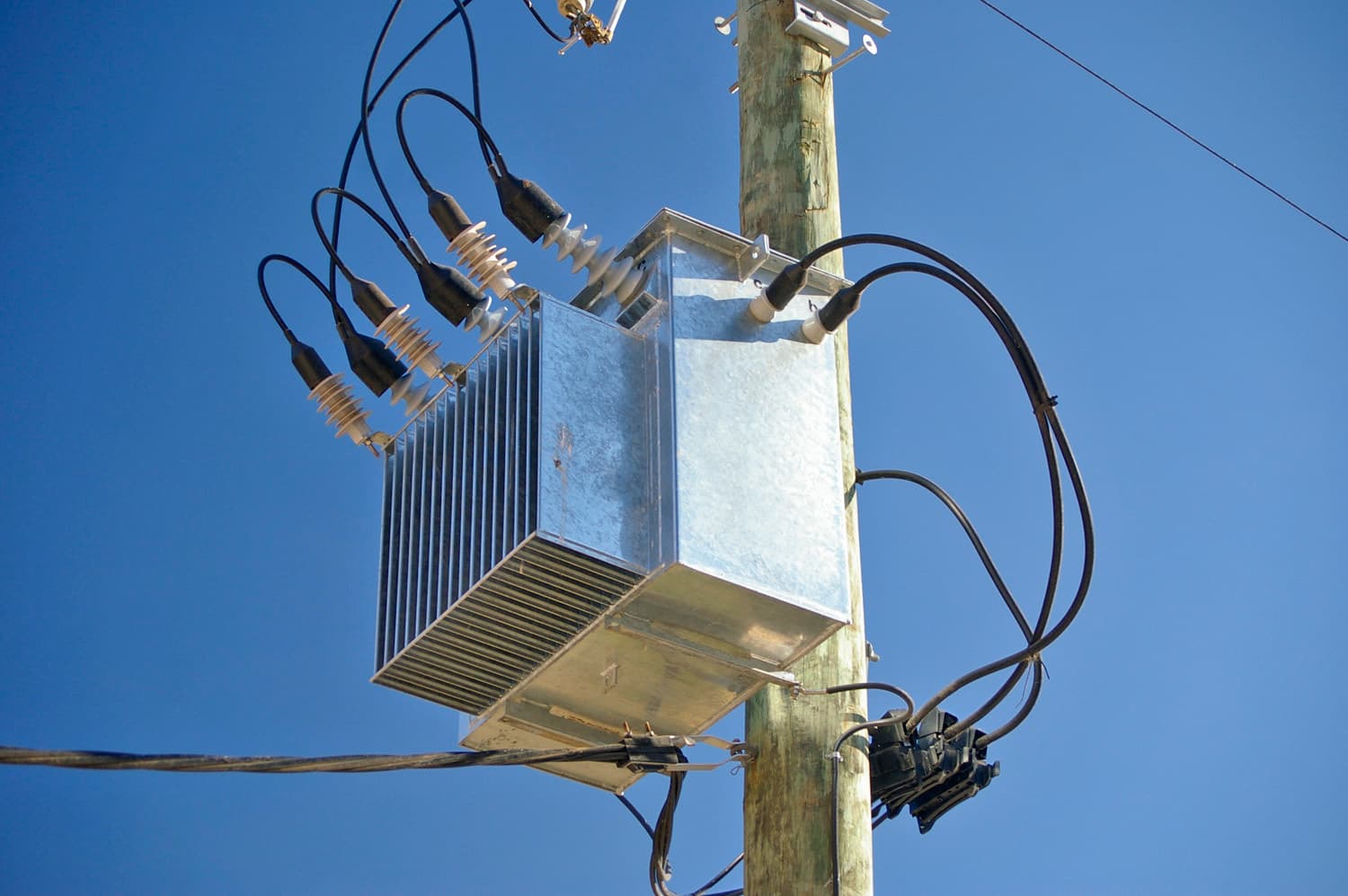
The header photograph is "Pole mounted Transformer" by Bidgee on Wikimedia Commons, used under CC BY 3.0. It shows a three-phase pole-mounted distribution transformer of the type used in Australia — the piece of equipment this article is about.
FAQs
Will EV charging cause blackouts in Australia?
Not at the national level on current projections. The Electric Vehicle Council estimates EVs will account for around 1 per cent of total grid peak demand by 2030 if uptake meets government targets and charging behaviour stays as it is. The more credible risk is local: clusters of EVs on the same low-voltage transformer, charging in the same evening window, in suburbs where uptake runs ahead of the average.
How much load does an electric car add to the grid?
Studies informing AEMO's forecasting put the peak-time contribution at up to 2 kW per vehicle. The figure that matters is not the average across a state but the coincident load on one local transformer, where several cars charging at once on the same phase can exceed the headroom that asset was built with.
Do I need to upgrade my home's wiring for an EV charger?
Often, yes. The Electric Vehicle Council found 67 per cent of Australian EV owners had not upgraded their home electrical system, and more than half charge from an ordinary power point rather than dedicated equipment. Installing a 32-amp charger frequently triggers a determination that the property's connection to the network needs upgrading, at the owner's cost.
Did Australia have fuel efficiency standards before the NVES?
No mandatory ones. Voluntary fuel-economy targets were set for new petrol cars in 1978 and were not achieved. Australia remained one of the last developed economies without a binding standard until the New Vehicle Efficiency Standard took effect on 1 January 2025.
What does the New Vehicle Efficiency Standard actually require?
It sets a fleet-average CO2 limit for each vehicle importer — 141 g/km for passenger vehicles in 2025, falling to 58 g/km by 2029 — with a penalty of $100 per gram over target, per vehicle. Importers below their target earn credits, which can be sold to those above it.