Most of a used-car inspection is the same whatever drives the wheels — our used car inspection checklist still applies. This guide covers what is different, and there is more of it than people expect.
The two checks that catch the most expensive surprises: get the battery state of health in writing, and confirm the battery warranty's servicing conditions have been met. Several manufacturers extend battery cover only if the car was serviced to their schedule — miss one and the extension is gone, and that is not something you can fix after you buy.
Battery state of health
State of health (SoH) is the battery's current usable capacity against its original capacity. It is the closest thing a used EV has to an odometer for the expensive part.
How to get it:
- The car's own display, on models that show it.
- An OBD2 dongle and a model-specific app — Leaf Spy for the Nissan Leaf, OBD Fusion for the Ioniq 5/6 and EV6, Scan My Tesla, CanZE for the Zoe.
- An independent certificate. This is now genuinely available in Australia. RedBook Inspect added an AVILOO battery test to its mobile pre-purchase inspection in October 2025 (inspections from $295, battery test as a checkout add-on, in NSW, Victoria, Queensland and WA), reporting state of health, charging behaviour and high-voltage battery history benchmarked against similar cars. Manheim now issues AVILOO state-of-health certificates at its Melbourne, Sydney and Brisbane auctions. The NRMA offers member-discounted battery health checks, and mycar offers a report under the name Voltest.
Ask for a certificate rather than a dashboard screenshot. It is worth knowing that certified cars sell better too: Pickles reported EVs sold with a battery health certificate achieved an average price uplift of about 6%, with more bidders and more bids per vehicle.
One caveat worth knowing: the SoH a car reports comes from the manufacturer's own algorithm and can differ from the battery's actual condition in either direction. An independent test that reads individual cell voltages sees things the dashboard does not — a large spread between cells is a warning sign the headline number can hide.
As a rough frame, above 90% is excellent, 80–90% is normal at three to five years, and below 75% is significant. Treat those as rules of thumb rather than standards.
Ask about charging history
This is the check nobody thinks to make, and the data behind it is strong. Geotab's analysis of more than 22,700 EVs found that cars charged mostly at low power degrade about 1.5% a year, projecting to 88% capacity at eight years — while cars frequently using high-power DC fast charging above 100 kW degrade about 3.0% a year, projecting to 76%.
So an ex-rideshare or ex-fleet EV that lived on DC fast chargers is a materially different car from a home-charged private example of the same age and odometer. Ask, and weigh the answer.
Geotab also found hot climates add about 0.4% a year of degradation, which is directly relevant here.
Check the connector — this now has a deadline
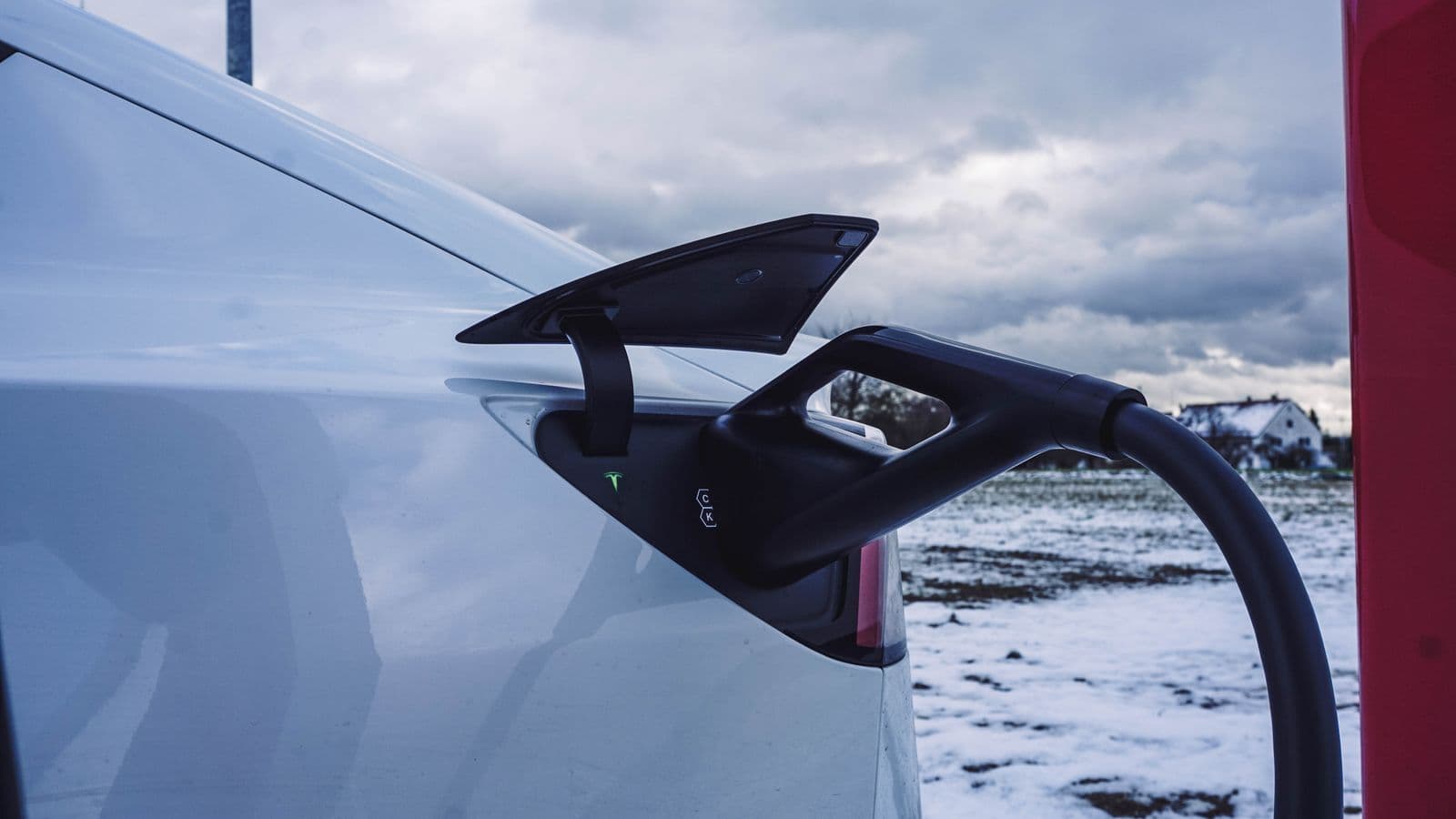
Australia uses Type 2 for AC charging and CCS2 for DC fast charging. A third standard, CHAdeMO, is on the way out.
In May 2026 the NRMA announced it will phase CHAdeMO plugs out at selected sites — starting with the busiest locations that see the least CHAdeMO use — converting those units to dual CCS2, on the grounds that the plugs are severely under-utilised and that on many older dual-plug chargers a CHAdeMO session blocks the paired CCS2 plug. The NRMA says CHAdeMO is not being switched off everywhere at once, but that it will get harder to find as older chargers are replaced. The cars affected are exactly the ones a used buyer encounters: older Nissan Leaf and Mitsubishi i-MiEV, plus the Mitsubishi Outlander PHEV, Eclipse Cross PHEV and Lexus UX 300e.
Adapters exist, but the NRMA's own guidance is that compatibility varies by vehicle, charger and adapter, and to check with all three before relying on one. If you are considering a CHAdeMO car, factor in a shrinking public network.
Confirm the cables are with the car
Public DC fast chargers have their cable attached. Public AC chargers usually do not — so you need to bring your own Type 2 cable, and the Government recommends at least five metres. A used EV sold without its Type 2 cable cannot use most public AC charging until you buy one.
Check for both: the portable "granny" cable that plugs into a normal power point, and a Type 2 to Type 2 lead.
Read the battery warranty's conditions, not just its length
Battery warranties generally follow the car rather than the owner, but the servicing conditions are where used buyers get caught.
- Toyota — hybrid, plug-in hybrid and battery electric traction battery cover is five years standard, extended to ten years only if an annual battery health check plus routine logbook maintenance is done at Toyota. For a used Toyota hybrid, evidence of that annual check every year is the most valuable document in the folder. ⚠ Read what that cover is: Toyota’s own disclaimer says it excludes traction battery capacity degradation, which is handled separately, and excludes vehicles used commercially — taxis, hire cars and rideshare.
- Hyundai — high-voltage battery 8 years / 160,000 km, and Hyundai states plainly that the balance of warranty transfers to the new owner. The separate extension of the vehicle warranty to seven years requires all scheduled services at an authorised dealer.
- MG — ⚠ which figures apply depends on when the car was first registered, which matters more on a used car than the headline number does. Registered from 1 July 2025: high-voltage battery 7 years / 150,000 km, separate from the vehicle warranty of 7 years unlimited km (extendable to 10 years / 250,000 km with exclusive authorised-dealer servicing, each service within 30 days and 2,000 km of the interval). Retailed 1 August 2024 — 30 June 2025: a 10-year / 250,000 km warranty applies, which MG stated covers the high-voltage battery. Retailed on or before 31 July 2024: 7 years / unlimited km. Check the car’s first-registration date against MG’s own warranty page before assuming any figure.
- BYD — traction battery 8 years / 160,000 km, vehicle warranty 6 years / 150,000 km.
Ask for the service history, and check it against the brand's own conditions rather than the seller's summary.
The 12V battery
An EV still has an ordinary 12V battery running the locks, infotainment and the computer that wakes the high-voltage pack. When it fails the car can be completely immobilised — will not unlock, will not wake, will not drive — with a full traction battery. Cars that have sat can kill one in two to three years. Note that Toyota, Hyundai and MG all warrant it separately for around two years, which tells you it is treated as a consumable.
Brakes, tyres and the spare
Regenerative braking means the friction brakes do less work, which extends pad and disc life but introduces a different problem: discs that corrode from underuse. The Government's guidance is that the braking system still needs regular inspection, calipers need cleaning and lubricating, and brake fluid still needs replacing. Look at the disc faces.
EVs are heavier and deliver torque instantly, which places extra strain on tyres, and may specify EV-specific tyres. Even unworn, tyres should generally be replaced every five to six years.
And check for a spare. Most EVs sold in Australia, including Tesla and BYD, carry no spare — just a repair kit that is no help for sidewall damage. A minority carry a space-saver (Kona Electric, Leaf, UX 300e among them).
Software and the previous owner's account
Not every EV gets over-the-air updates; some need a dealer visit. Older Tesla Model S and X with the first-generation media computer (2012 to early 2018) are prone to eMMC failure and slow down over time — resolved from March 2018.
Separately, confirm the seller has unlinked the car from their connected-services account. On a Tesla the seller should transfer ownership in the app; a buyer can also claim the VIN with proof of ownership. Kia Connect users report "this vehicle is linked to another account" when registering a used VIN, fixed by the previous owner deactivating it or by contacting support. Get this done before money changes hands.
The two checks every used buyer should run
- Recalls — free. Search the vehicle at vehiclerecalls.gov.au (opens in a new tab), run by the federal transport department. Recall rectification is free of charge. Note the site's own standing warning about people impersonating dealership staff offering to collect vehicles for outstanding recalls.
- Money owing, stolen or written off — $2. A PPSR (opens in a new tab) search by VIN. Our scams guide explains why this one is not optional.
Known Australian recalls worth searching for specifically: Hyundai Kona Electric and Ioniq Electric (a 2021 cell recall and a 2026 battery-management software recall), several Tesla Model 3 and Model Y campaigns, a BYD Atto 3 seat and airbag-switch recall — note that BYD's China-market fire-risk recall did not apply to Australian-delivered cars — and a large Toyota hybrid instrument-cluster recall.
If it is a plug-in hybrid
Everything above applies, plus one thing: a PHEV that its previous owner rarely plugged in has spent its life as a heavy conventional hybrid, and its advertised economy figure means very little. Ask, and read our PHEV guide before you commit.