
Europe's "2035 combustion ban" was never a ban on driving a petrol car. It is a law that says every new car and van sold in the EU from 2035 must emit zero CO2 from its tailpipe. That law is now being rewritten. In December 2025 the European Commission proposed cutting the 2035 target from a 100 per cent reduction to 90 per cent (opens in a new tab), and on 22 October two European Parliament committees backed a version that goes further again, according to electrive (opens in a new tab).
None of it is law yet. The full Parliament and the 27 member states still have to agree a final text. But the direction is clear: the world's most ambitious car-emissions rulebook is making room for hybrids, plug-in hybrids and some combustion cars after 2035.
Why should an Australian buying a Corolla Hybrid or a used HiLux care? Because Europe's rules shape the global product plans that decide which cars get built, our own New Vehicle Efficiency Standard (NVES) is due for its first review, and the federal Coalition has promised to scrap it. Here is what Europe is changing, why, the best argument against it, and what it means for buyers and sellers here.
At a glance
- Current EU law
- 100% CO2 cut for new cars and vans from 2035, against 2021 levels
- Commission proposal
- 90% cut, announced 16 December 2025
- Parliament committees, 22 October
- Backed a softer draft, per electrive
- Still to come
- Parliament plenary and a Council position
- Australia
- NVES fleet targets to 2029; first review expected late 2026
What the 2035 rule says, and what Brussels wants to change
The rule lives in Regulation (EU) 2019/631. After its 2023 revision it requires a 55 per cent cut in average CO2 from new cars by 2030 and a 100 per cent cut by 2035, both measured against 2021, which in practice means every new light vehicle registered from 2035 must be zero-emission (opens in a new tab), the European Parliament's own research service explains.
The Commission's proposal, COM(2025)995 of 16 December 2025, changes that in several ways, according to the same briefing:
- 2035 target: a 90 per cent cut for cars and vans instead of 100 per cent.
- Vans in 2030: a 40 per cent cut instead of 50 per cent. The 2030 car target stays at 55 per cent.
- Paying back the last 10 per cent: carmakers would offset the remaining emissions with credits for sustainable renewable fuels (capped at 3 per cent) and for low-carbon steel made in the EU (capped at 7 per cent).
- Averaging: compliance for 2030 to 2032 would be judged over three years rather than year by year.
- Small EVs: small zero-emission cars built in the EU would count as 1.3 cars until 2034, a "super-credit" meant to encourage affordable European EVs.
- Reviews: every five years from 2035.
The Commission framed it as keeping the destination while widening the road. Its release said the change would let plug-in hybrids, range extenders, mild hybrids and combustion-engine cars keep a role after 2035, as reported by Balkan Green Energy News (opens in a new tab). (A range extender is an electric car carrying a small petrol engine that only charges the battery.)
The relief Europe already granted
This is the second softening, not the first. Under the existing law, a 15 per cent cut applied from 2025 and manufacturers faced penalties for missing it year by year. In April 2025 the Commission proposed letting carmakers average their 2025, 2026 and 2027 results instead, and Parliament and Council passed it under the urgent procedure as Regulation (EU) 2025/1214 in June 2025 (opens in a new tab). The new proposal repeats that trick for 2030 to 2032.
Where the vote stands in late October 2026
Member states are split. A Council progress report dated 15 June says positions on the 2035 target "diverge widely" (opens in a new tab). Some governments back 90 per cent with the compensation attached; some will accept 90 per cent only if it is unconditional or only partly compensated; some want lower targets still; and others want to keep 100 per cent, citing the EU's climate law. A number of delegations want "zero-emission vehicle" redefined to include cars running only on carbon-neutral fuels.
The pressure has come from big car-making countries. Germany and Italy wrote to the Commission on 7 October 2025 asking that highly efficient combustion engines stay eligible after 2035, and on 5 December 2025 Bulgaria, Czechia, Hungary, Italy, Poland and Slovakia asked for hybrids, including ones running on renewable fuels, to be allowed beyond the deadline, the Parliament briefing records (opens in a new tab).
In Parliament, the Industry committee voted 49 to 27 with five abstentions and the Transport committee 27 to 18 with one abstention on 22 October, electrive reported (opens in a new tab). The draft backed by the centre-right, social democrat and liberal groups sets a base cut of 95 per cent, which can fall by up to 7.5 percentage points if carmakers use European low-carbon steel, so the weakest outcome is an 87.5 per cent cut. The Environment committee votes in early November, a plenary vote is likely in December, and the Council then needs a qualified majority. The same report says, citing Der Spiegel, that German chancellor Friedrich Merz and French president Emmanuel Macron have agreed to back a 90 per cent target without compensation.
We could not find a European Parliament press release on the committee votes, and other outlets have described the compromise differently, so treat the exact percentages as provisional until a final text is published.

Why Europe blinked
The official reason is demand. The Parliament's researchers point to the higher upfront cost of electric cars and worries about their resale values, and note that the electric share of new cars and vans fell from 15 per cent in 2023 to 14 per cent in 2024 (opens in a new tab), raising the risk that carmakers would miss targets and pay heavy penalties. Under the proposal, the penalty formula still charges €95 for every gram over target, multiplied by every car sold.
The market has moved since. In the first nine months of 2026, battery electric cars took 22.7 per cent of new EU registrations (opens in a new tab), up from 16.1 per cent a year earlier, according to the European carmakers' association ACEA. But the most popular choice was a hybrid, at 36.3 per cent, and petrol and diesel together still held 28.2 per cent.
- 36.3%
- Hybrid share of EU new cars, Jan-Sep 2026
- 22.7%
- Battery EV share
- 10.1%
- Plug-in hybrid share
- 28.2%
- Petrol and diesel combined
Carmakers have also been hedging out loud. In May 2024, Subaru, Toyota and Mazda jointly announced new engines for the electrification era (opens in a new tab), designed to work with motors and batteries and to run on e-fuels, biofuels and liquid hydrogen. Mazda's chief executive Masahiro Moro said the company would "continue to offer customers exciting cars by honing internal combustion engines for the electrification era". BMW's chief executive Oliver Zipse told Automobilwoche the 2035 ban "curtails successful technologies" and that technological openness is "the key to Europe's competitiveness", as translated by electrive (opens in a new tab). In fairness to Zipse, the same interview rejected postponing the 2025 targets.
The strongest case against the retreat
The best argument against Europe's change deserves to be stated properly.
The environmental group Transport & Environment estimates that a 90 per cent target would cut the share of battery EVs by 15 per cent, that three-year averaging for 2030 to 2032 would lower the battery EV share from 57 to 47 per cent, and that cars would emit 10 per cent more CO2 between 2025 and 2050 than under the current rules, the Parliament briefing reports (opens in a new tab). European consumer group BEUC warns the flexibilities could divert investment from affordable battery cars to plug-in hybrids and biofuels. Even the Commission's own Regulatory Scrutiny Board gave its impact assessment only a positive opinion "with reservations", finding the cost-benefit analysis incomplete.
Then there is China. The Council's own report frames the debate against a European industry facing "overcapacity and increasing global competition". The EU already applies countervailing duties of 17.0 to 35.3 per cent (opens in a new tab) on battery cars imported from China, in force for five years from 30 October 2024. The worry is simple: if European makers slow down on EVs, Chinese makers keep improving and take the market anyway.
Our answer, and this is our view, comes in three parts. First, 90 per cent is still a very steep target. Under the Commission's version the last 10 per cent must be paid back with fuel and steel credits; it is not a free pass. Second, a mandate that runs ahead of what buyers want and what the charging network can deliver doesn't produce cleaner air, it produces penalties, emergency averaging and fines that buyers end up paying for. Europe has now changed the rule twice in two years, which tells you the original timeline was set by ambition rather than by the market. Third, Europe's own Parliament has asked for emissions to be judged over a car's whole life, not just at the tailpipe, and manufacturers have been able to report life-cycle emissions voluntarily since June 2026 (opens in a new tab). We think that is the right yardstick, and on it a well-built hybrid run for 20 years looks a lot better than the tailpipe-only scorecard suggests.
As for China, tariffs and a slower mandate are both admissions that the race can't be won by decree. The cure for Chinese competition is cars Europeans want to buy at prices they can pay.
Australia's version: a fleet average with a review due
Australia never adopted a phase-out date. The NVES, in force since 2025, is a fleet-average CO2 target that tightens each year. For Type 1 vehicles (cars and SUVs), the headline limit falls from 141 grams per kilometre in 2025 to 58 in 2029 (opens in a new tab); for Type 2 (utes, vans and heavy off-roaders) it falls from 210 to 110. Each car's target is adjusted for its weight.
In the first half-year of results, 40 of 59 suppliers beat their targets and 12 per cent of covered vehicles were zero-emission (opens in a new tab). The regulator says the standard "will not stop you from buying a ute or four-wheel drive" (opens in a new tab).
Two political clocks are now running. The industry body FCAI expects the first major review to begin in the final quarter of 2026 (opens in a new tab), looking at availability, affordability and consumer choice. And on 23 September, shadow energy minister Dan Tehan said a Coalition government would introduce a bill repealing the NVES Act (opens in a new tab) within 30 days of taking office. We covered what repeal would and wouldn't change in our piece on the Coalition's pledge (opens in a new tab).
| Feature | European Union | Australia |
|---|---|---|
| Type of rule | Fleet CO2 target with a 2035 end-point | Fleet CO2 target, set to 2029 |
| Combustion cars after the end-point | Allowed under the proposal, within a 90% cut | No phase-out date |
| Credit for renewable fuels | Proposed, capped at 3% | None that we could find |
| Multi-year averaging | 2025-27 granted; 2030-32 proposed | Surplus units carried into later years |
| Where it stands | Parliament plenary and Council pending | Review expected late 2026; repeal pledged by Coalition |
What Australia can learn from Europe
Europe is the cautionary tale and the useful test case at once. Here is what we'd take from it.
Set targets the country can actually carry. Europe locked in 100 per cent in 2023 and has had to soften it twice since. The lesson isn't that targets are bad; it's that a target which ignores buyers, prices and infrastructure gets rewritten, and the uncertainty costs everyone. Australia's review should test the 2027 to 2029 steps against real sales and real charging coverage, not projections.
Remember our geography. Our population is spread thin and many drivers cover long country distances. The fuel network already reaches those towns; charging is patchier the further you get from a capital city. Fuel itself already costs more in the bush, as our look at regional versus city fuel prices (opens in a new tab) found, and a rule that pushes regional buyers into cars their towns can't easily support would add to that. That is our view, but it is the same "differences between member states, including as regards the uptake of electric vehicles and roll out of infrastructure" that Europe's own Council papers (opens in a new tab) flag.
Measure the whole life of the car. Europe is moving towards life-cycle reporting. A rule built only on tailpipe numbers rewards the wrong things. Our review could at least ask for life-cycle data.
Give low-carbon fuels a seat at the table. Europe proposes a small, capped credit for renewable fuels. Whatever you think of e-fuels, that keeps an existing fleet and fuel network in the conversation instead of writing them off.
Look after small makers. Britain has just finished its own consultation on its zero-emission vehicle mandate, which closed on 23 October (opens in a new tab). We argued for a small-maker carve-out here after the first NVES results showed low-volume sports cars carrying the heaviest per-car bill (opens in a new tab).
Will petrol and hybrid cars disappear from Australian showrooms?
Not on the evidence so far. If Europe settles anywhere between 87.5 and 95 per cent, hybrids, plug-in hybrids and range extenders keep a legal market there after 2035, and Toyota, Mazda and Subaru are already developing engines for that world. That matters to us because our new cars are built overseas to global plans. In September, 35.5 per cent came from China, 22.5 per cent from Japan, 17.3 per cent from Thailand and 9.6 per cent from South Korea (opens in a new tab), according to the FCAI. Those four countries supplied about 85 per cent of the market between them.
The mix is shifting fast, though. In the same month battery EVs took 24.2 per cent of new sales here, plug-in hybrid sales rose 122.7 per cent and hybrids 20.7 per cent on a year earlier, while petrol sales fell 36.2 per cent and diesel 18.4 per cent. Our reading: the plain petrol car is being squeezed by hybrids more than by EVs, and Europe's retreat makes it more likely, not less, that the hybrid stays in the global catalogue for a long time.

What it means if you're buying or selling
Should you buy a new petrol car now? If it suits your driving, yes. Nothing in Europe's change, or in the NVES, stops you buying or running a petrol car in Australia, and the European retreat suggests carmakers will keep engineering engines for years. What is shrinking is the cheap, simple petrol model, which is increasingly being replaced by a hybrid version of the same car. If a hybrid version exists and your driving is mostly urban, compare the drive-away prices and do the sums on fuel before deciding.
Will petrol resale crater? We see no sign of a collapse, but petrol and diesel cars have been discounted harder than hybrids this year. In the first half of 2026, petrol and diesel vehicles saw the sharpest increase in discounting (opens in a new tab) while hybrids "remained the most pricing-resilient fuel type", according to the Australian Automotive Dealer Association and AutoGrab. Expect a petrol car to keep depreciating normally, perhaps a little faster than a hybrid, rather than falling off a cliff.
Hybrid or EV? For most Australians who drive long distances, tow or live outside a capital city, a conventional hybrid is the low-risk middle road: no charging plan required, lower fuel bills, and strong resale. Model-year 2021 hybrids retained 88.2 per cent (opens in a new tab) of their original price on average in early 2026, according to AutoGrab's analysis for the AADA. An EV makes the most sense if you can charge at home, mostly drive in town and plan to keep it within its battery warranty.
What about the used market? The regulator itself points out that 70 per cent of Australians buy their cars second-hand (opens in a new tab). Today's new hybrids and petrol cars become tomorrow's used stock, and a softer global rulebook means parts and engines for them should remain in production for longer. That is good news for anyone who plans to keep a car for 10 years or more.
Don't panic-sell because of headlines about bans. Price it against current listings for the same model and year, have the service history ready, and point out fuel economy if it's a strong point. A well-kept, honestly described petrol car still sells. If you want to list it yourself, MotorLoop is where you can buy, sell & show cars, and it's free.
Our take
This is our view. Europe's retreat is a correction, not a collapse. The EU still wants a 90 per cent cut in new-car CO2 by 2035, which is a huge ask. What it has given up is the idea that one technology, mandated by one date, is the only way to get there.
We think that is the right call, and Australia should notice. The fuel network already exists, it is paid for and it already reaches country towns across Australia. Hybrids cut fuel use without asking anyone to rebuild their life around a charger. Simpler combustion cars can be fixed by the mechanic in the next town, and their parts are everywhere. A policy that leaves room for them is not anti-climate; it is realistic about how people actually buy, drive and keep cars.
We'd like the NVES review to learn from Brussels before it has to learn the same lesson the hard way: keep the targets honest, measure emissions over a car's whole life, give fuels and small makers a fair hearing, and set a pace that suits a big, spread-out country. Whether the scheme should exist at all is a question for voters. Whether it should be built for Australian conditions shouldn't be.
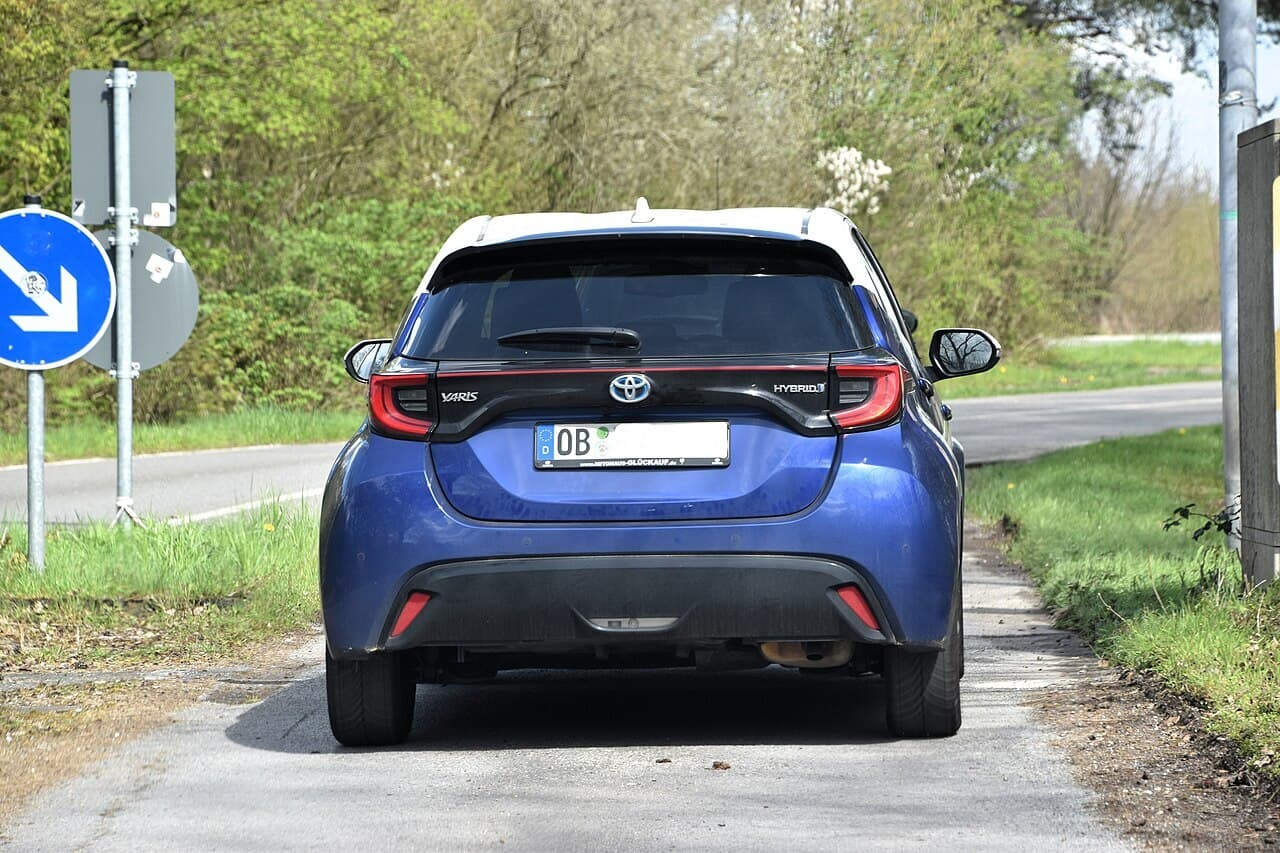
Header photo: Trougnouf (Benoit Brummer) (opens in a new tab) via Wikimedia Commons, CC BY 4.0 (opens in a new tab).
Related
- Coalition vows to scrap the NVES. What repeal would and wouldn't change for car buyers (opens in a new tab)
- Australia's emissions rules bill a Ferrari about $7,300 a car. Britain is easing its own (opens in a new tab)
- Used car market, spring 2026: buyers still have room, but stock is tightening (opens in a new tab)
- Regional vs city fuel prices: why the bush pays more, and which towns pay the most (opens in a new tab)