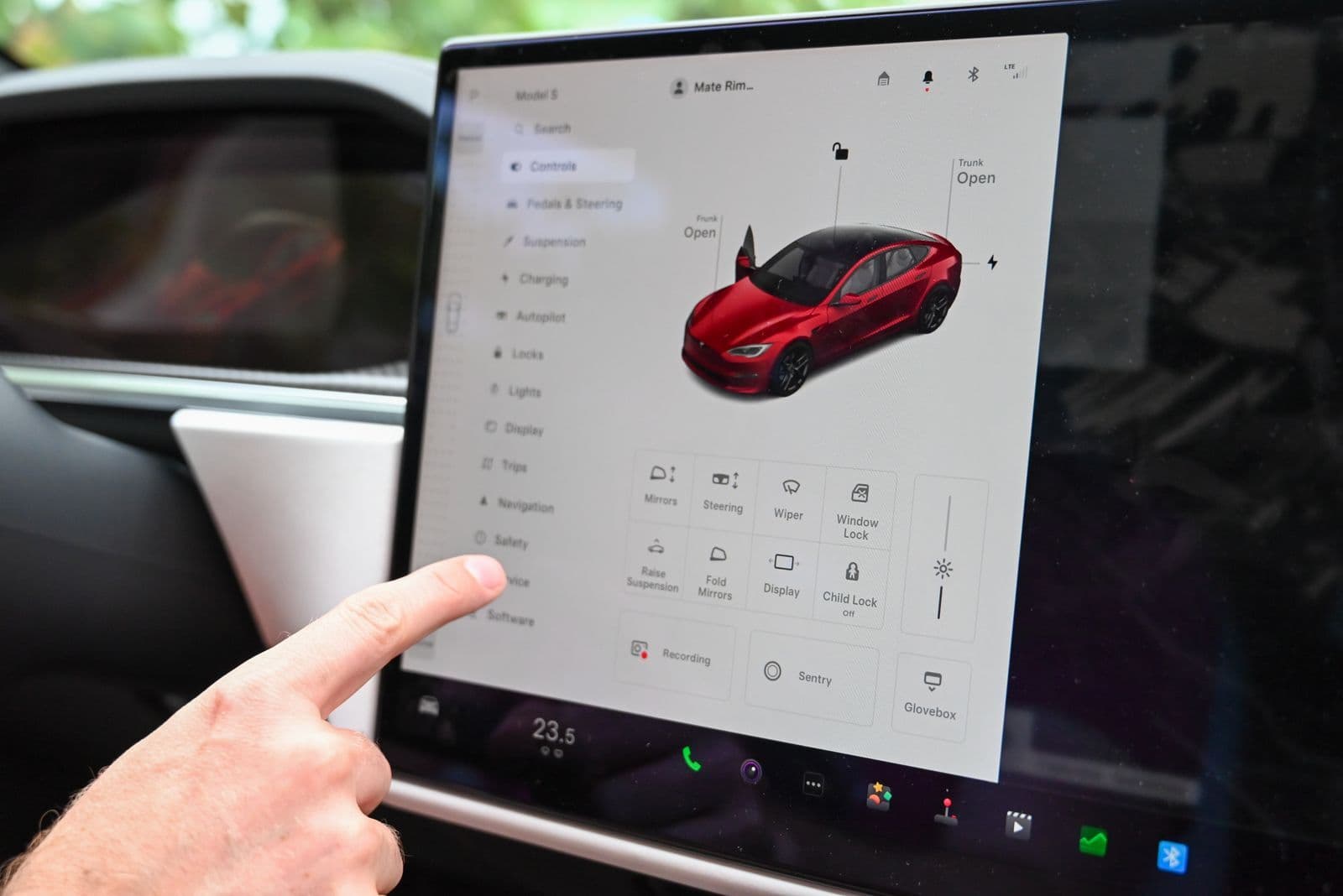
Somewhere along the way, carmakers decided a big screen was progress. The heater knob went, then the radio buttons, then the demister, and everything moved into a tablet stuck to the dashboard. We think it is a step backwards. A button you can find without looking is a safety feature, and the evidence says so.
- 10.0 s
- 2005 Volvo V70, four simple tasks at 110 km/h
- 44.9 s
- MG Marvel R, the same four tasks
- 1,437 m
- Distance the MG covered while the driver did them
The test that settled it for us
In 2022 the Swedish magazine Vi Bilägare took eleven new cars and a 17-year-old Volvo V70 to an airfield and timed drivers doing four ordinary jobs at 110 km/h: turn on the heated seat, raise the temperature two degrees and start the demister; turn on the radio and tune a station; reset the trip computer; dim the instruments and turn off the centre screen. Drivers had time to learn every car before the test.
The old Volvo, with its knobs and buttons, took 10.0 seconds, in which it travelled 306 metres. The slowest new car, the MG Marvel R, took 44.9 seconds and covered 1,437 metres. That is the best part of a kilometre and a half with the driver's attention on a screen instead of the road.
| Feature | Time (seconds) | Distance at 110 km/h |
|---|---|---|
| Volvo V70 (2005) | 10.0 | 306 m |
| Dacia Sandero | 13.5 | 432 m |
| Volvo C40 | 13.7 | 438 m |
| Tesla Model 3 | 23.5 | 752 m |
| Hyundai Ioniq 5 | 26.7 | 854 m |
| BMW iX | 30.4 | 973 m |
| MG Marvel R | 44.9 | 1,437 m |
Second place went to the budget Dacia Sandero, which keeps simple physical knobs for its heating and ventilation. It is a budget hatchback, and it beat a luxury electric BMW by 17 seconds.

Why buttons win
A physical control has a fixed place, a shape and a click. After a week in a car your hand finds the demister on its own, and your eyes never leave the road. A touchscreen has none of that. The target moves between menus, it has no edge to feel for, and a bump in the road puts your finger on the wrong thing. So you look. Every look is time spent driving blind.
Touchscreens are cheaper to build and easier to update than a dashboard full of switches, and they photograph beautifully in a showroom. None of those are reasons that help you when the windscreen fogs up on a wet night.
The safety rating agencies agree
This is no longer a matter of taste. Crash-test programmes now score it. Under ANCAP's 2026 protocols, carmakers are penalised for failing to provide physical buttons for the horn, indicators, hazard lights, windscreen wipers and headlights, or a permanently fixed area of the screen for them, with the new driving-control area worth five points and tactile controls rewarded. Euro NCAP has moved the same way.
When the people who rate a car's safety start marking it down for hiding the hazard lights in a menu, the argument is over.
The carmakers are backing down
Some manufacturers have already started bringing buttons back, Mercedes among them. We would like to see the rest follow, and not only for the five controls the safety ratings now require. Heating, demisting and volume deserve a knob too.
What to look for when you buy
- Try it on the test drive. Adjust the temperature, the fan and the demister at speed, on a safe road, without looking down for more than a glance. If you cannot, you will not manage it in the rain either.
- Count the buttons. Hazard lights, demister, volume and climate on physical controls are worth more to us than a bigger screen.
- Check the voice controls. Good voice control helps, but it is a backup, not a substitute for a switch you can find.
- Do not dismiss an older car. A well-kept car from before the screen took over can be easier and safer to live with every single day.
Header photo: Oq10pass, CC0, via Wikimedia Commons.
Related reading
- How to buy a used car in Australia
A step-by-step guide to buying a used car in Australia — setting a budget, searching smart, running a PPSR check, inspecting and test-driving, negotiating, and transferring the rego.
- Used car inspection checklist: what to look for
What to check when inspecting a used car in Australia — body and panels, engine, interior and electronics, tyres and brakes, the test drive and the paperwork — plus the red flags that mean walk away.