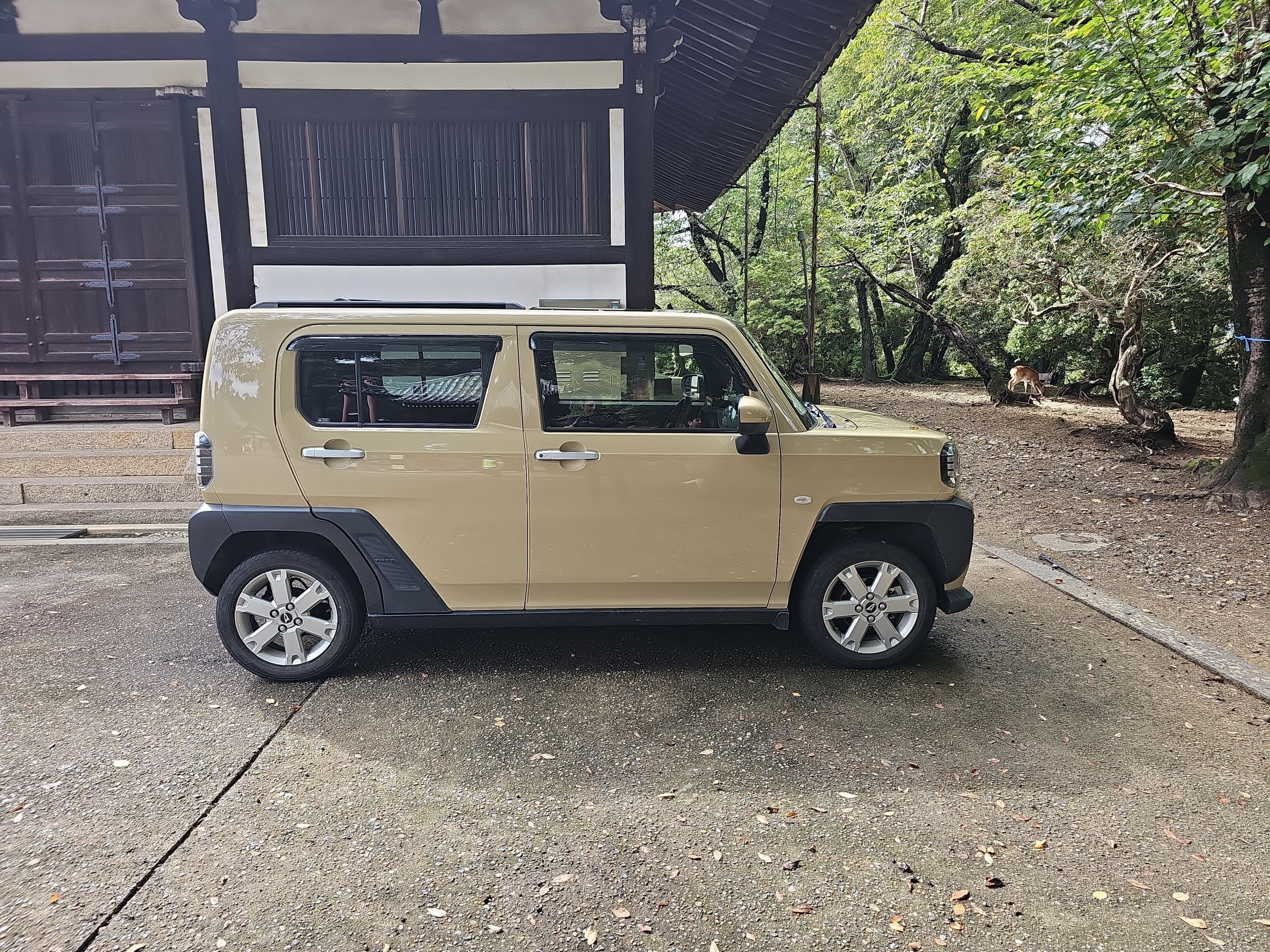
An opinion on compact homes, narrow roads, and vehicles that belong to the places they serve.
The small cars in Japan make much more sense to me when I stop looking at them as isolated objects and start looking at everything around them. A little car beside a little house, on a narrow street, with just enough space to park, does not look like a compromise. It looks like the right tool for the place. The proportions agree with each other. The vehicle belongs to the neighborhood rather than demanding that the neighborhood reorganize itself around the vehicle.
That is my basic opinion: many Japanese cars are small because much of the everyday environment they serve rewards smallness. Compact homes, limited plots, tight parking areas, and narrow local roads create an obvious reason to keep the vehicle manageable. There are other explanations, including vehicle classifications, ownership costs, and individual needs, but the physical relationship is what catches my attention first. Look at the house. Look at the street. Then look at the car. The logic is sitting there in plain sight.
Coming from a place where large cars are familiar, it is easy to see these vehicles as unusually tiny. Some almost remind me of carts. They carry people, shopping, equipment, and the materials of daily life within a modest footprint. I also think about horses and the vehicles of earlier periods: transport that occupied a scale closer to the person using it. This is a comparison of appearance and proportion, rather than a claim that a modern car has exactly the same dimensions as a historical cart or horse.
What interests me is the continuity of a simple question. How much space does someone actually need to move themselves and their belongings through a neighborhood? Japan’s smallest cars give an answer that feels refreshingly practical. They suggest that the appropriate size of a vehicle should depend on its surroundings and purpose, rather than on an assumption that more metal is automatically better.
The house and the car are part of the same decision
I find it difficult to separate the size of a car from the place where its owner keeps it. A vehicle has to live somewhere when it is not moving. It needs room beside a house, beneath a building, in a rented parking space, or inside a garage. Its width affects whether the doors open comfortably. Its length affects whether it fits without sticking into another area. Even before someone starts the engine, size has already become an everyday issue.
Where a home sits on a compact plot, the parking area may be one of the most unforgiving pieces of the property. There is no mystery about the attraction of a shorter, narrower car in that setting. A vehicle that fits neatly can leave a little more room for walking past, bringing in bags, storing a bicycle, or reaching the front door. Those sound like minor details until they become things someone has to negotiate every morning and evening.
That is why I think the phrase “small houses, small cars” captures something useful, even though it needs qualification. Homes across Japan differ enormously. Apartments, suburban houses, rural properties, and expensive urban homes cannot be reduced to a single size. The point is that in dense neighborhoods where living space and land are constrained, a compact vehicle can make an already tight arrangement work better. The car and the home are connected through the space between them.
A larger car can be desirable for many perfectly sensible reasons. Someone might need more seats, more luggage room, or a vehicle suited to frequent long journeys. But those advantages do not erase the practical challenge of storing it. If a car makes every arrival home feel like a precision exercise, its appeal has a daily cost. I like the idea of choosing something that feels comfortable in its own parking space, with enough room left over for the human activity around it.
There is also a visual relationship. A compact vehicle parked beside a modest house can look balanced. A much larger vehicle in the same space may dominate the entrance and become the main thing a passerby sees. This is an aesthetic judgment, and people will disagree about it. To my eye, though, a car should contribute to the life of a home without swallowing the view of it.
A narrow road changes what counts as convenient
The same logic becomes even clearer on a narrow street. Vehicle size is no longer just a measurement in a brochure. It becomes the difference between a relaxed turn and a careful correction, between passing smoothly and having to wait, between feeling that there is room and feeling that every edge is close. A narrow vehicle can reduce the amount of mental calculation needed for an ordinary journey.
Think about the last stretch before reaching home. The main road might be wide and straightforward, but the local approach may involve a tight corner, a short lane, or a meeting with another vehicle where there is little spare room. A driver buys a car for the entire journey, including that final stretch. A vehicle that performs beautifully on an open road still has to negotiate the part where the surroundings are least generous.
That is where small cars begin to look like intelligent choices rather than reduced versions of something else. They can be easier to position. Their corners may be easier to judge. A shorter body can help with turning into restricted spaces. None of this makes every small car equally maneuverable, because visibility, steering, and design also matter. But a smaller physical footprint gives the driver a useful starting advantage when the available space is limited.
The road also belongs to people outside cars. Someone may be walking home with shopping, riding a bicycle, delivering a parcel, or stopping at a doorway. I appreciate vehicles that leave a little more room for those activities. A car’s dimensions affect the experience of everyone around it, even when the driver is considerate. Width is a shared-space issue as well as a personal convenience.
My view is that the most successful neighborhood vehicle is often the one that makes ordinary movement feel less complicated. It does not need to look powerful while waiting at a corner. It needs to get around the corner without making the whole street stop and reorganize. There is a quiet competence in that. The small car may attract less admiration in a showroom, yet it can make much more sense at the exact place where someone uses it.
Kei cars turn smallness into a design brief
The clearest example is the kei car, Japan’s regulated light-vehicle category. According to the Kei Motor Vehicle Inspection Organization, the current dimensional limits are 3.4 meters in length, 1.48 meters in width, and 2 meters in height, with an engine-displacement limit of 660 cc for combustion-engine vehicles in the category. Those measurements help explain why many kei vehicles have such a distinctive presence on the street. Their size is an intentional design boundary. Kei Motor Vehicle Inspection Organization (opens in a new tab)
Within that boundary, designers still have to solve ordinary problems. People need seats, useful storage, visibility, comfortable access, and somewhere to put everyday belongings. A small vehicle cannot simply shrink every part of a larger one and expect the result to work. It has to use its limited space thoughtfully. That is one reason the tall, upright shapes of many compact Japanese vehicles appeal to me: they seem to take the available volume seriously.
Their boxiness can look almost comic if someone expects every car to suggest speed. I see it differently. A practical shape says that the vehicle has a job to do. The roof does not need to slope dramatically if that would sacrifice useful room. The body does not need a long nose just to make an impression. There is something pleasing about a design that lets usefulness influence its appearance so openly.
The category also reminds us that these cars are road vehicles, with responsibilities and constraints that differ from those of carts. My cart comparison is about scale and everyday service. A kei car still involves automotive engineering, braking, occupant protection, maintenance, and licensing. Calling one cartlike should express how compact and purposeful it looks, rather than imply that it is a toy or that its design is simple.
I think smallness becomes interesting when it is treated as a challenge worth solving well. How can a limited footprint accommodate a household’s routine? How can a vehicle remain approachable to drive and useful to load? Those questions deserve as much respect as questions about maximum power. They belong to a form of automotive creativity that is easy to overlook when attention stays fixed on larger, faster, more expensive machines.
Ownership involves more than buying the vehicle
The environment is central to my argument, but it is not the whole explanation. Vehicle ownership also means recurring costs and practical obligations. Taxes, insurance, fuel, inspections, repairs, parking, and purchase price all enter the calculation. Japan’s kei category has its own tax treatment; the inspection organization describes annual local kei-vehicle taxation and automobile weight tax among the relevant charges. Exact costs depend on the vehicle and circumstances. Kei-vehicle taxes (opens in a new tab)
I would be cautious about treating every small car as automatically the cheapest option. The price of a vehicle, its condition, its equipment, and its use can change the calculation. A heavily equipped new compact car and an older conventional car may present very different tradeoffs. But I understand why someone might consider a vehicle’s modest size alongside its ownership costs. Both can reflect an effort to keep transport proportionate to everyday needs.
What matters to me is the difference between buying capacity and using capacity. A household may need a car mainly for short trips, shopping, appointments, and carrying a few people. If the vehicle is chosen around those recurring tasks, it can make sense to avoid paying for a size that rarely proves useful. There will always be exceptions, and families know their own needs better than an observer does. Still, I find the question worth asking.
The pleasure of a small car may therefore have little to do with horsepower. It can be the pleasure of an easy fit, a manageable routine, and a purchase that does not demand more space than the owner wants to give it. That kind of satisfaction is difficult to photograph dramatically. It happens when someone parks, closes the door, and walks into the house without needing another thought about the car.
Why the image of carts and horses stays with me
The historical comparison that comes to mind is transport at a scale people could understand physically. A horse, a handcart, or a small working cart occupied real space, carried a limited load, and moved within the conditions of the route. The route mattered. The load mattered. The size of the transport was tied to what it had to do. Looking at a compact Japanese vehicle can bring back that same sense of a machine proportioned around an ordinary task.
I do not mean that a horse and a kei car are interchangeable measurements. Horses vary in size, carts vary in shape, and combining a horse with a cart creates a much longer arrangement than the cart alone. The similarity I see is closer to a human scale of transport: something that serves local life without necessarily becoming the dominant object in the neighborhood. That image helps explain my reaction more honestly than a literal dimensional claim would.
Japan’s actual transport history also needs care. The Ministry of Land, Infrastructure, Transport and Tourism explains that travel on foot and horseback persisted for centuries and that horse-drawn carriages did not develop as extensively as they did in China and Europe. Its account of Edo street use also describes walking, palanquins, handcarts, horses, and ox carts. There was no single historical vehicle whose measurements can explain the shape of every modern Japanese road. Japan’s road history (opens in a new tab), Edo streets and transport (opens in a new tab)
That makes the historical picture more interesting to me. Movement involved people and goods adapting to different routes and means of transport. The modern compact car can be read as another response to the practical demands of moving through a place. That is my interpretation, rather than a documented straight line from an Edo handcart to a present-day vehicle. It preserves the useful part of the comparison without making history carry an argument it cannot prove.
I am drawn to the idea that modern convenience does not always require a dramatic increase in physical scale. A small van can do a contemporary job while retaining a modest relationship with its surroundings. It has an engine, lights, weather protection, and far more engineering than an old cart, but it can still look as though it has been designed to pass through the neighborhood rather than overpower it.
Small vehicles can have serious working lives
The cart analogy feels particularly appropriate when I think about working vehicles. A little truck or van is easy to underestimate from a distance. It may look charming or unusual to a visitor, but its usefulness comes from what it can carry and where it can go. For the person using it, the important questions may concern loading, access, reliability, and parking close enough to the job.
There is a difference between a vehicle that looks capable and one whose capabilities match its work. A larger truck may be essential for some loads. A smaller vehicle may be better suited to other jobs, especially when access is restricted and the load is manageable. I like being reminded that competence is specific. The right vehicle is the one that can complete the actual task efficiently, rather than the one that makes the largest visual promise.
Imagine an ordinary delivery to a narrow residential street. The vehicle has to arrive, stop somewhere appropriate, allow its contents to be removed, and leave again. Its size affects every stage. A modest footprint may help the driver get close to the destination and reduce the amount of space needed while unloading. That is a hypothetical example, but it illustrates why vehicle dimensions have practical value beyond the driver’s private comfort.
I also admire the lack of ceremony in these vehicles. Their appeal is often rooted in function. They are there to move something, help someone, or support a day’s work. The little proportions can make them look friendly, yet friendliness is only part of the story. They deserve to be taken seriously as tools. The scale that makes them visually distinctive may also be what makes them suitable for the work they perform.
The neighborhood matters more than the brochure
A brochure encourages us to imagine the car away from its most difficult surroundings. The photographs show an open road, a scenic viewpoint, or a perfectly arranged driveway. There is room for everything. The vehicle looks effortless. Real ownership is more specific: the route to the supermarket, the corner outside the house, the parking space near work, and the place where another car always seems to be approaching at the same time.
That is why I think Japanese compact cars can challenge the way people elsewhere talk about automotive aspiration. We are often encouraged to desire more space inside the vehicle without considering how much space it consumes outside. Both forms of space matter. An extra measure of interior room is useful only when its advantages are worth the consequences for parking, maneuvering, and the places the owner regularly visits.
The city does not become easier simply because a car feels comfortable from the driver’s seat. Every vehicle contributes its dimensions to the street. A thoughtful choice considers the owner’s needs alongside the physical setting. That does not mean everyone should drive the smallest car available. It means the surroundings deserve a place in the decision, especially where the neighborhood makes the costs of excess size obvious.
To me, this is a form of common sense that can disappear beneath marketing. A compact vehicle can be desirable because it makes the day work smoothly. It can be satisfying because it is easy to place, easy to live beside, and large enough for the jobs it actually does. There is no reason that satisfaction should rank below the satisfaction of owning a larger machine. They are different answers to different circumstances.
Japan cannot be reduced to one vehicle size
My opinion needs room for Japan’s variety. The country has large vehicles, broad roads, major expressways, substantial houses, and places where a bigger car is completely sensible. It also has sports cars, luxury cars, family vehicles, and commercial transport far beyond the kei category. A visitor who notices small cars has noticed an important feature of the landscape, but has not discovered a rule that explains every owner or every neighborhood.
There are differences between central urban districts, suburban streets, and rural areas. People travel different distances and carry different things. Household size, accessibility requirements, climate, hobbies, and work can all influence a vehicle choice. The relationship between a car and its environment is powerful precisely because environments differ. A suitable car in one place may be a frustrating car in another.
Even within a neighborhood, two households can make different reasonable decisions. One might prioritize compactness. Another might need additional passenger or cargo space. My preference for cars that fit neatly into the street should not become a judgment about strangers whose circumstances I do not know. I can admire small vehicles and still recognize that the ideal size depends on the life being lived around them.
The point I want to keep is narrower and more useful: where space is tight, smallness has real value. A little car beside a compact home on a narrow local road can represent a coherent arrangement. Its dimensions respond to the setting. That is the relationship I find convincing, and it remains convincing without pretending that all Japanese homes or streets look alike.
There is room for personality in a small footprint
Small practical vehicles do not have to be emotionally empty. Their proportions can be memorable. A tall little van, an upright hatchback, or a compact truck can have a character that a more conventional silhouette lacks. Some people may see awkwardness. I see a distinctive answer to a demanding problem, and that answer can become attractive in its own right.
I enjoy the honesty of a vehicle that looks like it has accepted its purpose. Its shape does not need to imitate a much larger machine to earn respect. It can make a virtue of clear windows, usable doors, straightforward access, and a body that occupies little space. Design can express confidence through precision and suitability as well as through dramatic width or an aggressive stance.
That is also why I resist treating compact vehicles only as evidence of sacrifice. A person may choose one because the tradeoff is welcome. Easier parking, a better fit beside the home, and less difficulty on local streets can feel like improvements. The owner is gaining convenience in exchange for capacity they may not require very often. From that perspective, the small vehicle can be the more generous choice for daily life.
The appeal extends to the look of the neighborhood. When vehicles remain proportionate to buildings and streets, I find it easier to appreciate the other details: entrances, plants, bicycles, shopfronts, and people moving between them. The car stays part of the scene. It does not automatically become the subject of every view. That visual balance is something I value, even though it is a personal response rather than a statistic.
A vehicle should fit the life around it
My opinion about Japan’s small cars ultimately comes back to the relationship between transport and place. Small homes and constrained plots can favor a small parking footprint. Narrow streets can reward a manageable width and length. Everyday errands can make usefulness more relevant than imposing proportions. These factors combine into an argument that is easy to see once attention moves beyond the car itself.
The resemblance to carts and horses remains a useful image for me because it keeps transport connected to the scale of everyday life. I use it as an analogy, with the historical differences acknowledged. I am interested in the idea of a vehicle serving a neighborhood on the neighborhood’s terms: carrying what is needed, passing where it needs to pass, and leaving enough room for everything else that happens there.
There is a kind of restraint in that arrangement, but restraint can be a source of freedom. A vehicle that fits can make arriving, leaving, loading, and parking feel easier. It can ask less of the space around the home. It can reduce the number of small problems the owner has to solve before and after every journey. Those are meaningful benefits, even if they never appear in a glamorous advertisement.
When I look at a small Japanese car, I therefore try to see more than its size. I see the house it may return to, the street it may use, and the ordinary tasks it may carry out. The little footprint begins to look purposeful. The car is compact because compactness can be useful, and in the right setting that usefulness is a quality worth wanting. For me, a car that fits its world has an appeal that sheer size cannot replace.
See Japan’s cars in the gallery
For a visual companion to this opinion, see the small-car photograph from Nara, Japan used at the top of this article. The compact car and its surroundings invite the same question about proportion: how much vehicle does this place need? You can also browse MotorLoop’s car photo gallery for more photographs shared by the community.