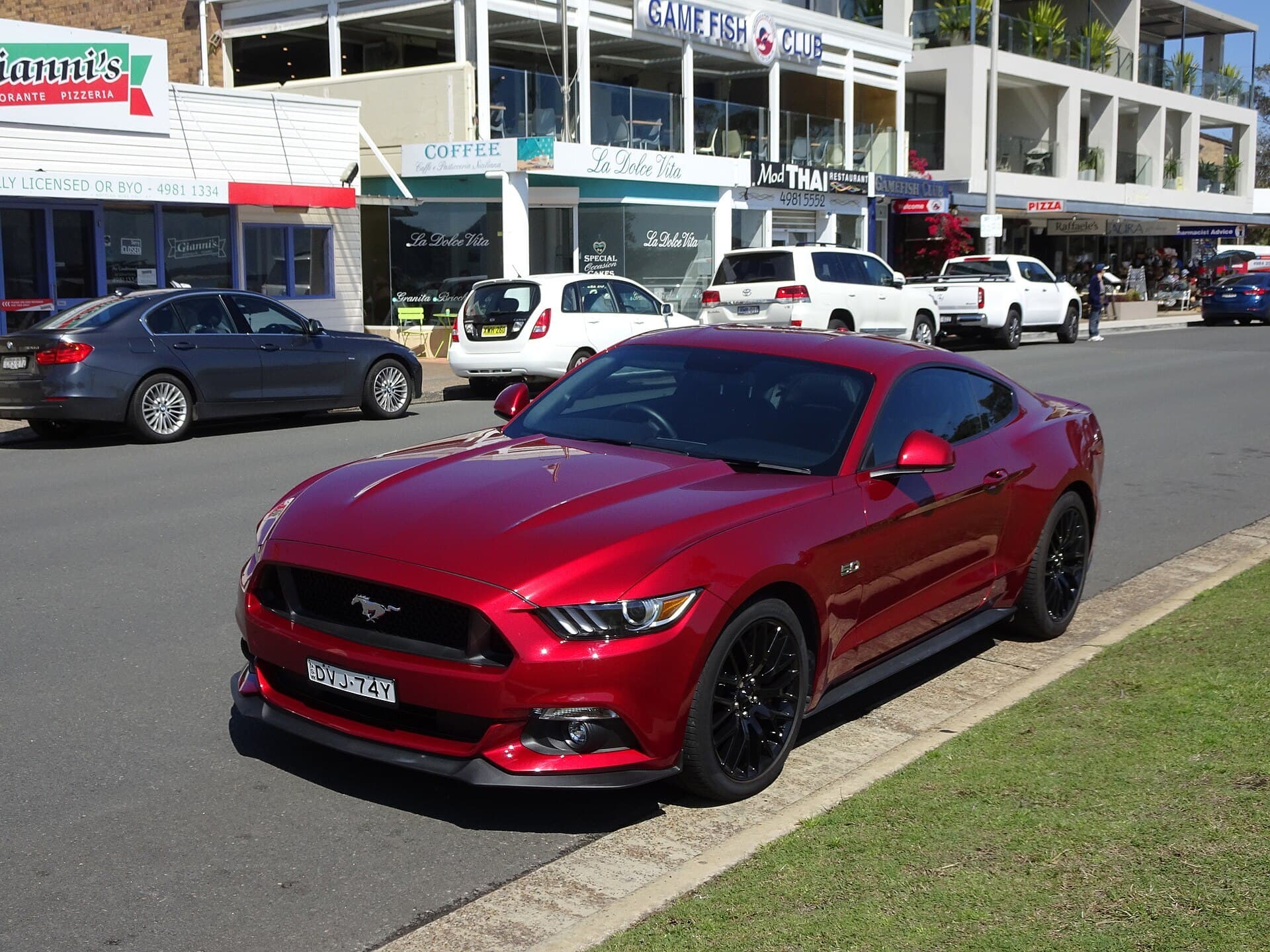
For half a century a Mustang in Australia was a rare sight. Ford Australia converted a small batch of left-hand-drive cars in the mid-1960s, specialists converted more over the decades, and then in December 2015 Ford finally put a factory right-hand-drive Mustang on sale here (opens in a new tab), ending what GoAuto called 60 years of left-hand-drive conversions. The first allocation of 4,000 cars sold out before a single right-hand-drive car had left the factory.
Australians then kept buying. Add up the yearly VFACTS figures in CarExpert's new-car sales database (opens in a new tab) and you get 40,483 new Mustangs from 2015 to the end of 2025, plus 1,748 more in 2026 so far. A car that used to stop conversations now sits beside you at the lights most weeks.
So does a common Mustang still mean anything? We think it does, just not what it meant in 2015. The exclusivity has gone. The experience of a big naturally aspirated V8, rear-wheel drive and, if you choose it, a six-speed manual hasn't gone anywhere. And for anyone buying or selling one second-hand, the sheer number of cars changes the maths.
The Mustang in Australia, by the numbers
- Factory RHD on sale
- December 2015
- New sales 2015 to 2025
- 40,483 (VFACTS via CarExpert)
- Peak year
- 9,165 in 2017
- 2025
- 4,052, the top-selling sports car
- 2026 range, drive-away Sydney
- From about $78,800 (EcoBoost) to $147,950 (Dark Horse T8-Spec Pack)
From one-off conversion to the car next door
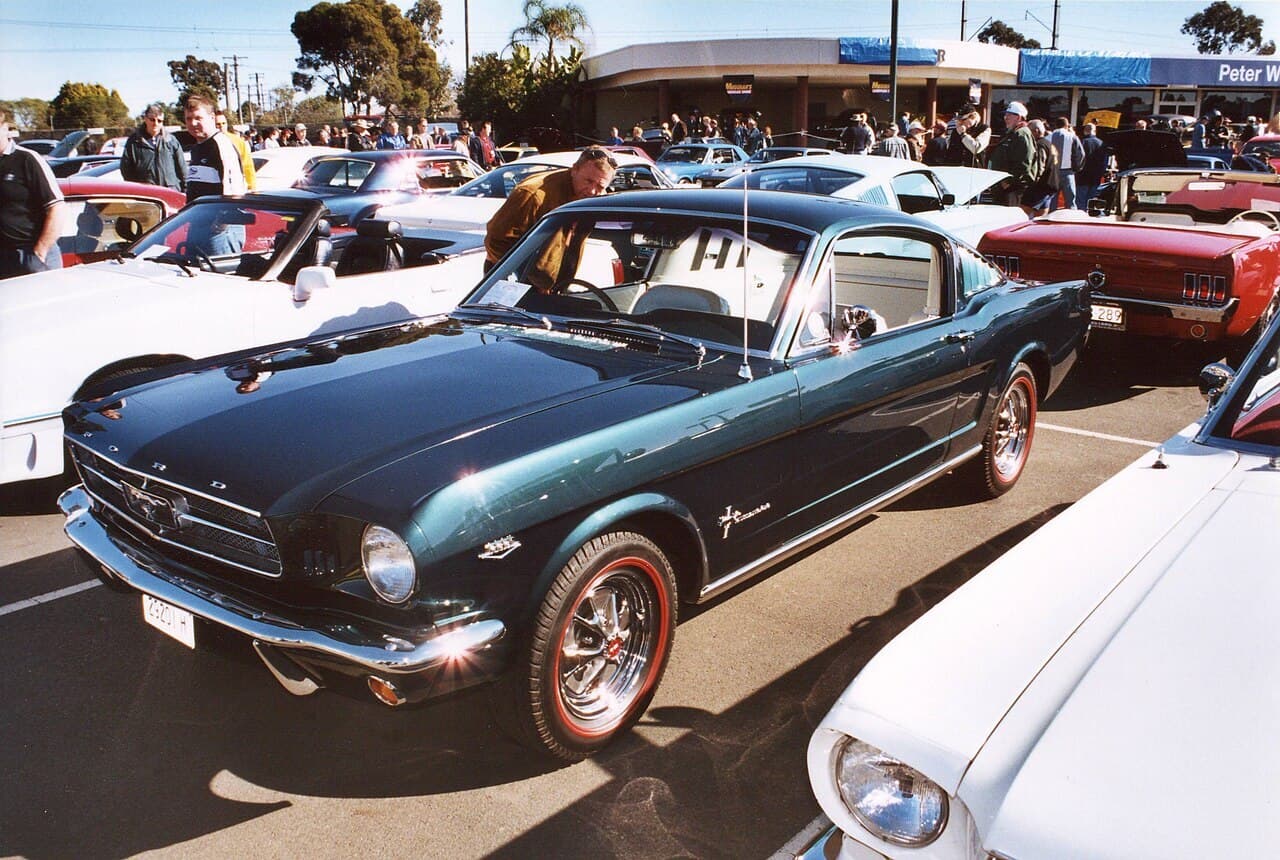
The history explains why the Mustang once felt special here. According to Wikipedia's history of the first-generation Mustang (opens in a new tab), Ford Australia organised the import and right-hand-drive conversion of early cars, about 209 in all: 48 in 1965 and a further 161 in 1966, with the conversion work listed at Homebush in New South Wales. After that, a Mustang on an Australian road usually meant a private import and a converted dashboard.
The sixth-generation car, the one enthusiasts call the S550, changed that. GoAuto's launch overview describes it as the first time Ford's sports coupe was built in right-hand drive at the factory, with a 5.0-litre naturally aspirated V8 GT and a 2.3-litre turbocharged EcoBoost four-cylinder, and manual or automatic gearboxes.
The yearly figures from the same VFACTS-based database (opens in a new tab) tell the story of a boom and a long tail:
- 2015: 121 (the first cars, in December)
- 2016: 6,208
- 2017: 9,165
- 2018: 6,412
- 2019: 3,948
- 2020: 2,923
- 2021: 2,827
- 2022: 1,887
- 2023: 1,475
- 2024: 1,465
- 2025: 4,052
To put 2016 in context, Just Cars reported (opens in a new tab) that the Mustang's 6,208 sales made it the top seller in the "Sports below $80,000" segment and accounted for more than a third of that segment's 18,228 sales. The next-best, the Hyundai Veloster, managed 2,232.
- 40,483
- New Mustangs sold in Australia, 2015 to 2025
- 9,165
- Sold in 2017 alone
- 4,052
- Sold in 2025, top sports car
The current generation, the S650, revived the numbers in 2025. Cars24 reported in January 2026 (opens in a new tab) that the Mustang was Australia's best-selling sports car in 2025 with 4,052 sales, well clear of the BMW 2 Series on 1,175, the Mercedes-Benz CLE on 934 and the Mazda MX-5 on 821. Cars24 called it the model's strongest result since 2018.
It wasn't a smooth year. CarExpert, reporting Ford's latest recall in September 2026 (opens in a new tab), noted a September 2025 stop-sale over water possibly entering the body control module, which could cause tail-light and exterior lighting faults. We'll come back to recalls in the buying section.
Rarity was never the whole point
Here is where we land, and it's our view rather than a measurement. A car can lose its rarity without losing its character. Rarity is about what other people see when you drive past. Character is about what you feel from the driver's seat. The Mustang's mass popularity has cost it the first and done nothing to the second.
Climb into a Mustang GT and you get a naturally aspirated 5.0-litre V8, the engine known among enthusiasts as the Coyote. You get rear-wheel drive and a long bonnet in front of you. In the current car you can still get a manual: CarExpert's 2026 price list (opens in a new tab) shows the GT with a six-speed manual from about $91,300 drive-away in Sydney, and the Dark Horse with a manual too. In our view that's an unusual offer in 2026, when so many new performance cars have turned to turbochargers, dual-clutch gearboxes or batteries.
None of that is spoiled by seeing three more Mustangs on the way home. We'd argue the opposite. The sound of a V8 at full noise is the same whether you're the only Mustang in town or one of thousands. Fast is not the same as felt, as we have written before about the naturally aspirated car (opens in a new tab), and the Mustang is one of the few new cars left that is built to be felt.
What ubiquity gives back
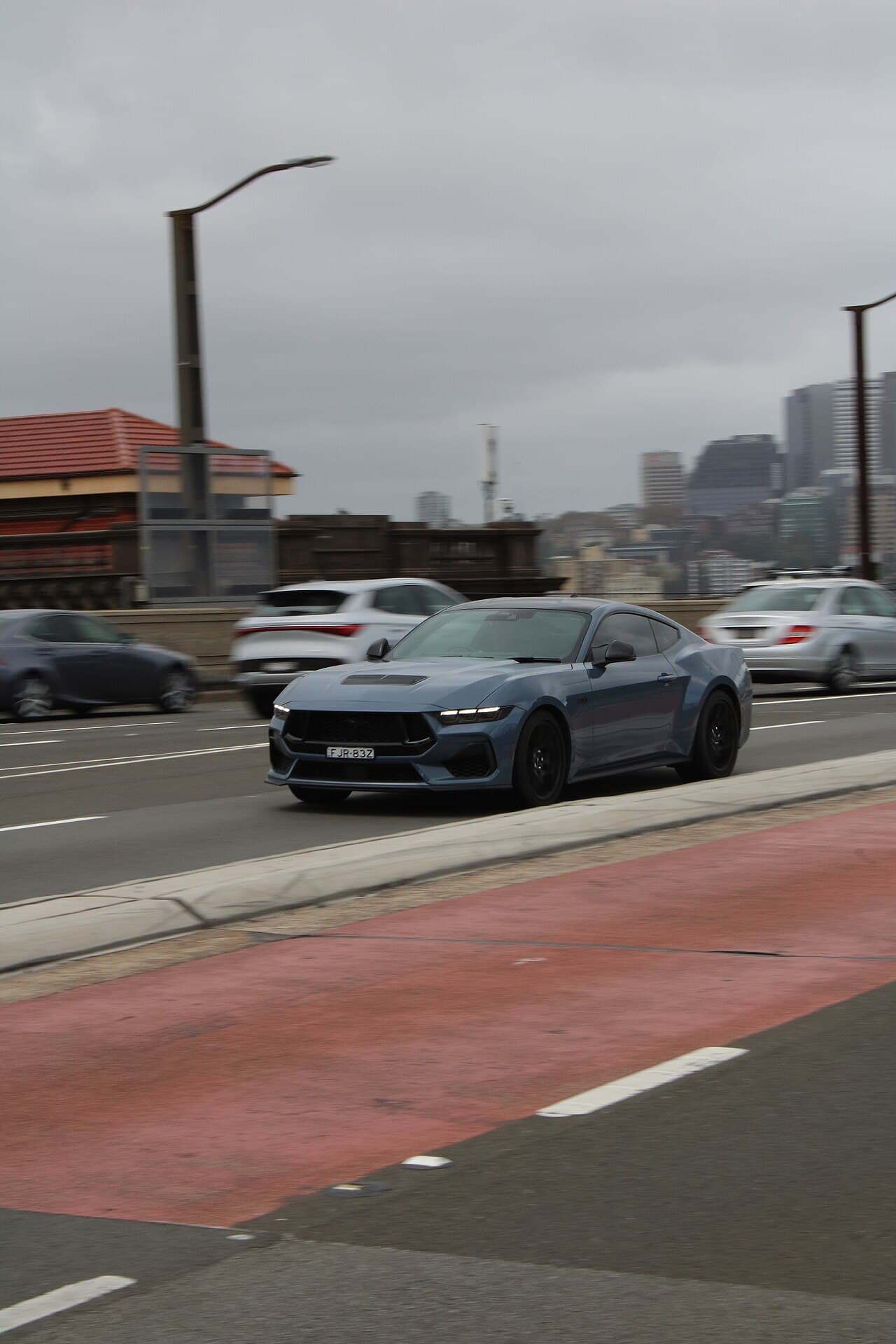
There is a practical upside to the crowd, and again this is our analysis. A car with tens of thousands of examples on Australian roads is a car the trade knows. Independent workshops have seen the engine before. Insurers have claims history to price from rather than guessing. Wreckers have panels, and the aftermarket has a reason to stock parts locally. Track-day groups and clubs have enough members to run their own events. Our guide to Australian car clubs (opens in a new tab) names Mustang clubs among the thriving ones, and a big local population is exactly what keeps a marque club alive.
That fits the house view we keep coming back to: simple, durable, repairable machinery beats rare and complicated machinery for the person who actually owns it. A rare car is lovely until it needs a part.
The Mustang on the racetrack
Part of the Mustang's appeal in Australia is that it carries the Ford flag in Supercars. Scott McLaughlin won both races at the 2019 Adelaide 500 (opens in a new tab) on the Mustang's championship debut, according to Supercars. In today's Gen3 era, the race Mustang runs a 5.4-litre V8, Supercars confirmed during development (opens in a new tab).
We covered this year's racing at length, from the Bathurst 1000 decided by a fuel gauge (opens in a new tab) to the Gold Coast 500 (opens in a new tab). The point for road-car owners is simple. The badge on your boot is the badge on a race car that thousands of people watch every round, and that link between showroom and grid is something rarity can't buy.
The United States: everywhere since 1964, and still collected
If you want proof that ubiquity doesn't kill a car's appeal, look at the country that built it. When Ford celebrated the 10 millionth Mustang in August 2018 (opens in a new tab), it called the car America's best-selling sports car of the past 50 years, based on Ford's analysis of US registration data supplied by IHS Markit, and the world's best-selling sports car three years straight. The 10 millionth car was a white GT V8 convertible with a six-speed manual, built at Flat Rock in Michigan as a salute to VIN 001, the first serialised Mustang of 1964. In the same release Ford said it had sold more than 38,000 Mustangs in Europe since 2015.
Ten million cars is many times Australia's 40,000-odd. Yet Americans still collect Mustangs, and they collect them in tiers. That's the lesson.
At the bottom of the ladder, an ordinary early car is an accessible classic. On Hagerty's own auction marketplace, a 1965 Mustang coupe with a 289 V8 and automatic sold for US$31,565 on 24 September 2026 (opens in a new tab), with the listing noting cosmetic imperfections and recent refurbishment. That's real money, but it isn't exotic money for a 61-year-old car people recognise anywhere.
At the top, the special cars are in another world. In a 2021 roundup of the most valuable Mustangs from each generation (opens in a new tab), Hagerty put the 1965 Shelby GT350R at an average condition #2 ("excellent") value of US$898,000, and the 1969 to 1970 Boss 429 at US$259,000. For the later generations it picked out the low-volume, focused cars: the 1993 SVT Cobra R, of which Hagerty says just 107 were built, the 2000 Cobra R and the 2013 to 2014 Shelby GT500. Those figures are five years old, so treat them as a picture of the pecking order rather than a price guide.
What Australia can learn from it
Our reading of the American market is that a Mustang stays special when something separates it from the herd. In the US that has been low build numbers, a racing connection, a homologation story or simply originality. A common car can still be a good classic, but it's the special editions and the unmolested examples that pull away.
Apply that here and a few Australian Mustangs look worth watching, in our view. Limited local runs such as the Dark Horse T8-Spec Pack, which CarExpert lists at $147,950 drive-away (opens in a new tab) with a six-speed manual, are the obvious candidates. So are early, original cars with a full history, manual V8s that haven't been modified, and anything carrying paperwork that proves what it is. We'd be cautious about expecting a typical automatic GT from the 2017 peak to become rare. The VFACTS numbers say too many of them exist.
| Feature | United States | Australia |
|---|---|---|
| Mustangs on the road | Ten million built by 2018 | 40,483 new sold here, 2015 to 2025 |
| Where value concentrates | Shelby, Boss, Cobra R and low-volume cars | Too early to say; limited editions and original manual V8s are our pick |
| Ordinary early cars | Accessible classic, about US$31,500 for a 1965 coupe at a recent Hagerty sale | Factory RHD history starts in 2015 |
What it means if you're buying or selling
Buying used. The big local supply is your friend. You can afford to be fussy and walk away from a car that doesn't check out. A few Australian points matter more than the colour:
- S550 or S650. The S550 (sold here from late 2015 until the S650 arrived) is the common, cheaper buy. The S650 is the current car, with the newer interior and the recall activity listed below. Both offer the 2.3-litre EcoBoost and the 5.0-litre V8.
- EcoBoost or V8. The four-cylinder is the cheaper car new, by more than $12,000 drive-away on CarExpert's current figures. If the engine is the reason you want the car, the V8 is the Mustang most people mean, and it's the one we'd buy.
- Safety in early cars. In January 2017 ANCAP gave the Mustang a two-star safety rating (opens in a new tab). Check exactly which driver-assistance features a particular early car has, rather than assuming.
- Factory RHD or converted. A Mustang older than the 2015 factory cars has almost certainly been converted. Ask for the engineering and compliance paperwork that allowed it to be registered, and read our guide to importing and exporting cars in Australia (opens in a new tab) before you buy one from overseas.
- Recalls. Run the VIN on the government's register. For example, recall 25C35, published on 17 October 2025 (opens in a new tab), covers 45 2024 Mustangs whose instrument cluster may fail to show critical warnings. More broadly, CarExpert reported in September 2026 that Ford Australia had recalled 7,724 S650 coupes and convertibles built from May 2023 to May 2026 over excess heat-shrink on a grounding eyelet in the wiring harness, with a stop-sale on almost 500 dealer cars and parts not expected until December. The same report mentions a separate August recall of 4,955 Mustangs over a possible windscreen-wiper fault.
- Modifications. A crowded market means plenty of modified cars. In our view an unmodified car is easier to inspect, easier to insure and easier to sell later.
- Insurance. Get quotes on the exact variant and postcode before you commit. Premiums can differ markedly between the EcoBoost and the V8, so quote both if you're undecided.
Buying new. The 2026 line-up, per CarExpert's drive-away figures for Sydney (opens in a new tab), runs from about $78,800 for the EcoBoost automatic to about $91,300 for a manual GT, about $112,300 for the Dark Horse and $147,950 for the Dark Horse T8-Spec Pack. Some of those sit above the luxury car tax threshold of $80,809 (opens in a new tab) that applies to non-fuel-efficient cars in 2026-27, and the ATO says LCT is charged at 33 per cent on the amount over the threshold. That tax is built into the price you're quoted. Our explainer on the 2026-27 LCT thresholds (opens in a new tab) has the detail.
Selling. You're competing with a lot of similar cars, so stand out on the things a buyer can't get from the next ad. A full service history, a clean PPSR, a manual gearbox, an unusual or factory colour, a V8 and an unmodified car all set yours apart. Photograph the paperwork as well as the car. When we searched MotorLoop's own listings on 28 October 2026 there were no Mustangs on the site, so a well-presented car would have the page to itself. You can buy, sell & show cars on MotorLoop, and it's free.
Keep the build plate details, the original invoice if you have it, the service book and any recall completion records together. On a car this common, documents are what turn "another Mustang" into "the right Mustang".
Our take
We think the Mustang's success has cost it something real. In 2015 a factory right-hand-drive Mustang was an event. In 2026 it's a familiar shape in a shopping-centre car park, and nobody turns around for an ordinary GT any more. If exclusivity was the reason you wanted one, the numbers have taken that away.
But we don't think exclusivity was ever the best reason. The best reason is the drive: the V8, the rear-wheel drive, the manual you can still order new. On that, the Mustang is as good as it was before 40,000 of them arrived, and arguably better, because the crowd brings parts, mechanics, clubs and buyers with it.
The American lesson is that a common car can still be a loved one, and that the special ones are the cars with a story, a low build number or an untouched history. So if you own a Mustang, keep it original and keep the paperwork. If you're buying, pick the version you'll enjoy driving rather than the one you hope will be rare. Some people want to get from A to B. The Mustang is for the people who enjoy the trip, and there are plenty of them, which, in our view, is no bad thing.
Header photo: Hugh Llewelyn (opens in a new tab) via Wikimedia Commons, CC BY-SA 2.0 (opens in a new tab).
Related
- Australian car culture is alive, and a club is the way in (opens in a new tab)
- Gold Coast 500: a city closes its streets to V8 race cars, and nearly 200,000 people turn up (opens in a new tab)
- The Bathurst 1000 was decided by a fuel gauge, and that is why we still watch (opens in a new tab)
- Luxury car tax thresholds rise for 2026-27 (opens in a new tab)