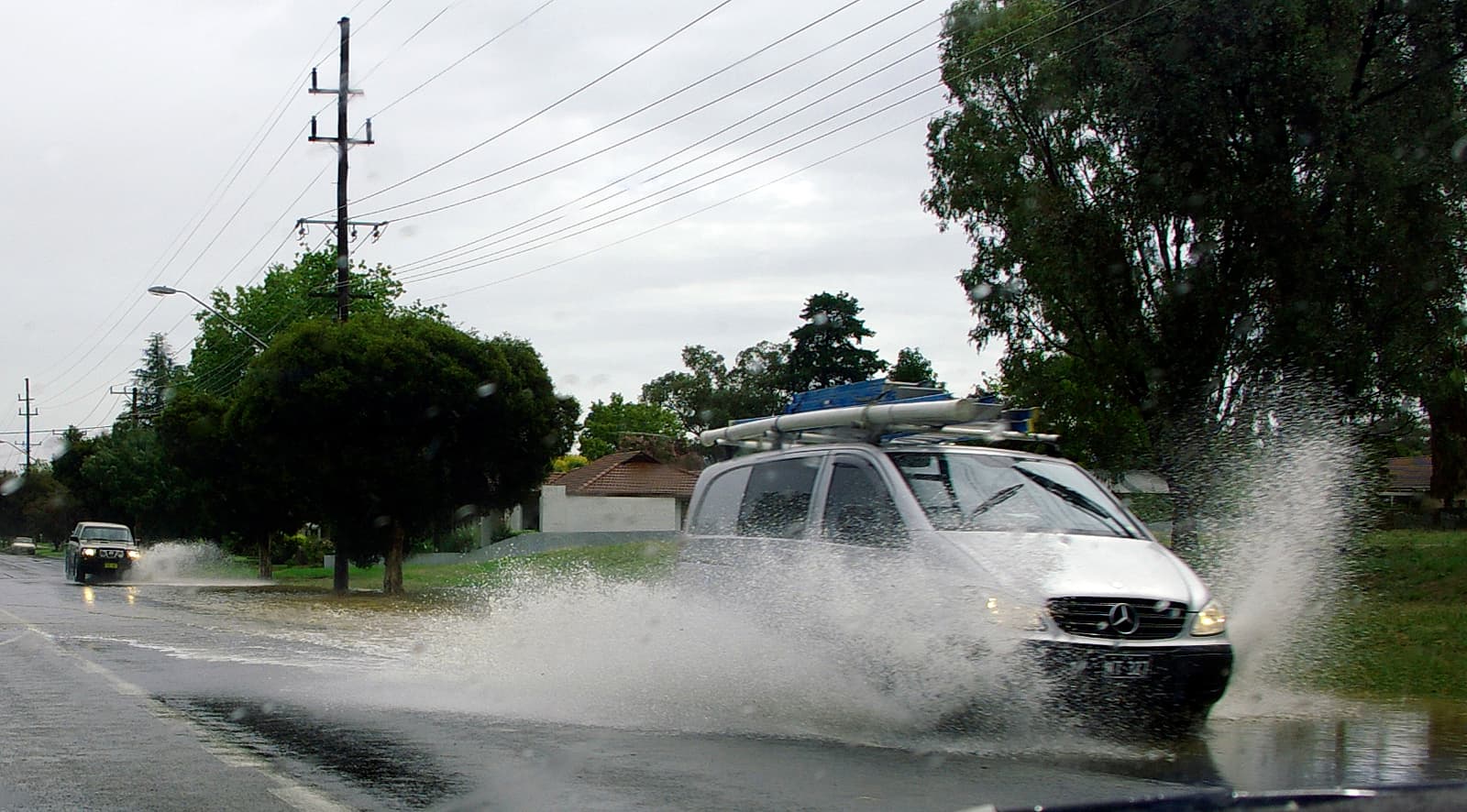
On Sunday 25 October, the final MotoGP at Phillip Island never started. Heavy rain and poor visibility kept the medical helicopter on the ground, and the race was called off at 3:30pm (opens in a new tab) after fans had waited for hours, according to the ABC. We've covered that farewell separately (opens in a new tab). The point for the rest of us is simpler: it's wet, and the Bureau of Meteorology describes spring as a peak time for severe thunderstorms (opens in a new tab), especially down the east coast.
On a wet road, everything your car does to keep you out of trouble goes through four patches of rubber, each roughly the size of your hand. Anti-lock brakes, stability control and lane-keeping all work by asking those patches for grip. None of them can create grip the tyres don't have.
Here's the odd part. If you buy tyres in Germany, France or Ireland, a label beside the price tells you how well that tyre stops in the wet, graded A to E. Buy the same tyre in Australia and the law cares about one thing once it's on the car: whether there's 1.5mm of tread left. That gap matters to anyone buying a used car this storm season, and to anyone selling one.
Wet roads and tyres at a glance
- Australia's tread minimum
- 1.5mm in the principal grooves (Victorian guidance)
- Australian tyre-age limit for cars
- None we could find
- EU wet-grip label
- Graded A to E, required at point of sale since May 2021
- One EU class step
- 3 to 6 metres of extra stopping distance, per the European Commission
- ADAC 2026 test spread
- 30.1m to 37.9m stopping from 80 km/h on wet asphalt
What Australia actually regulates
Australia's tyre rules come in two layers, and neither of them tells a shopper how well a tyre grips in the rain.
The first layer applies when a tyre is sold new. Passenger car tyres must meet Australian Design Rule 23/03, and the government's explanatory statement says that standard is fully harmonised with UN Regulation No. 30 (opens in a new tab), the international rule covering construction, dimensions, load and speed ratings. That's a standard about whether the tyre is built properly for its size and rating. It isn't a wet-braking test, and the statement makes no mention of the separate UN rule that does deal with wet grip, which we'll come to.
The second layer is the roadworthiness rule once the tyre is on your car. Victoria's Department of Transport puts it plainly in its Vehicle Standards Information sheet on tyres (opens in a new tab): except at the tread wear indicators, tyres must have at least 1.5mm of tread in all principal grooves, the tread mustn't be worn so far that a wear indicator touches the road, and a tyre mustn't have excessive uneven wear across its width. The NRMA gives the same figure, saying the minimum legal tread depth in Australia is 1.5mm (opens in a new tab) and that less than that can increase the distance your car takes to stop.
What's missing is age. Victoria's sheet covers tread, cuts, bulges and repairs, but sets no age limit for passenger car tyres, and we could not find one in any other state's guidance we read. The RACV's advice is to get professional input on replacing tyres more than five or six years old (opens in a new tab) even if they look fine, because all tyres degrade over time. That's advice, not law.
Why 1.5mm is a floor, not a target
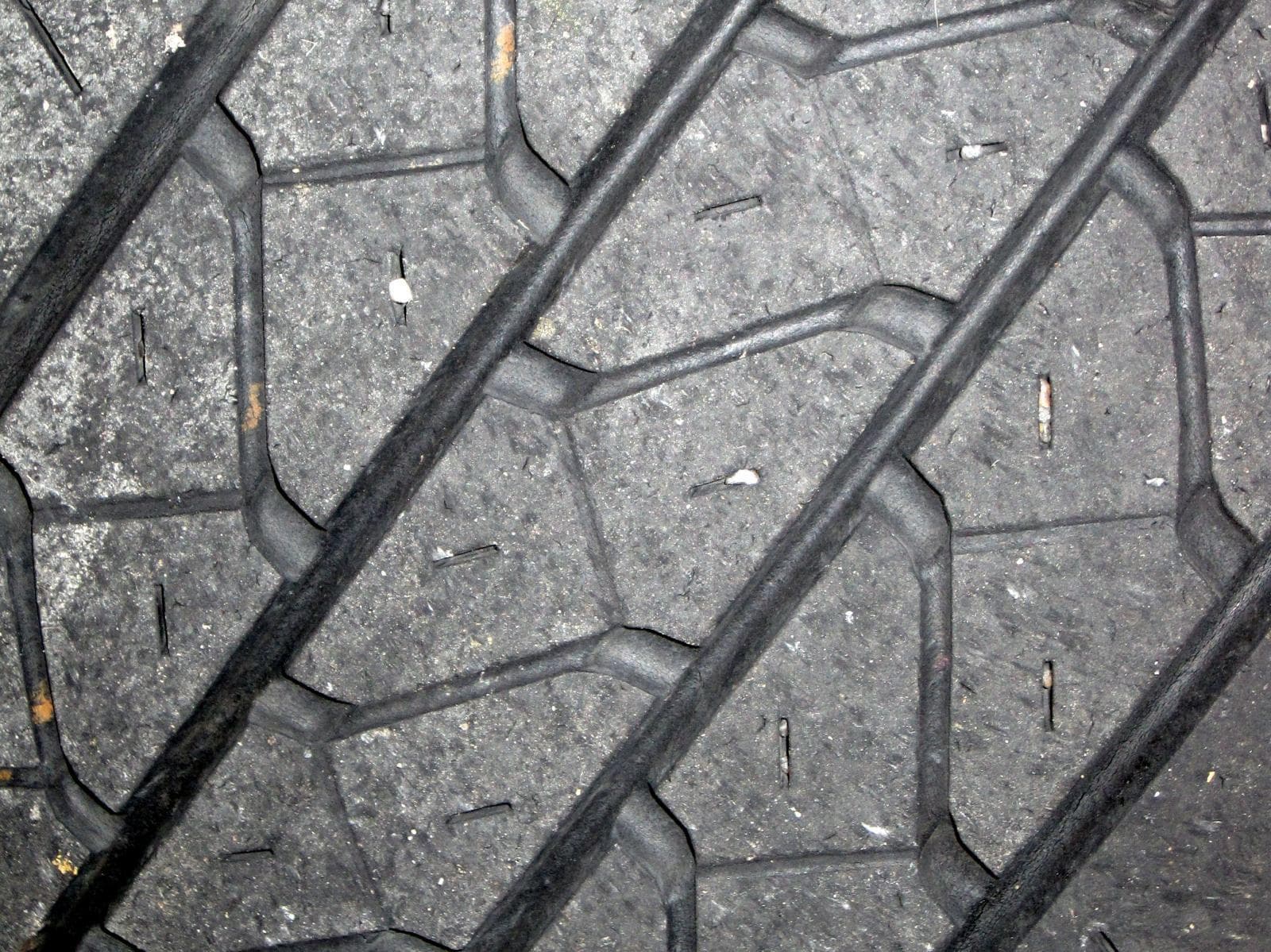
Tread does almost nothing on a dry road. In the wet its job is to pump water out of the way so the rubber can touch bitumen. As the grooves get shallower there's less room for that water, and the loss isn't gradual towards the end.
A test by the German magazine AutoBild, published by Continental and reported by Jax Tyres (opens in a new tab), braked a VW Golf on very wet roads with ABS working. On Continental tyres it stopped from 80 km/h in 25.8 metres on new tyres, 31.0 metres at 3mm of tread, and 36.2 metres at 1.6mm. From 120 km/h, the figures reported were 59.1 metres new, 124 metres at 3mm and 154.9 metres at 1.6mm. Those high-speed numbers are a test of aquaplaning in standing water rather than ordinary rain, but the shape is the lesson: the last few millimetres cost you far more than the first five.
That's why the RACV notes that some tyre companies recommend replacing at 3mm (opens in a new tab), and why our own guide to what you lose as a tyre wears down (opens in a new tab) treats 1.5mm as the point where the tyre is already illegal, not the point where it becomes worth replacing.
Not all new tyres stop alike
Tread depth is only half of it. Two brand-new tyres of the same size can stop very differently in the wet, and the price tag is a poor guide to which one will.
Germany's motoring club ADAC published its 2026 summer tyre test in size 225/50 R17 (opens in a new tab) on 24 February, covering 16 tyres. ADAC weights wet-road performance at 60 per cent of its driving-safety score. Braking from 80 km/h on wet asphalt, the overall winner, the Continental PremiumContact 7 (opens in a new tab), stopped in 30.1 metres. The Greentrac Quest-X (opens in a new tab) needed 37.9 metres, the longest in the test, and ADAC still rated it satisfactory overall.
Nearly eight metres is roughly a car and a half. In the real world it's the difference between stopping behind the car in front and stopping inside it.
It isn't a simple story of cheap versus expensive, either. ADAC found the Linglong Sport Master was very good in the wet but delayed and unsettled when pushed on a warm, dry road, which pulled its overall grade down. That's exactly why a single wet-grip grade on a label is useful: it isolates the thing that matters most when the storms arrive, rather than leaving you to guess from the brand name.
- 30.1m
- Best wet stop from 80 km/h, ADAC 2026
- 37.9m
- Worst wet stop in the same test
- 3-6m
- Extra stopping distance per EU label class, per the Commission
The European approach, in depth
Europe has done something Australia hasn't: it makes wet grip visible at the moment you buy.
The label
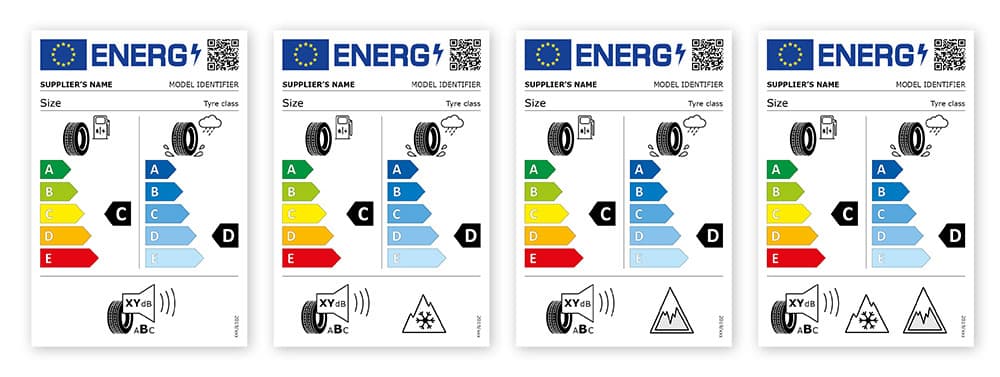
The current EU tyre label was introduced under Regulation (EU) 2020/740 and has applied since May 2021 (opens in a new tab), according to the European Commission. It covers car tyres (class C1), van tyres (C2) and truck and bus tyres (C3). Each label shows a rolling resistance class from A to E, a wet grip class from A to E, an external noise figure and class, and pictograms for tyres certified for severe snow or ice.
The Commission's description of wet grip is blunt. Tyres are rated A, the shortest braking distance, to E, the longest, and it says "the difference between a class and another can mean an extra 3-6 metres on the stopping distance". Run that across the whole scale and an A-grade and an E-grade tyre are separated by a gap you can see from the driver's seat.
Where you see it
The label isn't buried in a brochure. Under the Commission's guidance, tyres in a shop must be displayed with the label visible at the point of sale. Online, the label must sit close to the price or the purchase button. And when someone buys a new vehicle, the tyre label information must be provided before they sign. Every label carries a QR code linking to EPREL, the EU's product registry, where suppliers must register a tyre before it goes on sale.
The floor beneath the label
A label grades tyres above a minimum. That minimum is set separately. The Commission notes that minimum type-approval requirements come from the EU's general vehicle safety regulation, and the UN rule covering tyre noise, wet adhesion and rolling resistance is UN Regulation No. 117 (opens in a new tab), republished in the EU's Official Journal in August 2025. Testing body TÜV SÜD describes a recent amendment to R117 (opens in a new tab) that extends wet-grip requirements to tyres in a worn state, not only when new. That's a significant idea: it tests the tyre you'll actually be driving on in year three, not the one in the showroom.
Europe hasn't yet put that on the label. Asked whether worn-tyre wet grip would appear, the Commission answered in March 2024 that no change and no obligation was in discussion (opens in a new tab) for the label or the registry.
The United Kingdom adds two lessons
Britain sits outside the EU now, but two of its rules are worth Australia's attention because they deal with the problems our system ignores.
The first is age. Since 1 February 2021, the UK has banned tyres more than 10 years old on the front steered axles of trucks, buses and coaches, and on every single wheel of a minibus, according to the Driver and Vehicle Standards Agency (opens in a new tab). Cars aren't covered. But a DVSA officer, replying on that post, summed up the reasoning: research shows tyres degrade whether they're used or not.
The second is part-worn tyres. UK law under the Motor Vehicle Tyres (Safety) Regulations 1994 requires a second-hand tyre to have at least 2mm of tread, no serious cuts or bulges, and "PART-WORN" marked on it in letters at least 4mm high. Enforcement is another matter. In a June 2025 day of action in Preston, none of 30 part-worn tyres inspected met the legal requirements (opens in a new tab), Lancashire County Council reported. Two had screws embedded in them, one had a sidewall tear at risk of failure, and a nine-year-old tyre showed perishing that could reduce wet grip. We could not find a national Australian rule specific to the marking or minimum tread of part-worn tyres sold for reuse.
What Australia can learn
Our view is that Australia could borrow three things without inventing anything:
- A consumer wet-grip grade at the point of sale. The EU label already exists, the tyres are largely the same global products, and suppliers already test and register them for Europe. Showing that grade on an Australian quote or website is a disclosure, not a new test.
- Wet-grip minimums that apply to worn tyres. Our new-tyre standard is built on construction rules. A minimum that follows the tyre into its worn life is where the safety actually is.
- Clear rules on age and part-worn tyres. Even if Australia stopped short of a ban, a requirement that part-worn tyres be labelled, with a minimum tread and a visible date, would protect buyers who choose them to save money.
| Feature | European Union | Australia |
|---|---|---|
| Wet grip shown when buying | Yes | No |
| Wet grip graded A to E | Yes | No |
| Product registry with QR code | Yes | No |
| Wet-grip rules for worn tyres | Partly | None we could find |
| Tyre age limit | UK only: 10 years, heavy-vehicle front axles | None we could find for cars |
Mechanical grip beats electronic help
ABS stops the wheels locking so you can keep steering. Stability control brakes individual wheels to pull the car back into line. Both are genuine safety gains. But both work by managing the grip that's already there. On a tyre with 1.5mm of tread in standing water, the electronics are tidying up after a problem they can't solve.
That's our recurring theme, applied to rubber: simple mechanical fundamentals do the heavy lifting, and the electronics are a backstop. Good tyres at the right pressure, with real tread and a date code that isn't from the last decade, do more for you on a wet Friday night than any number of acronyms on a spec sheet.
Weight makes it harder. Every extra kilogram has to be stopped by the same four contact patches, which is one reason heavier cars, including many EVs, tend to be harder on their tyres. We've covered the wider cost of that in Beyond the Tailpipe: Tyres, Weight and the EV Recycling Problem (opens in a new tab).
We could not find a current national Australian figure for the share of crashes that happen on wet roads, so we won't put a number on it. The physics doesn't need one.
What it means if you're buying or selling
Tyres are one of the few parts of a used car you can judge properly in a driveway with a coin-sized tool. Use that.
If you're buying:
- Measure, don't eyeball. A tread depth gauge costs a few dollars. Check the inner, middle and outer grooves of every tyre, at a few points around each one. Our guide to checking tyres and wheels on a used car (opens in a new tab) walks through it.
- Read the date. The four-digit code on the sidewall gives the week and year of manufacture, so 4022 is week 40 of 2022, as the RACV explains (opens in a new tab). A low-kilometre car can be sitting on old rubber with plenty of tread. More on that in why a brand-new tyre can already be too old (opens in a new tab).
- Read the wear. Uneven wear across a tyre usually points to alignment or worn suspension, not just tired rubber. Victoria's guidance treats excessive uneven wear as a roadworthiness issue in its own right.
- Look for a mismatched set. Four different brands, or two very different tread patterns on one axle, suggests tyres have been replaced one at a time as cheaply as possible. Ask why.
- Don't forget the spare. Check it's there, check its date, and check whether the car has a space-saver or an inflation kit instead.
- Price it in. Get a quote for four tyres of the right size and load and speed rating before you make your offer. If the tyres are near the wear bars, that quote is a fair, documented reason to adjust the price.
If you're selling:
- Worn tyres cost you twice. A buyer will knock the replacement cost off your price, and many will knock off more for the doubt it raises about how the car's been looked after.
- Know your state's rules. In Queensland, the Department of Transport and Main Roads (opens in a new tab) says you no longer need a safety certificate just to advertise a registered car, but you must have one before you dispose of it to anyone other than a dealer; for private sellers it's valid for two months or 2,000km, and tyres are among the items checked. In Victoria, VicRoads lists a private-to-private transfer as needing a roadworthy certificate (opens in a new tab). In NSW, most light vehicles more than five years old need a yearly safety inspection report (opens in a new tab), the pink slip, before registration can be renewed.
- Show your working. A photo of a gauge in the groove and a close-up of the date code in your listing answers the question before a buyer asks it. Whether you're using MotorLoop to buy, sell & show your car or anywhere else, that kind of evidence builds trust.
Before the next storm, find the small raised bars at the bottom of your main grooves. If the tread is close to level with them, book new tyres. While you're there, check pressures cold against the placard on the door jamb, and include the spare. The RACV suggests checking pressures at least every fortnight and before any long trip.
Our take
We think the 1.5mm rule has become a comfort blanket. It tells you when a tyre is illegal. It doesn't tell you when a tyre has stopped doing its job, and on the evidence above, that happens well before the wear bars.
We'd like to see Australia adopt a consumer wet-grip grade. It isn't red tape: the testing is already done for Europe, and many of the same tyres are sold here. A buyer comparing two tyres at similar prices deserves to know that one of them might stop several metres shorter in the rain. We'd also like a grown-up conversation about tyre age and part-worn tyres, where Britain has shown the problem is real and enforcement is the hard part.
And we think owners deserve the plain message more than another gadget. ABS, stability control and the rest are welcome. But a car with four good tyres, correctly inflated, is safer in the wet than a car with every acronym on worn rubber. The cheapest safety upgrade on most used cars is still a set of tyres, bought on wet-grip performance rather than price alone.
Header photo: Bidgee (opens in a new tab) via Wikimedia Commons, CC BY-SA 3.0 (opens in a new tab).
Related
- Tread depth: what you lose as a tyre wears down (opens in a new tab)
- Why a brand-new tyre can already be too old (opens in a new tab)
- Checking the tyres and wheels when you inspect a used car (opens in a new tab)
- Safer cars, stubborn road toll: why Australia's road deaths aren't falling (opens in a new tab)