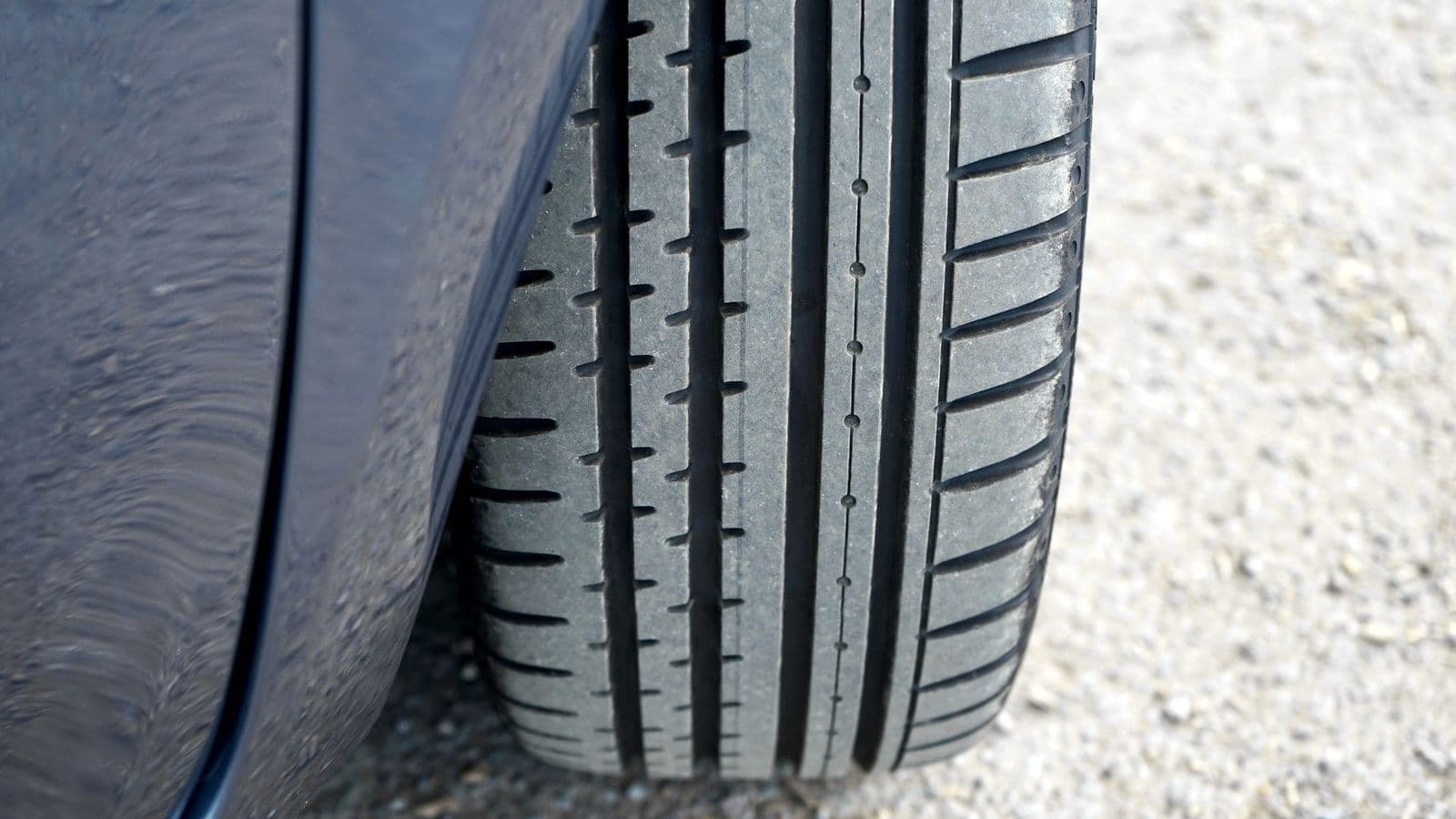
A worn tyre stops a car about as well as a new one right up until the road is wet. Then the relationship falls apart, and it falls apart faster than most drivers expect — the loss is not spread evenly across the tyre's life, it accelerates towards the end.
That is the single most useful thing to understand about tread depth, and it is why "still legal" and "still safe" are different statements.
The legal minimum tread depth in Australia is 1.5 mm, measured in the principal grooves across the central three-quarters of the tread, around the full circumference. A tyre below that is not roadworthy. But the braking data shows grip dropping away well above the legal limit, so treating 1.5 mm as a target rather than a hard floor is a decision with a measurable cost.
What the tread is actually doing
On dry bitumen, tread grooves do very little. A racing slick has none at all, because on a dry surface the most grip comes from the largest possible area of rubber in contact with the road.
In the wet the job reverses completely. Water cannot be compressed, and a tyre moving at 100 km/h has roughly seven milliseconds to get it out of the way at each point of contact. The grooves are drainage channels: they give the water somewhere to go so the rubber can reach the road underneath. Run out of groove volume and the tyre stops touching the road at all and starts floating on a wedge of water, which is aquaplaning. At that point steering, braking and traction all go to zero simultaneously.
Groove volume is depth multiplied by width. As the tyre wears, depth is the part that disappears, so drainage capacity falls roughly in proportion — and the failure is not gradual once the remaining channels saturate.
The numbers
Independent testing puts figures on it. In Continental's testing at its Contidrom proving ground, braking distance on tyres worn to 1.6 mm was 6.8 metres longer than on the same tyres at a full 8 mm of tread. At 3 mm, the penalty was only 2.2 metres.
That shape is the point. Going from 8 mm to 3 mm — most of the tyre's usable life — costs you a couple of metres. Going from 3 mm down to the legal limit costs you more than twice as much again, over a far smaller amount of wear.
Testing in New Zealand comparing new tyres against tyres worn to 1.6 mm in 1 mm of standing water found stopping distances from 80 km/h rising from around 26 metres to around 38 metres. From 120 km/h the same comparison ran from about 59 metres to over 150 metres, because the faster the car is moving the less time the tread has to clear the water.
This is why a great many tyre engineers and motoring bodies suggest replacing at around 3 mm rather than running to the legal limit. It is advice, not law — but it is advice with a test track behind it.
How to check it properly
- Find the tread wear indicators. Every road tyre has raised bars moulded into the bottom of the main grooves, marked on the shoulder by a small triangle, the letters TWI, or the manufacturer's logo. When the surrounding tread wears down flush with those bars, the tyre is at its wear limit. This is the check that needs no tools.
- Use a depth gauge for anything more precise. They cost very little. Measure in the main circumferential grooves, not in the sipes or the shoulder decoration.
- Measure in several places on each tyre. This matters more than the reading itself. Take an inner, middle and outer measurement on each tyre, and one at three points around the circumference.
- Check all four, including the spare. A full-size spare quietly ages and wears differently from the tyres doing the work.
Uneven wear is a diagnosis, not just a measurement
If those measurements differ across a single tyre, the tyre is telling you about the car. This is free diagnostic information most people throw away.
- Both edges worn, centre fine — chronic under-inflation. The tyre is flexing onto its shoulders instead of carrying load through the middle, which also runs it hot and costs fuel.
- Centre worn, edges fine — over-inflation, the contact patch crowned up in the middle.
- One edge only — a wheel alignment problem, usually camber or toe. Fixing the tyre without fixing the alignment simply consumes the next tyre the same way.
- Scalloped or cupped patches around the circumference — worn dampers or other suspension wear letting the wheel bounce, or a persistent imbalance.
- A feathered edge you can feel by running a hand across the tread — a toe alignment issue.
What makes tyres wear faster
Tread life varies enormously with things that have nothing to do with the tyre's quality:
- Pressure. Under-inflation is the most common cause of premature wear and increases rolling resistance at the same time, so it costs money twice.
- Alignment. A car that has met a kerb or a decent pothole can eat a front tyre in a few thousand kilometres.
- Driving style. Hard acceleration, late braking and quick cornering all abrade rubber. Tyre wear is one of the more sensitive indicators of how a car has been driven, which is worth remembering when you inspect a used one.
- Weight. A heavily loaded car, or a heavy car, wears tyres faster. This is one reason electric vehicles get through tyres more quickly than comparable petrol cars.
- Rotation. Front tyres on a front-drive car do the steering, most of the braking and all of the driving, so they wear far faster than the rears. Rotating on the manufacturer's schedule evens that out and gets more total kilometres from the set.
Buying a used car
Tread depth is one of the easiest things to check on an inspection and one of the most informative. Take a gauge with you. Four tyres near the wear bars is a genuine and quantifiable cost to bring into the price conversation, and uneven wear across a tyre is a question about the suspension and alignment rather than about the tyre.
Reading the rest of what the sidewall tells you — including how old the rubber is regardless of how much tread it has left — is covered in our guide to reading a tyre sidewall.
Related
- How to read a tyre sidewall: size, load, speed and age
- What makes one tyre cost three times as much as another
- Used car inspection and test drive: your questions answered
FAQs
What is the legal minimum tyre tread depth in Australia?
1.5 mm, measured in the principal grooves across the central three-quarters of the tread width and around the whole circumference. Below that the tyre is not roadworthy and the vehicle can be defected. Tread wear indicator bars moulded into the grooves show when a tyre has reached its wear limit without needing a gauge.
Should I replace my tyres at 3 mm instead of waiting for 1.5 mm?
Many tyre engineers and motoring organisations suggest it, and the test data supports the reasoning. Continental's proving-ground testing found tyres at 3 mm braked about 2.2 metres longer than tyres at full 8 mm tread, while tyres at 1.6 mm braked about 6.8 metres longer. Most of the wet-weather loss happens over that last millimetre and a half.
How do I check tread depth without a gauge?
Use the tread wear indicators. They are raised bars in the base of the main grooves, marked on the shoulder with a triangle or the letters TWI. If the tread surface is level with those bars the tyre has reached its limit. A gauge is still worth buying because it lets you compare inner, middle and outer readings, which is what reveals alignment and pressure problems.
Why is my tyre worn on one edge only?
That pattern usually points to a wheel alignment fault rather than to the tyre. Camber or toe settings outside specification drag one shoulder along the road. Replacing the tyre without correcting the alignment will consume the new one in the same way, so have the alignment measured at the same time.
Does tread depth affect stopping distance in the dry?
Very little. Dry grip comes mainly from the area of rubber contacting the road, which is why racing slicks have no tread at all. Tread grooves exist to clear water, so their depth matters enormously in the wet and hardly at all on a dry road — which is exactly why worn tyres feel perfectly fine until the day it rains.