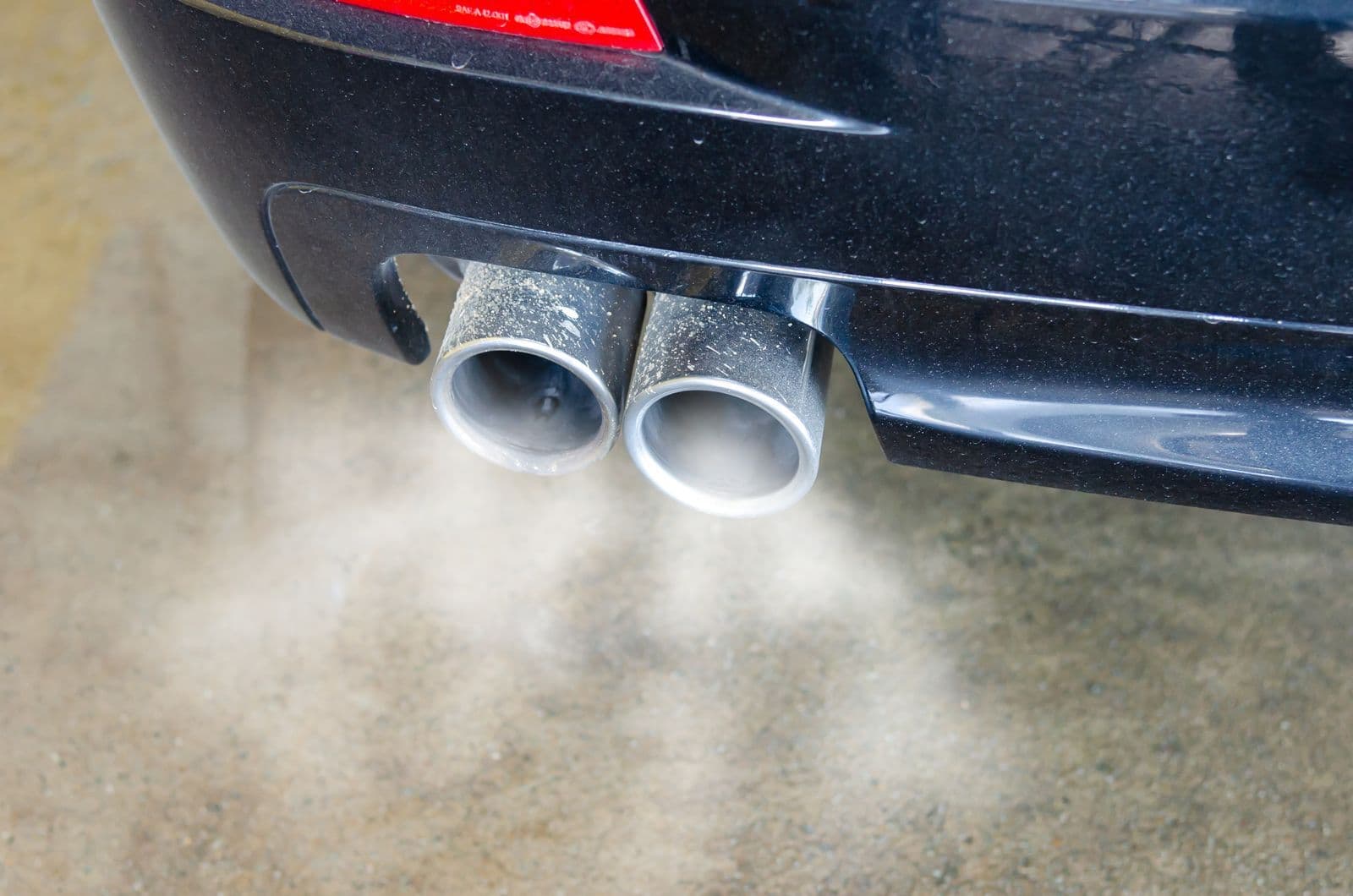
Ask why a modern diesel blocks its particulate filter and you will be told it is short trips. Manufacturers do say that, in their own documents, with numbers attached. But a Federal Court class action covering 264,170 Australian vehicles turned on close to the opposite duty cycle, and the published record is messier than the advice built on it.
- Applies to
- Diesel vehicles with a particulate filter
- Evidence
- Manufacturer booklets, service bulletins, Federal Court agreed facts
- Australian case
- 264,170 Toyota vehicles; defect trigger recorded as driving at about 100 km/h
- Toyota's stated remedy
- Over 60 km/h for about 30 minutes, or a stationary manual regeneration
- Published service life in km
- We could not find one at any manufacturer or regulator source
What a filter actually asks of you
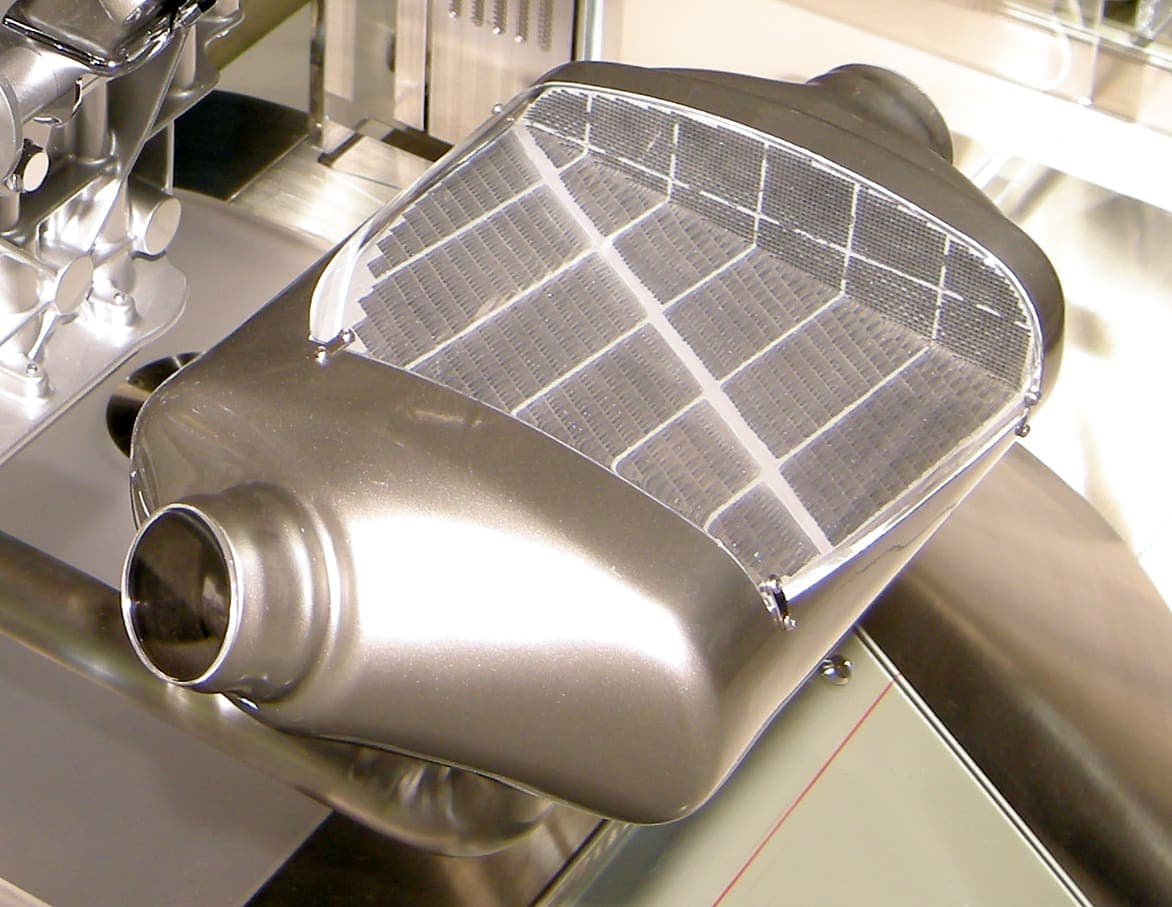
A diesel particulate filter is a ceramic wall-flow trap. Soot goes in mechanically and leaves chemically, by being oxidised to carbon dioxide, which takes heat. The Federal Court recorded it as an agreed fact between Toyota and the applicants that a DPF has finite soot storage capacity and must periodically burn that soot off, and that if that does not happen the filter blocks (opens in a new tab). Below the temperature at which particulate oxidises, soot simply accumulates and the pressure drop across the filter climbs.
That is the trade this series keeps finding. The device works: the US EPA's technical bulletin states that verified DPFs typically reduce particulate matter by 85-90% or more (opens in a new tab). What was given up to get that result is margin. An old diesel had no filter and no specification to breach; it just smoked. A modern one meets a far tighter limit indefinitely, on the condition that its duty cycle, its oil and its fuel all stay inside the specification. Step outside and the failure is not gradual - it is a warning lamp, then a workshop.
The manufacturers name short trips themselves
This is not folklore. Toyota Australia's own owner booklet states that automatic regeneration "may not occur or may be interrupted by certain operating conditions such as low speed, prolonged idling and engine stop/start" (opens in a new tab), puts automatic regeneration at roughly every 250 to 300 km taking up to 30 minutes, and gives the driver remedy as over 60 km/h for about 30 minutes or a stationary manual regeneration.
FCA is blunter. Its technical publication on fault code P2463-00 says the code "can be caused by a customer's driving habits" (opens in a new tab) where the vehicle "is not driven long enough at highway speeds to actively regenerate the DPF on its own", and describes the vehicle asking for regeneration at about 67% calculated soot load with no driver notification at all, a dash message at about 80%, and a remedy of roughly 30 minutes at steady speeds above 60 mph (95 km/h).
Ford went further and changed the tooling rather than the hardware. For 2015 to 2018 Transit vans with the 3.2L diesel in North America, Ford attributed repeated failed regenerations to "vehicles being used in a stationary or off-highway, low speed applications" (opens in a new tab) and had dealers enable Operator Commanded Regeneration so the filter could be cleared "without the need to drive the vehicle". Toyota's equivalent is a manual regeneration switch, which its booklet says is standard on all Toyota diesel models built from June 2018 (opens in a new tab).
Driving on with the DPF lamp lit is what turns a free fix into a tow: Toyota's booklet describes a final stage of reduced engine power and limited gear selection at which the on-board regeneration strategies are no longer available and the vehicle needs a dealer.
The counter-evidence: a 264,170-vehicle Australian case ran the other way
Here is the fact that should stop anyone repeating "just take it for a highway run" as a general law.
In Williams v Toyota Motor Corporation Australia Ltd [2022] FCA 344 (opens in a new tab), covering 264,170 Prado, Fortuner and HiLux vehicles with 1GD-FTV or 2GD-FTV engines supplied between 1 October 2015 and 23 April 2020, the Court recorded as an agreed fact that "a key occurrence which caused the Core Defect to manifest was the exposure of a Relevant Vehicle to regular continuous driving at approximately 100km per hour". The referee's finding, adopted by the Court, was that deposits or coking at the diesel oxidation catalyst prevented effective automatic or manual regeneration, producing excessive white smoke, foul-smelling exhaust and "DPF full" notifications. The Court held the vehicles were not of acceptable quality under section 54 of the Australian Consumer Law.
In that case, in other words, the exposure the Court recorded as triggering the defect was the drive commonly given as the cure. The 264,170 figure is the class covered by the proceeding, not a count of vehicles found to have been driven that way. That case is not finished: the High Court set aside the approach taken to assessing the reduction in value on 6 November 2024 and remitted it (opens in a new tab), so the quantum remains open. The parties agreed Toyota's 2020 field fix was effective (opens in a new tab).
There is a physical reason the highway advice is shakier than it sounds. When NREL wanted a test cycle that would produce lots of regenerations, it picked the EPA Highway Fuel Economy Cycle precisely "because of the relatively low engine oil and exhaust temperatures, and high DPF regeneration frequency of this cycle" (opens in a new tab). What a filter needs is exhaust temperature and load. A light-load cruise can supply neither.
The commuter stereotype also sits awkwardly against the national numbers. The ABS Survey of Motor Vehicle Use for the 12 months to 30 June 2020 has light commercial vehicles averaging 15.3 thousand km per year against 11.1 thousand for passenger vehicles (opens in a new tab). Utes are not, as a fleet, the low-kilometre vehicles.
The specification nobody reads: oil, fuel and ash
Regeneration removes soot. It does not remove ash, which comes mostly from lubricant additive metals, is non-combustible, and stays for the life of the filter. A 2020 review in Applied Energy reports a flow-restriction fuel penalty of 1-4% at 20 g/L of ash and 3-7.6% at 60 g/L (opens in a new tab), with "serious performance deteriorations" reported above roughly 40 g/L, showing up in service as frequent regenerations and reduced power. The same review reports that regeneration strategy appears to change where ash sits, not just how much there is - but it also cites a study finding the opposite direction, so that part is unsettled, and the review does not examine trip length at all.
Which is why the oil is a specification, not a preference. Toyota Australia specifies ACEA C2 SAE 0W-30, or ACEA C5 SAE 0W-20 on later HiLux, Fortuner and Prado production, and diesel of 10 ppm sulphur or lower (opens in a new tab), and lists using a non-specified oil under its DPF warnings. Cheap oil is not a saving here; it is ash you cannot get back out.
Fuel dilution of the oil from regeneration is real and measured - NREL found 4.1% fuel in oil after about 4,000 miles on ULSD - but the same study found the dilution partly evaporated back out during normal running, and reported little difference in total acid number, total base number, viscosity, soot, metals and wear scar (opens in a new tab) at those levels. It is also not DPF-specific: Audi's bulletin for petrol 3.0L models attributes the same condition to the engine "rarely reaching its operating temperature" (opens in a new tab) on frequent short trips.
Reading a recall without overreading it
Recall headlines travel further than unit counts. Australia's recall register lists a Ford Ranger 2021-2022 emissions recall where a software fault could trigger more frequent DPF regenerations; it covered 13 vehicles, and the regulator recorded "no safety hazard associated with this recall" (opens in a new tab). By contrast, the Toyota LandCruiser vegetation-fire recall covered 22,971 units, with a remedy of modified heat shields plus enabling the manual regeneration mode (opens in a new tab) so owners could regenerate in a safe place before entering dry vegetation. That heat is genuine: the NSW Resources Regulator puts typical diesel stack gas at 300-400°C and up to about 600°C during a regeneration event (opens in a new tab), and recorded six fires in six months in NSW mining where the DPF or catalytic converter was the heat source.
What we could not find
- A price. We could not reach any primary source for an Australian light-vehicle DPF replacement cost. The US EPA figures that circulate are scoped to heavy-duty and nonroad retrofit installations and do not transfer to a ute.
- A kilometre life. Toyota's booklet answers the replacement question by saying the DPF "has a much longer service life" than a serviceable filter and is designed to regenerate to restore its performance. There is no published km figure to quote.
- An Australian failure rate for city-driven utes. We could not find a study, regulator dataset or manufacturer field statistic linking urban duty cycle to DPF failure rates in the Australian fleet. For the Australian fleet covered by the Toyota class action, the recorded trigger points the other way.
- A verified penalty for removal. The UK's DVSA guidance states DPF removal "is almost always illegal" (opens in a new tab) and that a missing filter fails the MOT. The Australian penalty figures repeated on tuning-shop websites could not be verified against legislation, so we do not repeat them.
If you drive a diesel on short trips, the manufacturers' own documents say to take that seriously, and the fix they supply is either a sustained drive or, on most recent vehicles, a button. What the record does not support is the tidy version: that short trips are the cause, and a freeway run is the cure.