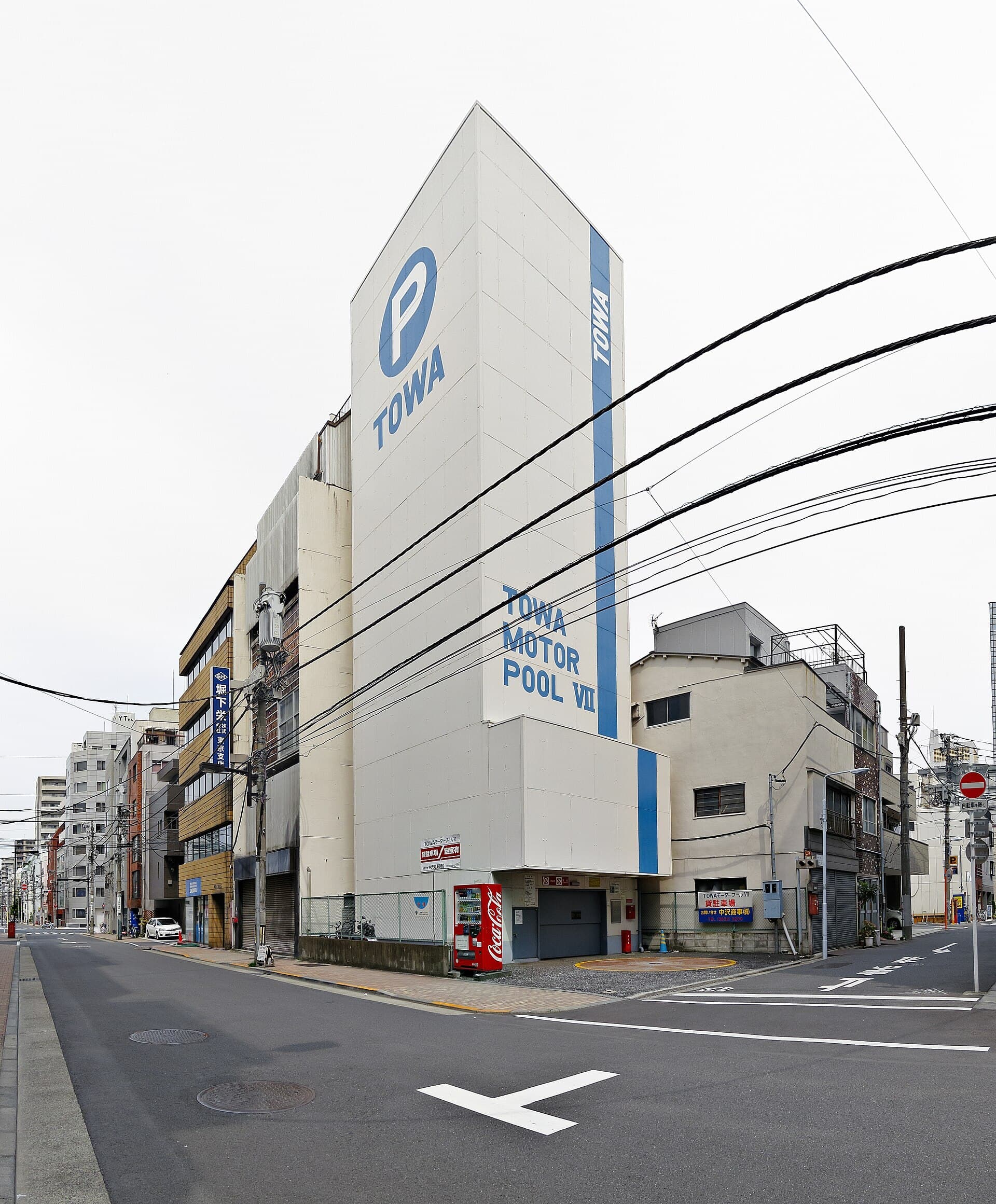
Walk through almost any Japanese city and you will pass a narrow steel tower squeezed between two buildings, often with a single roller door at the bottom and a small control panel beside it. Press a button and a carousel of pallets clanks into motion, bringing your car down to street level. These mechanical car parks are so ordinary in Japan that locals barely notice them. In Australia, most people have never used one.
They are not exotic technology. The basic idea — a vertical loop of platforms, much like a Ferris wheel for cars — has been around for most of a century. So why is something so practical everywhere in Japan and so rare almost everywhere else?
At a glance
- What they are
- Mechanical towers, lifts and stackers that store cars vertically
- Typical footprint
- Roughly two to three ordinary parking bays
- Widely cited Japan estimate
- About 1.6 million automated spaces (2012 figure)
- Key driver in Japan
- Proof-of-parking rules for car registration
What a car-park elevator actually is
The term covers a few related machines:
- Rotary (vertical circulation) towers — a chain of pallets rotates in a loop, like a paternoster lift. The most recognisable type, and the one that fits on a tiny lot.
- Lift-and-slide towers — a central elevator carries the car up and a shuttle slides it sideways into a bay. Taller, faster, and able to hold more cars.
- Puzzle and stacker systems — two- or three-level platforms that shuffle up, down and sideways. Common under apartment blocks.
- Fully automated garages — robotic shuttles that take the car from an entry cabin and park it with no driver inside the building.
The common thread: the driver never climbs a ramp or hunts for a bay. You leave the car at the door, the machine stores it, and the machine brings it back.
Why they make so much sense
The appeal is mostly about land. A conventional multi-storey car park spends a large share of its floor area on ramps, aisles and turning circles — space that holds no cars. A rotary tower removes nearly all of that. On a footprint not much bigger than two ordinary bays, a tower can hold many times that number of cars by going up instead of out.
Beyond space, the benefits stack up:
- Security. Nobody walks among the parked cars, so break-ins, dings and scrapes from neighbouring doors largely disappear.
- No hunting. You never circle a level looking for a gap.
- Small, awkward sites become useful. A sliver of land between two buildings that could never host a ramp can host a tower.
- Lighting and ventilation needs drop, because people don't move through the storage area.
For an apartment developer or a small landholder in a dense city, that combination is hard to argue with.
Why they are everywhere in Japan
Japan's density explains part of it, but regulation explains a lot more. Since the early 1960s, Japan has required most car owners to prove they have an off-street place to keep the vehicle before it can be registered. The garage certificate — the shako shōmeisho — is issued through the local police after the parking space is checked, and in the big cities the space generally has to be within about two kilometres of where the owner lives. Rules vary by municipality and vehicle class, with lighter requirements for some small kei cars and some rural areas.
The effect is simple: in Tokyo or Osaka you cannot just leave your car on the street outside, and you cannot register one without somewhere to put it. That turns every parking space into something people will pay real money for, every month. Once a bay is that valuable, a machine that packs a dozen of them onto a lot built for two pays for itself.
Japanese manufacturers have refined these systems for decades, so they are familiar, well supported and quick to install. A widely cited estimate puts Japan's automated parking stock at roughly 1.6 million spaces as of 2012, built up over many years — at one point in the early 1990s, tens of thousands of rotary spaces were being added annually.
Japan didn't wait for anyone else to prove the idea. It had the problem, so it built the answer for itself.
That last point matters. Japan rarely treats a domestic problem as something to solve only once another country has gone first. Parking was a local constraint with a local engineering industry ready to meet it, and the solution became part of the streetscape.
So why don't we see them in Australia and the West?
Mechanical parking does exist outside Asia. Germany has well-known automated towers, the United States has a scattering of robotic garages in dense cities, and many Sydney and Melbourne apartment buildings use car stackers in their basements. What the West mostly lacks is the small, freestanding public tower on an ordinary city lot. A few reasons tend to come up.
Land has been cheaper
Outside the densest city centres, Australian and North American land has historically been cheap enough that a flat lot or a ramp garage pencils out. A machine only makes sense when land is expensive enough to justify it.
Parking was never scarce by law
Western councils have long required developers to supply generous parking, and kerbside parking is often free or cheap. Japan does the opposite: it makes the owner find the space. When the street absorbs the demand, there is little pressure to stack cars.
The cars are bigger
Mechanical bays have size and weight limits. A pallet designed around a compact Japanese sedan or kei car may not take a large dual-cab ute, a full-size SUV or a heavy electric vehicle. Australia's best-selling vehicles skew large, which narrows the market for off-the-shelf systems.
Running costs and approvals
The towers are not free to own. They need ongoing maintenance contracts, periodic inspections and spare parts, and a breakdown can leave owners unable to reach their cars until a technician arrives. Fire-safety, building and accessibility approvals can also be slower for an unfamiliar machine than for a standard concrete car park, and insurers and councils tend to be cautious about technology they rarely see.
Waiting for your car
Retrieval takes time — often a minute or two per car, longer at peak hour if several people arrive together. Drivers used to walking straight to their car can find that frustrating, especially in a busy public car park.
Are they actually cheap to build?
Compared with the alternatives, they can be. Per parking space, a compact tower can cost less than digging a basement or building a ramped structure, and it frees up land that can be used for something more valuable. But the saving depends on land prices, the number of cars stored and the long-term maintenance commitment. Where land is cheap and parking is free on the street, the economics rarely work. Where land is expensive and parking is scarce, they often do.
The conditions that made towers common in Japan — expensive inner-city land, limited street parking and buyers willing to pay for a secure bay — are slowly appearing in parts of Sydney and Melbourne. As apartment living grows and councils reduce minimum parking requirements, mechanical parking may become a more common sight in Australian cities.
The takeaway
Car-park elevators are not a futuristic idea waiting for a breakthrough. They are proven, mature machines that Japan adopted because its laws and land prices made every parking space precious. Western cities have mostly been able to spread out instead of stacking up. As density rises and the cost of a parking space climbs, the tower that seems quirky today may look like simple common sense.
Header photo: TOWA Motor Pool VII, Taito, Tokyo, by Ken OHYAMA, CC BY-SA 2.0 (opens in a new tab), via Wikimedia Commons (opens in a new tab).
FAQs
How many cars can a rotary car park tower hold?
It depends on the model and height, but compact rotary towers commonly hold somewhere between about eight and twenty cars on a footprint of only two or three ordinary parking bays. Larger lift-and-slide towers can hold many more.
Can you park an SUV or ute in a mechanical car park?
Sometimes. Each system has maximum length, width, height and weight limits. Many older or compact units suit small and mid-size cars only, so large SUVs, dual-cab utes and heavy electric vehicles may not fit. Always check the limits before signing a lease.
Why does Japan have so many mechanical car parks?
Mainly because of high land prices and Japan's proof-of-parking rules, which require most car owners to show they have an off-street space before a vehicle can be registered. That makes parking spaces valuable enough for stacking machines to pay off.
Are there mechanical car parks in Australia?
Yes. Car stackers are fairly common in apartment buildings in Sydney and Melbourne, and some commercial sites use automated systems. Freestanding public rotary towers like those in Japanese cities remain uncommon.