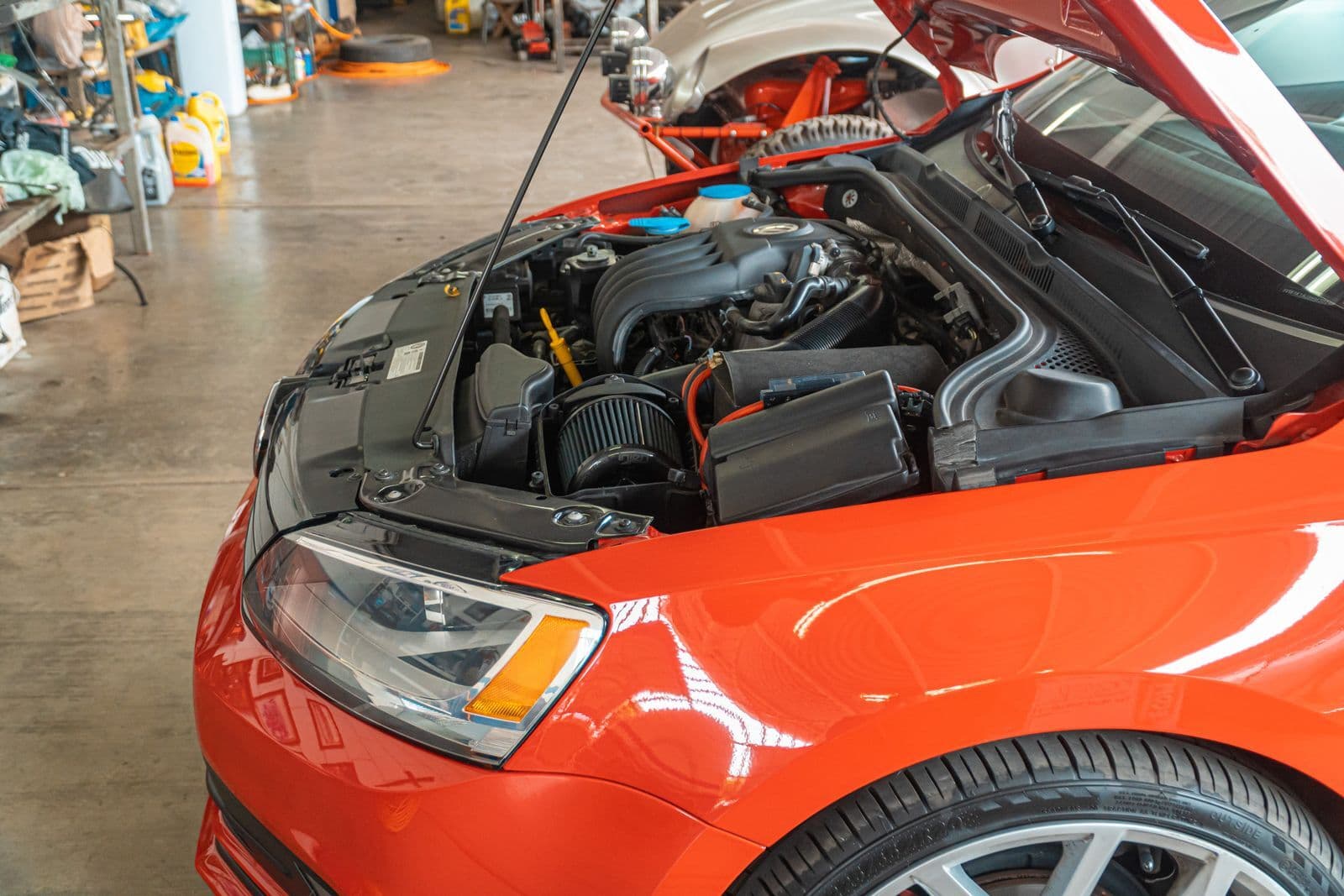
The story is that modern cars swapped metal for plastic in the cooling system, and that the plastic slowly cooks itself to death. The material mechanism behind that story is real and has been measured in a laboratory. What the complaint record shows is much narrower: the failures cluster on a small number of specific designs, and the most serious cooling-related fire recalls we could retrieve were not caused by a plastic part at all.
- Applies to
- Glass-filled nylon (PA66/GF30) coolant parts
- Measured
- 42.5-45.0% tensile strength loss after 1008 h at 130 °C
- Not measured
- Any service life for these parts
- Evidence
- Peer-reviewed immersion study, US regulator complaint data
- Australian context
- Average vehicle age 10.6 years
What hot coolant does to glass-filled nylon
Polyamide 66 reinforced with about 30% glass fibre, usually written PA66/GF30, is widely used for thermostat housings, radiator end tanks and coolant flanges. In a 2019 study in Molecules (opens in a new tab), four commercial PA66/GF30 grades were immersed in monoethylene glycol coolant at a constant 130 °C for 1008 hours. Tensile strength fell from 178 to 100, 185 to 102, 171 to 94 and 167 to 96 MPa - losses of 42.51%, 44.86%, 45.03% and 43.82%.
The mechanism the authors identify (opens in a new tab) is chemical, not mechanical. Glycol's hydroxyl groups interact with the polar groups on the nylon chain and hydrolyse the amide bond; pyrolysis-GC/MS found 1,6-hexanediamine as a scission product, rising with immersion time. Absorbed hydroxyl also acts as a plasticiser between chains and at the glass-fibre surface, degrading the transfer of stress from the plastic into the fibre that reinforces it.
Read the conditions before you read the number. That test was continuous total immersion in near-neat glycol at a constant 130 °C (opens in a new tab): no thermal cycling, no pressure cycling, no air interface, no 50/50 dilution, and above the normal operating temperature of a maintained system. The authors make no service-life prediction and did not test a formulated in-service coolant. Turning 43% into "your thermostat housing is half dead at eight years" is an extrapolation the study does not support, and we could not find any source that predicts a service life for these parts.
It goes soft, not brittle
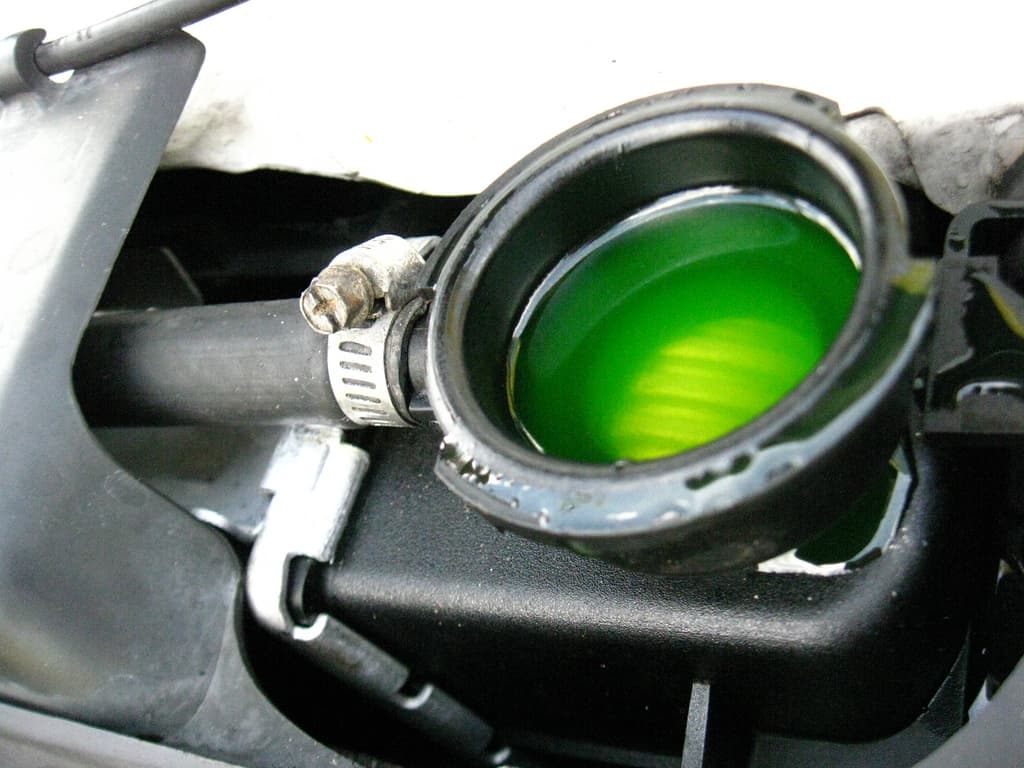
The usual consumer explanation is that the plastic goes brittle and shatters. Under this test it did close to the opposite. Tensile modulus fell 49-55% (opens in a new tab) - further than strength - elongation at break rose 23-63%, and impact strength was essentially flat, ranging from -3% to +15%. The aged material became more compliant, not more brittle.
That distinction matters because short-fibre reinforcement depends on shear transfer at the fibre surface. Lose the interface and you lose stiffness faster than you lose ultimate strength, so a housing can be well down on capability while still looking and behaving normally. It is the pattern this series keeps running into: the part is not built with a generous margin, it is built to a specification - a fluid, a temperature, a pressure - and it performs to that specification until the specification stops being met.
Even the fluid is part of the spec. In a 2025 study of glass-fibre polypropylene held in a concrete-simulating alkaline solution (opens in a new tab) at pH about 12.6 and 60 °C for 90 days, hydroxyl ions corroded the silica network at the fibre surface and the glass fibre mass fraction fell from 79.9% to 73.65%; the authors describe fibre corrosion, matrix chain breakage and debonding as a coupled process rather than separate routes. That work was done for concrete reinforcement, not cooling systems, and coolant is far less alkaline than the solution tested, so it indicates a possible contributing mechanism and nothing stronger. We also could not verify the commonly repeated claim that in-service coolant measurably drops in pH and acid-catalyses this - the oxidation chemistry is established elsewhere, but no primary measurement in engine coolant was reached.
Where the complaints actually cluster
Owner-reported cooling complaints are not spread evenly across designs. Of the 585 complaints filed against the MY2013 Chevrolet Cruze in the US regulator's database (opens in a new tab) (retrieved 13 August 2026), about one in five mention coolant, a thermostat, overheating, the water pump or the radiator. Dozens name the thermostat housing specifically, and several owners describe replacing it repeatedly: one reports it "has been replaced 4 times, it is still over heating" (ODI 11464586).
Those are unverified owner reports, not findings. They are a count, not a rate: there is no denominator, they are influenced by how many cars were sold and how much attention a problem gets, and the database does not record engine variant - so the pattern cannot be pinned on one engine. What it does suggest is repeat failure of the same part rather than one-off defects, which is what you would expect from a time-and-temperature process rather than a random fault.
The counter-evidence: the platforms most often blamed show almost nothing
Here is the part that cuts against this article's own premise. One of the platforms most often blamed online for plastic cooling failures shows almost no cooling signal in the same database. MY2014 Jeep Cherokee returned 2,639 complaints with 2 cooling-related (opens in a new tab). A general modern-car epidemic is not what this dataset looks like.
The single Cherokee complaint that explicitly names "a plastic housing that cracks and warps easily" is about the oil filter housing, not the thermostat housing (opens in a new tab) (ODI 11745945) - the popular version of that story appears to have the wrong part.
And the most severe cases on the public record are not plastic failures. In US recall 12V431000 (opens in a new tab), Ford reported that on certain MY2013 Escape vehicles with the 1.6 L engine the "cylinder head cup plug (freeze plug) may become dislodged resulting in significant loss of engine coolant", with the consequence that "as leaking engine coolant evaporates on the hot engine, the glycol may ignite causing an engine compartment fire". A cup plug is metal - our observation, since the record names no material. In recall 13V583000 (opens in a new tab), the same vehicles "may experience localized overheating of the engine cylinder head which may cause cracks that could allow oil to leak". Ford states no root cause and the record does not identify any cooling component as the trigger. Both are United States campaigns; Australian applicability is not established by them.
Also unsubstantiated at primary source, despite being repeated constantly:
- That 2-ethylhexanoic acid in OAT coolants attacks nylon parts. The one study that actually immersed PA66/GF30 in that coolant attributes the damage to glycol hydrolysis and says nothing about 2-EHA.
- That plastic water pump impellers commonly shear off the shaft with no leak and no warning. We reached no bulletin, recall or filing evidencing it.
- That the 3.6 L Pentastar plastic thermostat housing is or was recalled. We found no cooling-related recall for the platforms checked.
- That coolant specifications include a plastics compatibility test. We deliberately did not obtain the ASTM standards, so we cannot characterise their contents in either direction.
Why losing coolant is expensive
The reason a cheap part matters is what sits downstream of it. Cast aluminium alloys of the type used in engine castings show a steep transition in hardness reduction between 220 and 238 °C (opens in a new tab), with Al-Si casting grades traditionally limited to below 180 °C in engine applications, and for wrought AA6061-T6 "most strength reduction is permanent upon cooling". Fatigue strength falls too: AlSi8Cu3 by 25% at 150 °C.
Those are metal temperatures measured on specimens, not instrumented engines - and metal temperature is not coolant temperature. A steam-blanketed region can run far hotter than the gauge suggests, which is precisely why an overheat is not a scare and then a recovery.
Topping up a slow coolant loss and driving on is the mistake that gets expensive: the gauge reads coolant, not metal, and the strength aluminium loses to a local overheat is not recovered when it cools back down.
What this means if you are buying
Hydrolytic degradation is cumulative in time at temperature, so exposure scales with a car's age rather than its badge. The ABS Motor Vehicle Census recorded 20.1 million registered vehicles at 31 January 2021 with an average age of 10.6 years (opens in a new tab), from 13.3 years in Tasmania to 9.5 in the ACT. A fleet that old puts a large share of Australian cars into the window where these parts get replaced. We could not substantiate the intuitive argument that Australian heat and towing make it worse - it is plausible, and we found no source for it.
On inspection, look for crusted coolant residue at housing joints and end-tank seams, a low or stained reservoir, and any history of repeat replacement of the same part. On paperwork, remember a recall register records safety defects, not durability. Coolant leaks are not exempt from recall, as the Escape campaigns above show, but the ordinary case - a housing that weeps years out of warranty with no fire or stall attached - is handled by a service bulletin, a warranty extension, or nothing, and will never appear on a recall list. Check vehiclerecalls.gov.au as well as any overseas register, and treat a clean result as the absence of a known safety defect rather than proof of reliability.
If a part like this fails, the warranty sticker is not the end of it. The ACCC states there are "no set rules for deciding whether a product is of acceptable quality, or how long a product should last for", that acceptable quality means a product "is safe, durable and free from defects", and that "the basic rights covered by consumer guarantees can't be taken away by anything a business says or does" (opens in a new tab). Remedies can extend to "compensation for damages or loss" - which is the limb that matters when a low-cost coolant component takes an engine with it.