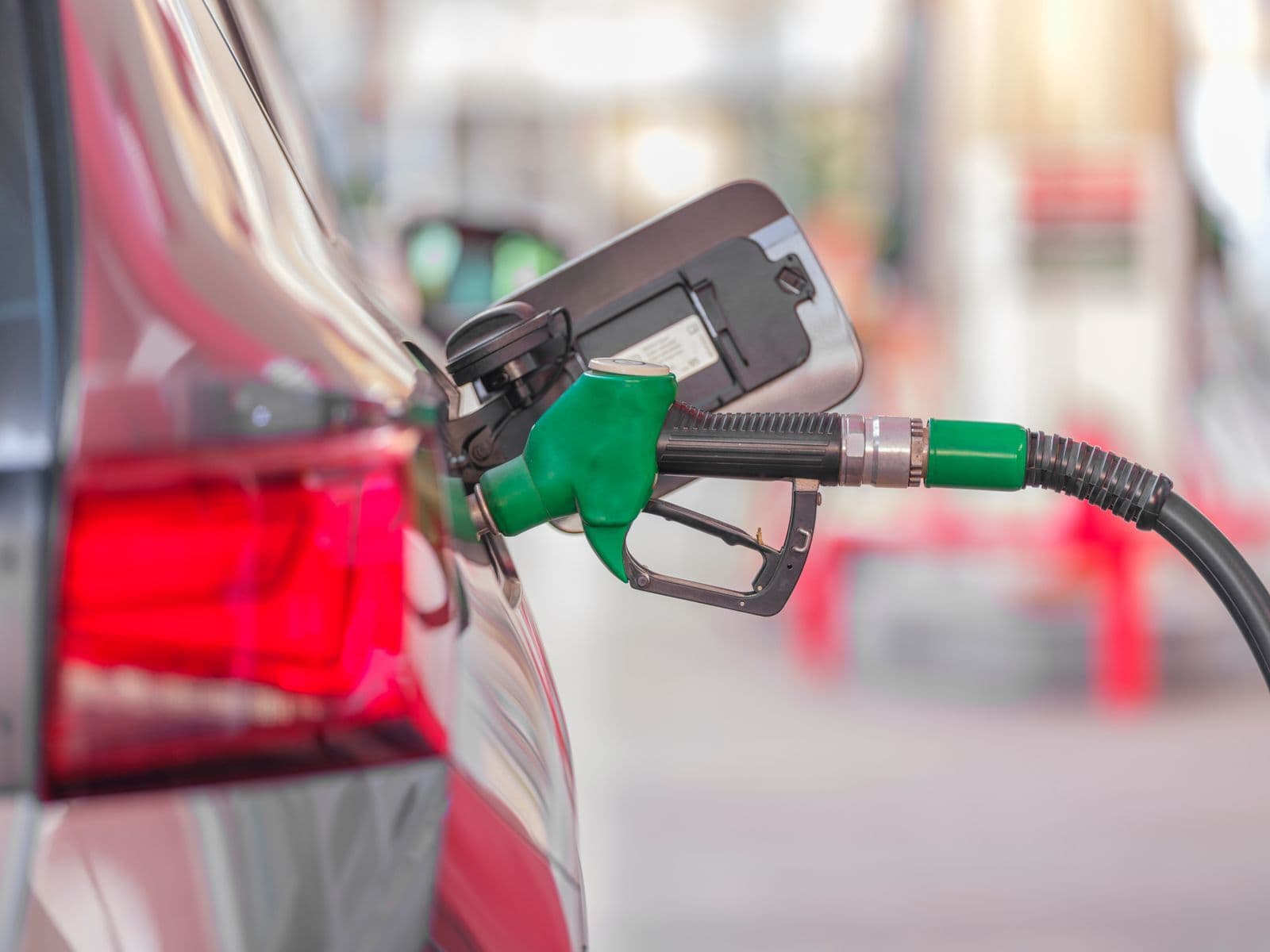
An Australian forecourt can carry seven or eight different products: 91, E10, 95, 98, E85, diesel, premium diesel and LPG, plus AdBlue in a separate dispenser. Most drivers only ever need one of them. This guide runs through each fuel, what it is actually made of, which cars it suits, and whether paying extra ever pays off.
Start with the fuel flap
Every car sold in Australia carries the manufacturer's minimum fuel requirement on a label inside the fuel filler flap, and again in the owner's manual. It will say something like "Unleaded 91 RON", "Premium Unleaded 95 RON min", "98 RON" or "Diesel", and sometimes "E10 suitable". That label is the answer to almost every question on this page. Everything below explains why it says what it says.
Regular unleaded, 91 RON
Regular unleaded (RULP, or just "unleaded") is the baseline petrol grade in Australia and the fuel the majority of the passenger fleet is built for. Its legal minimum is 91 RON and 81 MON. It is sold at every servo in the country and is the cheapest petrol grade where E10 is not offered.
Suits: most naturally aspirated Japanese, Korean and Australian-designed engines, most small cars, most utes and SUVs with petrol engines from the mainstream brands. If the flap says 91, this is your fuel and premium buys you nothing.
E10, 91 with up to 10 per cent ethanol
E10 is regular 91 base petrol blended with 9 to 10 per cent ethanol. In NSW the ethanol is mostly made from wheat starch left over from flour milling; Queensland's comes from grain sorghum. The blend lifts the octane to about 94 RON, and it is often the cheapest petrol at the pump in NSW and Queensland because both states have biofuel mandates that push retailers to sell it.
Two things to know. First, ethanol carries less energy per litre than petrol, so a tank of E10 goes about 3 per cent less far than a tank of 91. RACQ's rule is that E10 has to be at least 3 per cent cheaper than 91 to come out ahead. Second, ethanol is a solvent and attracts water, so it is not suitable for every engine. Most petrol cars built after 2000 are E10 compatible; older vehicles, particularly pre-1986 cars, anything with a carburettor, older motorcycles, boats and small engines generally are not. The NSW Government runs an online E10 compatibility checker covering most makes and models, and the manufacturer's advice always wins. If you cannot confirm compatibility, use 91.
Premium unleaded, 95 RON
Premium 95 must meet a minimum of 95 RON and 85 MON. It is the standard fuel across Europe and the minimum for most European-designed engines sold here, as well as a growing number of turbocharged petrol cars from Japanese and Korean brands. Since 15 December 2025 it has also been the grade with the tightest aromatics limit in Australia, 35 per cent versus 45 per cent for 91 and 98, which was done to support Euro 6d-compliant engines.
Suits: any car with "95" on the flap. In a car designed for 91 it is generally a waste of money; NRMA's guidance is that the maximum theoretical economy gain is about one per cent per octane number, and only if the engine's computer can exploit it.
Premium unleaded, 98 RON
There is no separate legal standard for 98; it is sold against the premium (95) standard with a higher octane. Each brand markets it under its own name, such as Ampol Amplify 98, BP Ultimate 98, Shell V-Power (Viva Energy) or 7-Eleven's Mobil Synergy Supreme+ 98, and these are also the products that carry each company's strongest detergent additive package.
Suits: high-compression and high-boost engines, sports cars, performance variants of mainstream models, and some newer cars fitted with petrol particulate filters where the manufacturer specifies 98. If the flap says 98, do not experiment with lower grades; a turbocharged engine tuned for 98 can drop into limp mode on 91. If the flap says 91 or 95, 98 offers no measurable benefit beyond the additive package.
E85
E85 is 70 to 85 per cent ethanol blended with petrol, with an octane rating around 105 to 108 RON. It only works in flex-fuel vehicles (Holden and Saab sold factory versions here) or engines that have been purpose-built or tuned for it, because standard fuel pumps, seals and lines are not designed for that much ethanol. Availability is limited to a small number of metro United sites in Queensland, NSW and Victoria. For everyone else it is not an option and putting it in a normal car will cause damage.
Diesel
Automotive diesel is a different fuel for a different engine. Diesels ignite by compression alone, so the relevant quality measure is cetane, the speed with which the fuel self-ignites, rather than octane, which is the resistance to it. Australian diesel is regulated under its own determination with minimum cetane requirements and a 10 ppm sulfur cap that has applied since 2009, long before petrol caught up.
Two seasonal notes. In alpine areas during winter, servos sell "alpine diesel", which has a lower cloud point so wax does not form in the fuel at sub-zero temperatures; ordinary diesel can gel and block filters on a cold morning in the high country. And during the 2026 supply disruption the government temporarily allowed diesel with a flash point of 60.5°C instead of 61.5°C until 30 September 2026, a change with no practical effect on drivers.
Premium diesel
Every major brand sells a "premium" diesel: Ampol Amplify Diesel, BP Ultimate Diesel, Shell V-Power Diesel, Mobil Synergy Diesel and so on. The base fuel is the same diesel from the same terminal, with a detergent and lubricity additive package blended in. RAC WA's assessment, after running its own tests, was that premium diesel has the same cetane rating as regular and that credible evidence for the claimed cleaning benefits is thin. The additive packages are real; whether they are worth 10 to 20 cents a litre in a modern common-rail diesel that is serviced properly is a judgement call. They are not required by any manufacturer.
AdBlue
AdBlue is not a fuel. It is a urea solution injected into the exhaust of many modern diesels to reduce nitrogen oxide emissions, and it goes into its own tank, usually behind a blue cap next to the diesel filler. Put it in the fuel tank and the outcome is among the worst misfuelling scenarios there is. See MotorLoop's guide to putting the wrong fuel in your car.
LPG (autogas)
Automotive LPG is regulated under its own standard and was once a major grade in Australia, but with the end of local LPG-capable car production its availability has shrunk and many servos have removed the dispensers. If you run an LPG-converted or dual-fuel car, plan refuelling on longer trips.
Which grade is cheapest to run?
For a car designed for 91: E10 if it is more than 3 per cent cheaper than 91 and your car is compatible, otherwise 91. For a car designed for 95: 95. For a car designed for 98: 98. Going up a grade is money spent on octane the engine cannot use; going down a grade in a car that needs premium costs you economy, power and eventually the engine.
FAQs
My car says "95 recommended". Can I use 91?
Usually yes, with a small loss of power and economy, because the engine's knock control is designed to cope. "Recommended" is different from "minimum" or "required"; if the label uses those words, stick to the grade it names.
Is premium petrol cleaner?
Not any more in the way it used to be. Before December 2025, 91 was allowed 150 ppm sulfur and premium 50 ppm. Now all petrol grades share a 10 ppm limit (temporarily 50 ppm during 2026). The remaining difference is the detergent additive package, which varies by brand rather than grade.
Why is E10 sometimes the same price as 91?
Retailers set the gap. In NSW and Queensland the biofuel mandates keep E10 widely available and usually a few cents cheaper; elsewhere it is often absent or priced level with 91, in which case there is no reason to choose it.
Can a diesel car use premium diesel and regular interchangeably?
Yes. They are the same base fuel and can be mixed in any proportion.
What does "RON" stand for?
Research Octane Number, the standard laboratory measure of a petrol's resistance to knock. MotorLoop has a full explainer on what the octane number means.