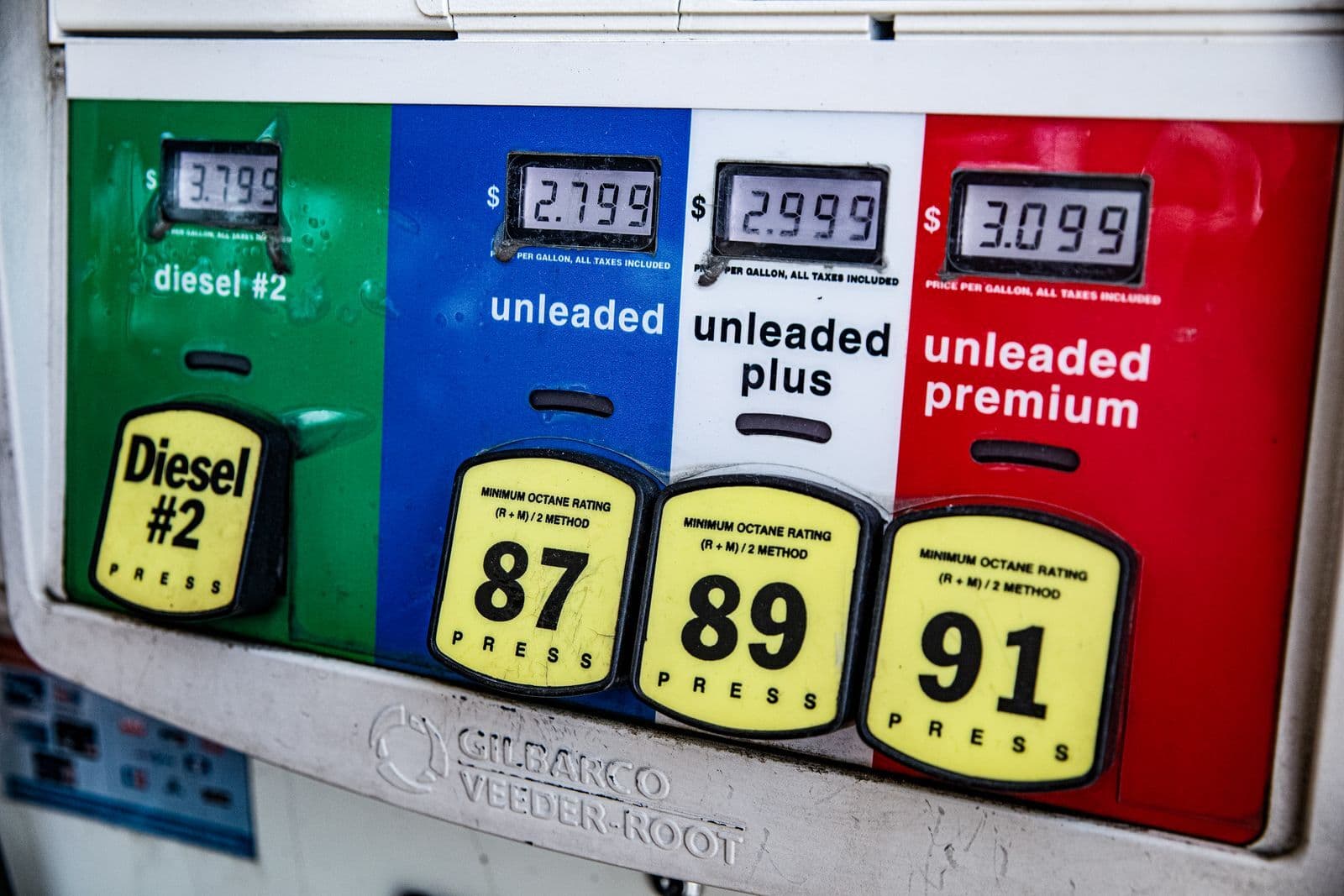
The number on the bowser, 91, 95 or 98, is not a measure of how much energy is in the fuel, how clean it is, or how much power it makes. It is a measure of one thing: how hard the fuel is to ignite by pressure alone. Understanding that single idea explains why some engines need premium, why most do not, and why "98 is better fuel" is only true for some cars.
Knock: the problem octane solves
A petrol engine is supposed to ignite the fuel-air mixture with a spark, at a precise moment, so a single flame front sweeps across the cylinder and pushes the piston down smoothly. When the piston squeezes the mixture, pressure and temperature rise. If the fuel at the far side of the chamber gets hot enough to ignite on its own before the flame front reaches it, you get a second, uncontrolled explosion colliding with the first. That is knock, also called pinging or detonation. You hear it as a metallic rattle under load, and it hammers pistons, rings and bearings. Sustained knock can hole a piston.
The higher an engine's compression ratio, or the more boost a turbocharger or supercharger adds, the hotter and higher-pressure the mixture gets, and the more prone it is to knock. Octane rating is simply a scale for how much of that abuse a fuel can take before it self-ignites.
How the number is measured
Octane is measured in a laboratory engine, not calculated from the fuel's chemistry. The reference scale runs from n-heptane, a hydrocarbon that knocks very easily (defined as 0), to iso-octane, which resists knock very well (defined as 100). A fuel rated 95 knocks the same way a blend of 95 per cent iso-octane and 5 per cent n-heptane does under the test conditions. Fuels can score above 100, ethanol has a RON of around 129, because the scale is extrapolated, not capped.
There are two standard tests, run on the same type of variable-compression single-cylinder engine:
- RON (Research Octane Number) is measured at 600 rpm with a cool intake charge and fixed ignition timing. It represents mild, low-speed driving.
- MON (Motor Octane Number) is measured at 900 rpm with a preheated intake charge and variable timing. It is a harsher test that represents high-speed, high-load driving. The MON of pump petrol is typically 8 to 12 points below its RON.
Australia, Europe, the UK and most of Asia put the RON on the pump. The United States and Canada use the AKI (Anti-Knock Index), which is the average of the two, (R+M)/2. That is why American "regular" is 87 and "premium" is 91 or 93: those are the same fuels Australians know as roughly 91, 95 and 98 RON. A car imported from the US that says "91 octane minimum" on the fuel flap wants 95 RON here, not 91.
What the Australian grades actually are
The Commonwealth petrol standard defines two grades. Regular unleaded must have a minimum RON of 91 and a minimum MON of 81. Premium unleaded must have a minimum RON of 95 and MON of 85. There is no separate 98 standard: 98 RON petrol is sold against the premium (95) standard with a higher octane, so the legal floor for "98" is 95. In practice retailers test and label it as 98.
- 91 RON, regular unleaded (RULP): the baseline, and the fuel the majority of Australian cars are designed for.
- E10: 91 RON base petrol blended with 9 to 10 per cent ethanol, which lifts the RON to about 94. It is not a premium fuel and it carries slightly less energy per litre.
- 95 RON, premium unleaded (PULP): required by most European-designed engines and a growing share of turbocharged cars.
- 98 RON, premium unleaded: for high-compression and high-boost engines, sports cars and performance variants.
- E85: 70 to 85 per cent ethanol, around 105 to 108 RON, for flex-fuel and purpose-built engines only.
Together, 91 and 98 account for roughly 88 per cent of Australia's petrol volume; 95 is the remainder.
Why more octane is not more power (usually)
Octane is a threshold property. If your engine never reaches the pressures and temperatures that would make 91 knock, then 95 or 98 has nothing extra to offer it. The fuel does not burn hotter, does not contain meaningfully more energy, and does not make the car faster. Motoring bodies including NRMA, RACV and RACQ all say the same thing: in a car designed for 91, premium is unlikely to deliver a measurable gain in performance or economy.
The exception is engines that are designed to exploit higher octane. Modern engines carry a knock sensor, a microphone bolted to the block that listens for detonation. When it hears knock, the engine computer retards ignition timing and sometimes richens the mixture until the knock stops. That protects the engine but costs power and economy. An engine tuned for 95 or 98 running on 91 spends its life pulling timing; the same engine on the correct fuel can advance timing to its design point. NRMA's long-standing rule of thumb is a maximum of about one per cent economy improvement per octane number, and only where the engine can actually use it.
Some engines are calibrated with a range: "95 recommended, 91 acceptable". Those cars will run on 91 with reduced output and slightly higher consumption, without damage, because the knock control is designed to handle it. Cars that say "98 required" or "95 minimum" are a different story; see MotorLoop's guide to using the wrong fuel.
Octane and ethanol
Ethanol has very high octane, which is why blending 10 per cent into 91 petrol produces a 94 RON fuel, and why E85 can support very high compression and boost. The trade-off is energy density: a litre of E10 carries roughly 3 per cent less energy than a litre of 91, so the fuel economy is slightly worse. RACQ's guidance is that E10 needs to be at least 3 per cent cheaper than 91 to break even.
Octane versus quality
Octane says nothing about sulfur content, aromatics, detergent additives or cleanliness. Those are governed separately by the fuel quality standard and by each brand's additive package. Historically, Australia's 91 was allowed 150 ppm sulfur and premium 50 ppm, which is why some mechanics recommended premium for reasons that had nothing to do with knock. Since 15 December 2025 all grades are legally held to 10 ppm (with a temporary relaxation during the 2026 supply disruption), so the sulfur argument for premium has largely disappeared. See MotorLoop's guide to Australia's fuel quality standards for the detail.
FAQs
Is 98 better for my engine than 91?
Only if the manufacturer specifies it. In a car designed for 91, 98 will not clean, protect or improve the engine in any measurable way; the octane simply goes unused. Follow the label inside the fuel flap or the owner's manual.
Why does the US call premium "91" when Australia calls it "95"?
Different scales. The US pump shows the AKI, the average of RON and MON. Because MON is typically 8 to 12 points lower than RON, an AKI of 91 corresponds to about 95 RON, and 93 AKI to about 98 RON.
Can I mix 91 and 98 in the same tank?
Yes. The octane of a blend is roughly proportional to the mix. Half a tank of 91 topped up with 98 gives something close to 95, which is a legitimate way to get a car that wants 95 through a town that only sells 91 and 98.
Does higher octane fuel last longer in storage?
No. Octane does not affect storage life. Petrol of any grade begins to degrade within a few months as light fractions evaporate and the fuel oxidises, and ethanol blends absorb moisture faster.
Does E10's 94 RON make it a substitute for 95?
No. E10 sits above 91 on the octane scale but it is not manufactured to the premium standard, and carmakers that specify 95 mean 95 RON premium. If your car requires 95, use 95.