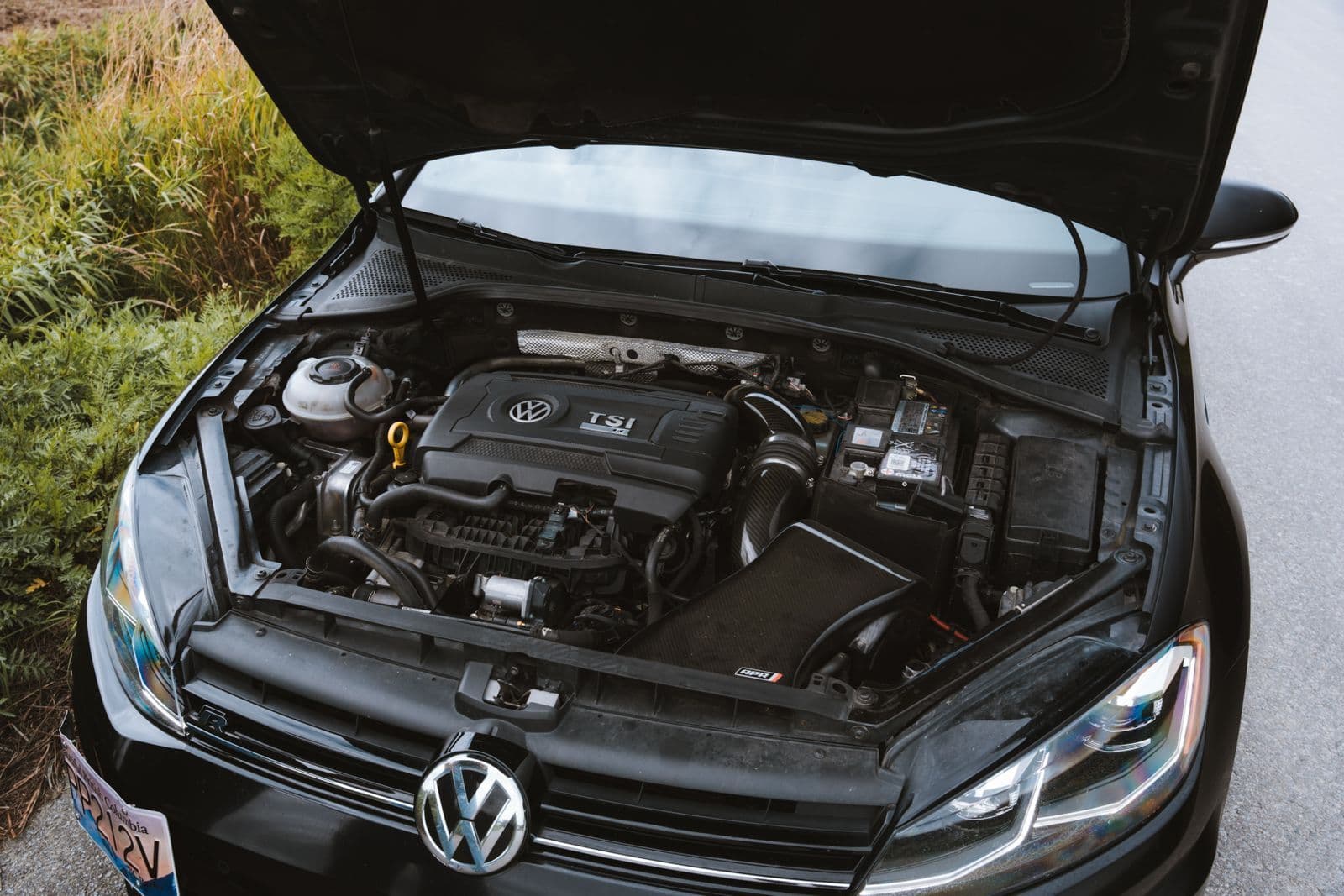
A timing chain has a reputation as the part you fit and forget. We could not find a manufacturer document that says so. What the record does show is an asymmetry: belts get a published replacement figure in the service schedule, while chains turn up in warranty extensions, special coverages and safety recalls instead.
- Applies to
- Chain-driven petrol engines, especially turbocharged direct injection
- Mechanism
- Pin and bush joint wear increasing chain pitch, not metal stretching
- Evidence
- ASTM D8279 oil test, four manufacturer bulletins, one Australian recall
- Published service limit
- 0.3% to 0.5% elongation depending on application
- Australian record
- Recall REC-001025, 42,399 Mitsubishi Pajeros, February 2015
"Stretch" is the wrong word, and the right word explains the failure
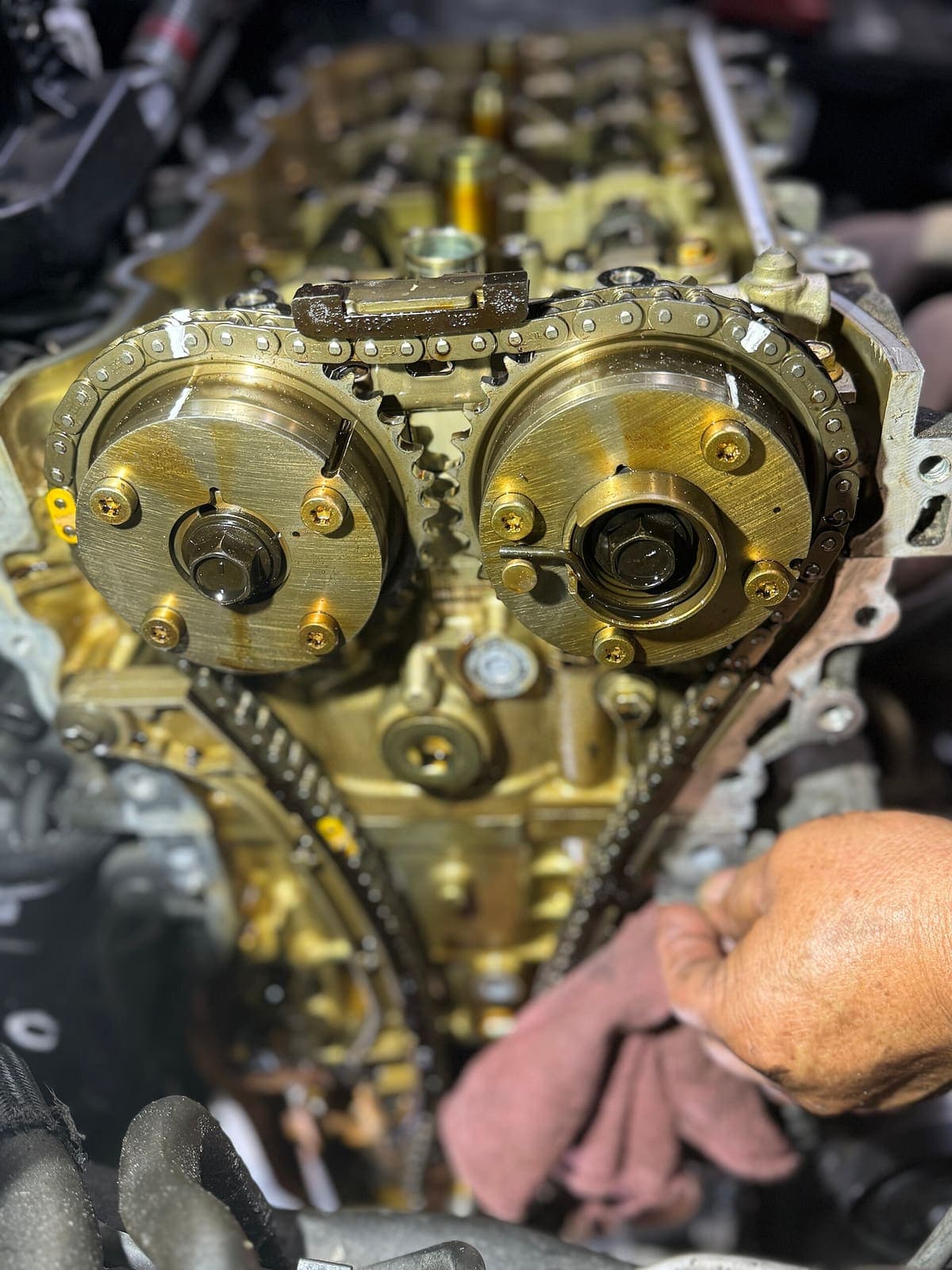
The metal does not stretch. Each link is a pin sliding inside a bush under high contact pressure, and a peer-reviewed teardown study of engine-run chains by Summer, Bergmann and Grün at Montanuniversität Leoben (opens in a new tab) traces the wear through stages: the hard coating on the pin breaks out, the softer substrate is exposed, abrasive grooving follows, then adhesive wear against the bush. Their nanoindentation figures show why the coating matters so much - the chromium nitride pin coating measured 22.7 GPa against 7.74 GPa for the pin substrate underneath and 7.2 GPa for the bush.
Summed across every joint, that clearance growth appears as an increase in the chain's effective pitch, which retards valve timing. A single badly worn joint can fracture and break the chain outright. The same study notes that published service limits for chain elongation run from 0.3% to 0.5% depending on the application (opens in a new tab), so a measurable amount of wear is expected rather than a defect.
That is the shape of the change worth understanding. The joint is not built with a large margin and left to degrade slowly. It is built to a specification - a coating, an oil, a drain interval - and it holds up as long as the specification holds up.
The oil industry built a test for chain wear, then tightened it
The clearest evidence that this is a real, industry-acknowledged failure mode is that the lubricant industry standardised a test around it. ASTM D8279 (opens in a new tab) exists because undesirable timing-chain wear had been observed with turbocharged gasoline direct-injection engines in field service, and because reference oils of known performance produced separable results - meaning the oil is a controlling variable, not just the hardware.
The mechanism the test forces is soot. Direct injection wets the cylinder wall and cold or rich running generates soot that contaminates the oil. Those particles enter the pin and bush joints as a three-body abrasive and compete with the anti-wear additives, so the protective tribofilm cannot form. Southwest Research Institute's specification sheet for the Sequence X test (opens in a new tab) describes the fixture: a 2012 Ford 2.0L EcoBoost run for 216 hours in six two-stage cycles per day, phase one at lambda 0.78 with low coolant and crankcase ventilation temperatures, phase two at lambda 0.98, with the piston ring gaps opened up to force around 70 litres per minute of blow-by. Chain length is measured after break-in and again at the end, and the pass mark is 0.085% elongation. The test became a mandatory element of ILSAC GF-6 and API SP in 2020.
It has since been made harder. Chevron's March 2025 overview of ILSAC GF-7 (opens in a new tab) shows the maximum permitted Sequence X chain wear moving from 0.085% under GF-6A and GF-6B to 0.080% under GF-7A and GF-7B, which the same briefing calls roughly a 5% change in wear performance. Worth noting what that document does not say: Chevron attributes GF-7's objectives to fuel economy and emissions targets and to advances in engine technology, and it names no manufacturer and cites no field failures as the reason for the chain-wear change.
Two cautions on those numbers. The 0.085% figure is an accelerated 216-hour result on one specific engine used to rank oils, not a prediction of vehicle life, so it cannot be read against the 0.3% to 0.5% service limits as though they measure the same thing. And ASTM's own scope says chain wear "has been observed" with these engines in field service, which is an observation about some engines, not a property of every turbocharged or direct-injection engine.
What manufacturers have actually put on the record
General Motors told its dealers, in a US and Canadian Special Coverage bulletin (11340C, November 2012 (opens in a new tab)), that on the 2.8L and 3.6L V6 fitted to the 2007 GMC Acadia and Saturn Outlook and to 2007 to 2009 Cadillac CTS, SRX and STS models among others, "under certain driving conditions, and with the vehicle's original oil change intervals, the timing chain could wear prematurely and cause the illumination of the Service Engine Soon light." That is a manufacturer naming the drain interval as a factor. Its first remedy was a control-module reprogram to shorten the oil-life interval, which GM told owners was done "to prevent premature wear of the timing chain" before conceding the reprogramming "may not fully correct this condition for all vehicles."
BMW of North America extended coverage on the engine timing chain and oil pump drive chain modules of the N20 and N26 four-cylinder turbo petrol engines to 7 years or 70,000 miles from the original in-service date, in Service Information bulletin B11 03 17 (opens in a new tab). The bulletin states in terms that it "is NOT a notice of a Recall or Service Action", and it is worth reading it that way. Volkswagen Group of America separately notified its US dealers of a class action settlement (opens in a new tab) covering repair or replacement of a failed timing chain or tensioner for 10 years or 100,000 miles, with consequential engine damage reimbursed on a sliding scale from 100% down to 25%, and only where the owner could produce proof of adherence to the oil maintenance schedule.
None of those three programmes applies to an Australian-delivered car. GM's was a US and Canadian dealer program whose reimbursement deadlines closed in 2013. BMW's bulletin expressly lists vehicles operated and repaired outside the United States and Puerto Rico as non-qualifying. The Volkswagen settlement was administered by US dealers through a US settlement administrator. All three have also run out of time on the vehicles they covered.
Counting recall entries is a bad way to size this problem, too. Mercedes-Benz recall 19V-821 (opens in a new tab) concerned a threaded connection holding the timing chain idler gear on the M176 V8, and involved approximately six vehicles. That is an assembly defect, not wear, and it says nothing about the fleet.
The Australian record
Australia has one directly on-point regulator entry. Recall REC-001025 (opens in a new tab), published 16 February 2015, covered 42,399 Mitsubishi Pajeros built between 2006 and 2014, and stated the defect as the "inappropriate structure of the engine timing chain tensioner", with abnormal noise from the loss of tension control and the hazard that the chain may break and the engine stop and not restart. The remedy was dealer inspection and repair.
That is a genuine local record about tensioner design. Beyond it, none of the overseas programmes described above reaches an Australian-delivered car, so an Australian owner's rights come from the Australian Consumer Law rather than from a manufacturer bulletin. Check what those guarantees cover for a particular car before assuming any of the overseas coverage is available here.
The counter-evidence: the worst recent cam-drive failure in the market was a belt
If the argument is that chains have become a liability, the strongest fact against it is that the belts did worse.
American Honda recalled 2018 to 2019 MDX and 2019 RLX, RLX Sport Hybrid and TLX models because a supplier produced timing belts that did not meet specification and "may shred or slip, causing the cam shafts to fall out of timing" (opens in a new tab), with shredded belts able to stall the vehicle and prevent a restart. That is a crash-risk safety recall, the same severity class as a broken chain. On a much larger scale, Stellantis established a Europe-wide programme covering "excessive oil consumption and/or premature degradation of the timing belt" on previous-generation PureTech 1.0 and 1.2 engines, paying 100% of parts and labour for up to 10 years or 180,000 km (opens in a new tab) plus reimbursement of owner-paid repairs.
The folklore figure for belt life is out of date as well. GM's specification for the 2.8L diesel in the 2017 to 2018 Colorado and Canyon is belt replacement at 150,000 miles, roughly 240,000 km (opens in a new tab); the bulletin exists only because a software fault made the reminder appear 50,000 miles early.
What a buyer can actually check
The symptoms are checkable before you hand over money. BMW's bulletin describes its stated symptom as a whining noise from the lower engine area near the oil pump that rises in frequency as engine speed rises, and its diagnosis uses a scan-tool test plan that reports the chain as either not stretched or stretched. A cold-start rattle that clears after a second or two is the other classic prompt for a closer look.
A scan showing no fault codes is not evidence that a timing chain is sound - Honda's own belt recall was diagnosed by physically reading a part lot code, not by plugging in a scanner, so a car can carry a defective cam drive with nothing stored.
Budget realistically if the inspection turns something up. GM's warranty labour to replace the chain on that 2.8L and 3.6L V6 was 6.9 hours on the Cadillac CTS, SRX and STS and 9.0 hours front-wheel drive or 9.2 hours all-wheel drive on the Acadia, Enclave, Traverse and Outlook, the last figures including an air-conditioning recharge and power steering and coolant refill. Labour varies enormously by engine, so get a quote for the specific car rather than assuming any multiple of a belt job. We could not find an Australian retail price for either job at primary source.
For an owner, the useful conclusion is the one GM's bulletin points at. Buy oil to the specification and manufacturer approval printed in your handbook rather than to a viscosity grade alone, and treat short trips, towing and stop-start city duty as a reason to shorten the drain interval rather than stretch it. GM said that about particular engines under particular conditions, not as a universal law - but it is the manufacturer, in its own document, naming the interval as the thing that moved.