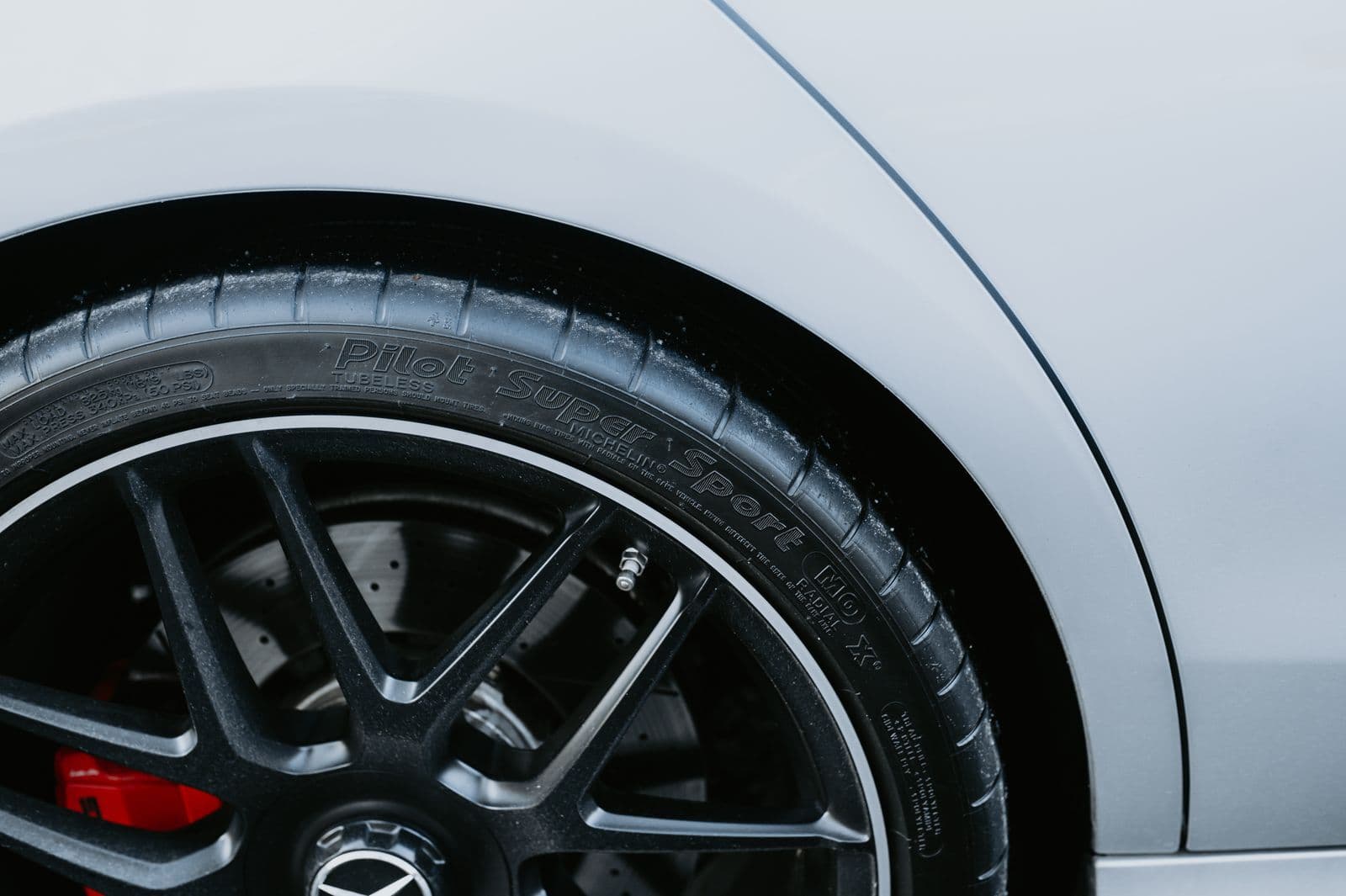
Two tyres in the same size, sitting on the same shelf, can differ in price by a factor of three. Both are round, both are black, both hold air and both are legal to fit. Almost everything that separates them is invisible from the outside — which is exactly why the cheap one sells.
Here is where the money actually goes, and what it buys you.
The difference shows up in the wet, not the dry. Nearly any tyre stops a car acceptably on dry bitumen. Wet braking is where the spread between a budget tyre and a good one turns into car lengths.
The compound is chemistry, not just rubber
A modern tread compound is a recipe with dozens of ingredients: natural and synthetic rubbers, carbon black, silica, oils, resins, curing agents. The proportions are the product. Change them and you move the tyre around what engineers call the magic triangle — the three-way tug-of-war between grip, rolling resistance and tread life.
The tension is real and unavoidable. A softer, stickier compound grips better, especially when it is cold or wet, but it abrades away faster and absorbs more energy as it flexes, which costs fuel. Harden it for long life and low fuel use and you give up wet grip. For most of tyre history, buying one meant selling another.
Silica is the reason that trade-off is less brutal than it used to be. Adding precipitated silica as a reinforcing filler, coupled to the rubber with a silane bonding agent, lets a compound stay grippy at the low frequencies that matter on a wet road while losing less energy at the frequencies that matter for rolling resistance. Published figures in the rubber industry literature put the improvement at roughly a fifth off rolling resistance with a double-digit percentage gain in wet skid performance.
That chemistry is not free. Silica-heavy compounds are harder to mix — they need longer mixing cycles at controlled temperatures to disperse properly, and badly dispersed silica performs worse than not using it at all. A budget manufacturer running a shorter mixing cycle on cheaper raw materials produces something that looks identical and behaves differently.
The casing you cannot see
Under the tread sits the part that actually holds the car up: layers of textile cord in the body ply, steel belts under the tread, a bead bundle that clamps the tyre to the rim, and often a nylon cap ply wrapped over the belts to stop them growing at speed.
What varies between price tiers is the material quality, the number and angle of the layers, and above all the uniformity — how consistently the machine lays each layer down. A tyre with uneven belt placement is out of round in a way no balancing machine can fully correct. You feel it as a steering-wheel shimmy at 100 km/h that never quite goes away, and it wears itself unevenly for the rest of its life.
Premium plants measure force variation on every tyre and reject the ones outside tolerance. That rejection rate is a cost, and it is a cost the buyer of the cheap tyre is not paying.
The tread pattern is modelled, not drawn
The grooves in a tyre are not styling. Their job is to give water somewhere to go in the fraction of a second the tread block spends on the road, and to give the rubber enough biting edges to grip while still being stiff enough not to squirm under cornering load.
Getting that right involves finite-element modelling, noise simulation to move the pattern's resonant frequencies out of the range the human ear finds most irritating, and physical iteration. Each iteration means a new mould, and a tyre mould is a serious piece of tooling. Amortising that development across a model line is a large fixed cost that a company copying a pattern does not carry.
What the testing costs
The gap that is hardest to see on a shelf is the proving ground. Developing a tyre to a target means instrumented wet and dry braking, aquaplaning lanes, high-speed durability rigs, thousands of kilometres of wear convoys, and repeating all of it every time a compound changes.
Independent European testing programmes publish the result of that spending each year, and the spread is not subtle. In recent ADAC summer tyre tests the difference in wet braking distance from 80 km/h between the best and the worst tyre in a single size has run to around 17 metres — roughly four car lengths, arriving at the point where the good tyre has already stopped. Continental has published a comparison in which a car on a budget tyre took close to 60 metres to stop from 80 km/h on wet asphalt where the same car on its premium tyre stopped in about 34 metres.
Those are the numbers the price difference buys, and they only ever get collected on a day you did not plan for.
Where a cheaper tyre is a defensible buy
None of this makes every cheap tyre a bad decision, and it is worth being straight about that.
- Mid-tier tyres from established makers test remarkably close to premium. The steep part of the curve is at the bottom of the market, not between the top two tiers. A well-reviewed mid-range tyre is usually the best value on the wall.
- A car that does 4,000 km a year in a dry climate, driven gently, is not extracting the benefit of a premium compound before the tyre ages out. Fitting the best available tyre to a rarely-used car mostly buys rubber that will time-expire with tread left.
- Matching the tyre to the car matters more than the badge. A quiet touring tyre on a family SUV will feel better than a track-oriented tyre from a famous brand.
What is difficult to defend is the unknown-brand tyre at the bottom of the price list on a car that carries your family down a wet freeway.
How to tell them apart before you hand over money
- Look up independent test results for the exact size, not the model name. Manufacturers optimise different sizes differently, and a tyre that wins in one size can be mid-pack in another.
- Read the sidewall gradings. Tyres sold into the North American market carry a UTQG stamp — a relative treadwear index, a wet traction grade of AA, A, B or C, and a temperature grade. They are self-reported by the maker and only comparable within a brand, but a C traction grade is still telling you something.
- Ask what else is in the fitter's range. A shop that stocks one budget brand and one premium brand and nothing between is not offering you the part of the market where the value is.
- Check the date code before you accept the fitting, so you are not paying new-tyre money for stock that has been sitting for years.
What this means when you are buying a car
Four tyres is a real number — often more than a service, sometimes more than a set of brake pads and discs. When you inspect a used car, the tyres are both a cost to negotiate and a signal about the previous owner. Mismatched budget brands on an otherwise well-kept car usually means somebody was economising at the end, and it is worth asking what else got the same treatment.
If you are working out what a car costs to keep on the road, our running-costs guide puts tyres alongside fuel, rego, insurance and servicing in a single weekly figure.
Related
- What a car costs to run: your questions answered
- Used car inspection and test drive: your questions answered
FAQs
Are expensive tyres actually worth the money?
In the wet, the measured difference is large enough to matter: independent European tests have recorded gaps of around 17 metres in wet braking distance from 80 km/h between the best and worst tyre in a single size. The steepest part of that curve is between unknown-brand budget tyres and competent mid-range ones, so the best value for most drivers is a well-reviewed mid-tier tyre rather than the dearest one on the wall.
Why do two tyres in the same size perform so differently?
The tread compound and the internal construction differ, and neither is visible. Compound recipes trade grip against rolling resistance against wear, and silica-based compounds — which need longer, more carefully controlled mixing — soften that trade-off. Underneath, the number, angle and consistency of the steel and textile layers decide how the tyre holds its shape under load.
Does a more expensive tyre last longer?
Not reliably, and often the opposite. Grip and tread life pull against each other, so a high-performance tyre may wear faster than a cheaper touring tyre by design. Treadwear ratings are a better guide to longevity than price, and a tyre optimised for wet grip is buying you stopping distance rather than kilometres.
What is the magic triangle in tyre design?
It is the industry's name for the three-way compromise between grip, rolling resistance and tread wear. Improving one traditionally worsened another, because all three come out of the same compound properties. Fillers such as silica shifted the whole triangle outwards rather than removing it, which is why modern tyres can be both grippier and more efficient than tyres from twenty years ago.
Is it safe to fit budget tyres to just the rear axle?
Mixing tyre models across an axle is not permitted, and mixing front to rear is a poor idea even where it is legal. If you fit two tyres rather than four, the general industry guidance is to put the newer or better pair on the rear, because a rear axle that loses grip first makes a car much harder to recover in the wet.