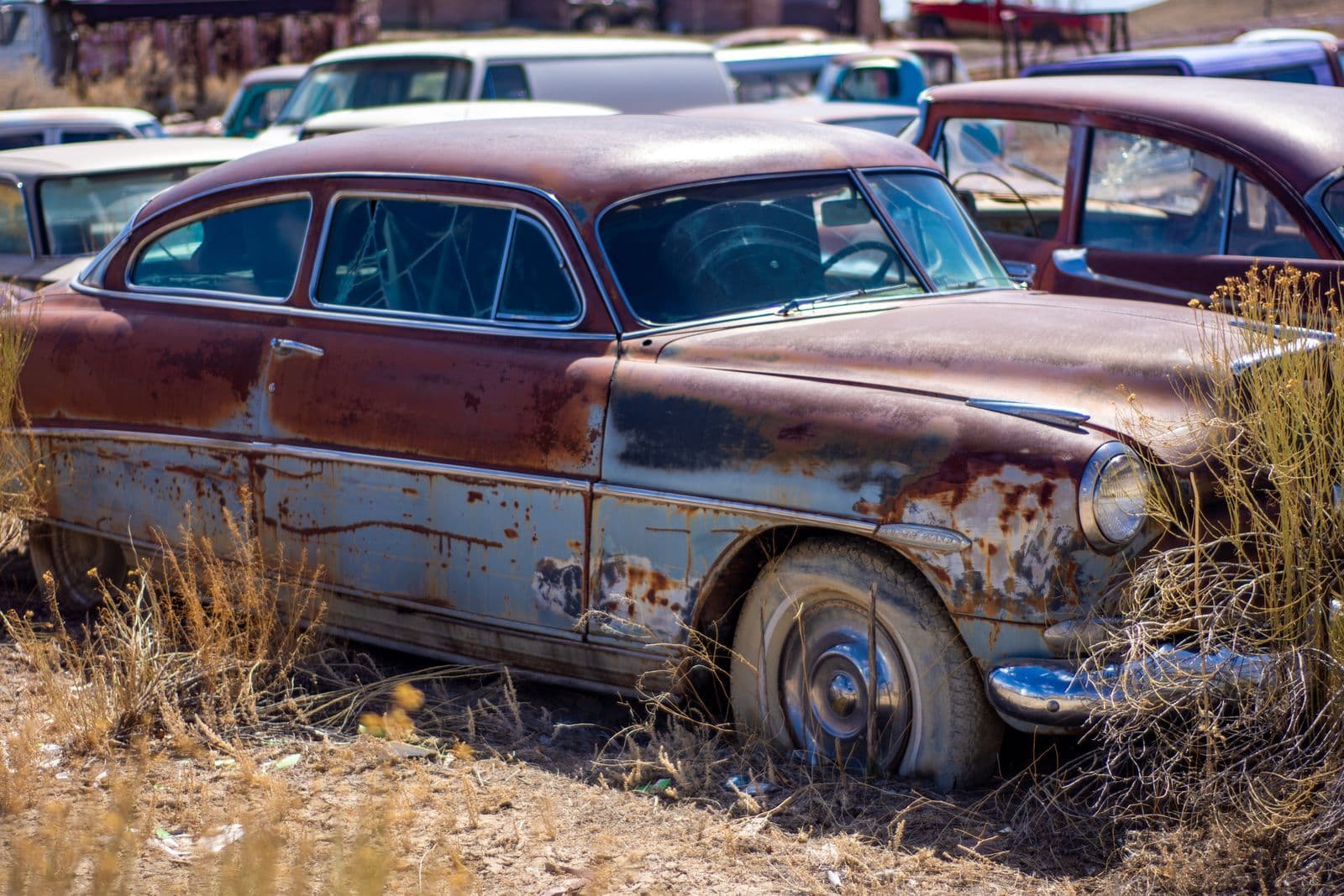
The usual line is that they built them better once. On body corrosion the record points the other way. Between the mid-1970s and the late 1980s the industry changed how a body shell is primed and what the steel underneath the paint is coated with, and both changes are dated, documented, and were paid for on purpose.
- Applies to
- Steel car bodies built since the mid-1980s
- Evidence
- Peer-reviewed review, 1987 technical paper, national inspection data
- Where it still bites
- Ladder chassis, seams and hem flanges, behind wheel-arch liners
- Australian driver
- Marine aerosol, not winter road salt
- Written cover
- Toyota Australia lists 7 years perforation
What changed in the paint shop
The single largest process change is one you cannot see: the body shell is dipped in primer and electrically charged, so the paint is driven into box sections, seams and cavities that a spray gun physically cannot reach. The industry calls that property throwing power. A 2016 open-access review of automotive body coating in Coatings (opens in a new tab) reports that 10% of all cars were electrocoated by 1970 and 90% by 1990, that the anodic process ran from 1964 to 1972 and the cathodic process from 1976 onward, and that a modern paint stack runs 100 to 140 micrometres and 9 to 16 kilograms of paint per car. Those adoption percentages are second-hand within that review rather than an industry statistic, so read them as what one published review reports.
The polarity change matters more than it sounds. In the older anodic process the body was the anode, so small amounts of iron dissolved into the film and degraded it. Reversing it stops that, and the same review (opens in a new tab) records that the modified epoxy chemistry used for cathodic e-coat also deposits more film at lower current.
None of this survives damage inflicted after the paint shop. A repair panel, a drilled accessory hole or a weld made in a body shop breaks the film, and the corrosion clock restarts at that spot.
The improvement was also bought rather than stumbled into. The US federal corrosion-cost study commissioned by Congress states that "Car manufacturers have dramatically increased the corrosion resistance of vehicles over the past two decades", and puts $2.56 billion a year of the sector's corrosion cost down to the extra manufacturing cost of corrosion engineering and corrosion-resistant materials (Koch et al., FHWA-RD-01-156, 2002 (opens in a new tab)). That is a US fleet on a 1999 to 2001 cost base, not a current or Australian figure.
Zinc under the paint
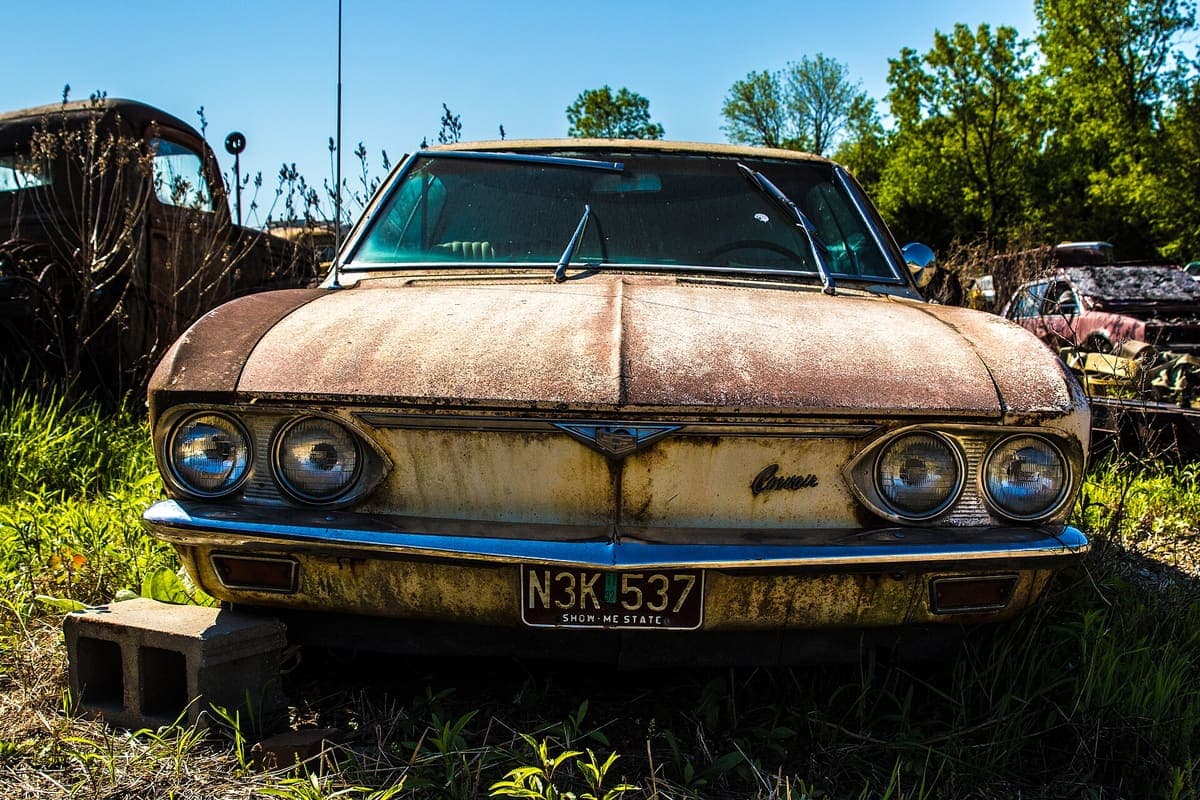
The second change is to the steel itself. Zinc is anodic to steel, so at a scratch, a cut edge or a stone chip the zinc corrodes preferentially and the exposed steel is protected until the coating is consumed.
A 1987 technical paper in Automobiltechnische Zeitschrift (opens in a new tab) states that Audi was the first volume manufacturer to market cars with a 100% galvanised steel body - the Audi 100 in 1985 and the Audi 80 in 1986 - and records that Porsche had been building sports cars with fully galvanised bodies since 1975. That priority claim is the paper's own. The same paper describes what it cost to build: galvanised steel can only be spot-welded on direct current, with different welding parameters and changed electrodes, and the shells are degreased and phosphate-treated before the cathodic primer, with PVC sealing the weld flanges and hot wax sealing the lower-body cavities after the top coat.
Two things follow that are worth saying out loud. Full galvanisation dates to the mid-1970s in low-volume sports cars and the mid-1980s in volume cars, so the gain is over cars built before that period rather than over recent used cars. And because zinc is sacrificial, "galvanised means rustproof for life" does not follow - the perforation warranty quoted below is finite. Adoption was also gradual and varied by maker and by market, and we could not find a source establishing when it became universal.
What the record shows at twelve years
A roadworthiness inspection fails a car for corrosion in load-bearing structure, which makes failure rates a direct measure rather than a self-reported one. A Bilprovningen compilation of 3.1 million Swedish inspections in 2012, cited in Folksam and Villaagarna's 2018 rust crash-test report (opens in a new tab), found 0.7% of twelve-year-old cars failed due to rust in load-bearing structures. The spread across models was wide, with the worst reaching up to 15% of cars inspected, and corrosion escalating rapidly for some models once they passed ten to twelve years. Sweden salts its roads heavily, so treat that 0.7% as an upper bound for most Australian driving.
It is a safety point, not only a cosmetic one. In the same report (opens in a new tab), a moderately rusted VW Golf V retested to its original Euro NCAP protocol scored 32 adult-protection points against 33 when new - four stars instead of five - with the authors crediting its cavity wax for keeping the inner structure sound. A heavily rusted Mazda 6 was far worse: the floor deformed vertically by over one decimetre, the wheelbase shortened by approximately one decimetre, two welds at the driver's-seat floor-to-sill joint separated leaving a 20 cm opening, the inner left side beam took four folds and was assessed as close to collapse, and the dummy's head came very close to the steering wheel with the airbag near bottoming out. The report states explicitly that surface rust along the outer shell of the side beams had negligible effect.
The evidence that cuts the other way
Modern practice partly works against itself. Plastic and felt wheel-arch liners and plastic underbody panels can let moist sand and dirt pack in behind them, sitting against the side beams and floorpan, and those areas cannot be cleaned without removing the liner - which rarely happens. Folksam and Villaagarna (opens in a new tab) note this has been criticised as the industry reducing traditional rust protection at the same time, and found the rust on their test Golf was partly caused by dirt trapped inside the wheelhouse inner fenders. That report does not measure whether the trade-off outweighs the overall gain, and neither could we.
Body-shell progress also does not automatically transfer to a separately built ladder chassis. In its dealer letter for Warranty Enhancement Program ZH7, Toyota Motor North America stated it "determined that the frames in some vehicles may not have corrosion-resistant protection sufficient for use in these areas" (opens in a new tab), and set up programs replacing frames at no cost on 2007-2008 Tundra, 2005-2008 Sequoia and 2005-2010 Tacoma models where inspection met or exceeded a court-ordered Rust Perforation Standard, arising from a class action settlement approved on 21 May 2017. That is 21 listed cold-climate jurisdictions with heavy road-salt use, and Toyota distinguishes the condition from normal surface rust - so the read-across to an Australian ute is weak. The structural lesson carries anyway: on a body-on-frame vehicle the frame is a separate structure with its own protection, so a sound body tells you nothing about the state of the rails underneath it.
The live Australian corrosion story is a current one. On 23 April 2025 the ACCC announced Federal Court proceedings against Ateco Automotive Pty Ltd, trading as LDV Automotive Australia (opens in a new tab), alleging misleading representations about the durability and suitability of T60 and G10 models (excluding eT60). The ACCC alleges the vehicles had a propensity to develop rust or corrosion within the first five years from manufacture, and that in advertising a 10-year anti-corrosion warranty between 23 April 2019 and 31 August 2020 LDV represented that the relevant T60 models did not have a material risk of developing rust or corrosion in the first 10 years. These are allegations only, untested at the date of that release.
Australia's corrosion map is its own
Australia has its own standard for atmospheric corrosivity, AS 4312 Atmospheric corrosivity zones in Australia. Airborne sea salt is a dominant spatially varying driver: CSIRO's corrosivity mapping work (opens in a new tab), built on corrosion rates measured at 475 sites across 420,000 square kilometres of South Australia, models a short-range salt term that falls off exponentially over roughly one to two kilometres from an open-surf coast, alongside medium- and long-range terms acting over tens to hundreds of kilometres. That model does not cover industrial pollution, which is a separate driver. We have not printed category corrosion rates here because the standard is paywalled and we did not read the table at source.
"Australia doesn't use road salt" is false as an absolute. Peer-reviewed measurements from 2016 to 2018 (opens in a new tab) put an estimated 890 tonnes near Perisher, NSW across the 2017 snow season, from application records obtained from contractors to NSW RMS, and up to 20 tonnes annually at Falls Creek Resort in Victoria, with stream conductivity peaking at 390 microsiemens per centimetre at salted Perisher sites against 26.5 at unsalted ones. The defensible statement is that salting here is confined to alpine areas in the June to September snow season. A car driven to the snow gets salt exposure; a car that never leaves Perth does not.
What a perforation warranty actually covers
Toyota Australia underwrites the result in writing, which is a commercial bet worth reading. Toyota Australia's warranty terms (opens in a new tab) list perforation (rust through panel) at 7 years/unlimited km, with utility deck panel paint and surface rust at 1 year/20,000 km.
That split is the point of the whole document. Perforation cover means a hole through the panel; surface rust is a different thing, treated separately and far more briefly. Warranty terms change and differ between makers, so read the current document from the maker you are buying rather than a forum post - Toyota Australia's own published term is 7 years, not the twelve you will see quoted online, and Toyota's document notes that Australian Consumer Law guarantees can exceed the warranty.
Aftermarket electronic rust-protection modules deserve a separate note. In July 1996 the US Federal Trade Commission announced a proposed consent agreement with David F. McCready (opens in a new tab), inventor and former president of RustEvader Corporation, settling false-advertising charges over the "Rust Evader", a device costing up to $600 that claimed to impress an "electron bath" on a vehicle's surface. Under the proposed order he would pay $200,000 in consumer redress, be barred from using the names "Rust Evader" and "Rust Buster" for the device and from claiming it prevents or substantially reduces corrosion, and would have to hold substantiation for any performance claim about any motor-vehicle product. The FTC alleged the salt-water tank demonstration used to sell it did not reflect real-world conditions, the process being far more effective under water. The corporation itself did not settle - a default judgment against it was announced on 7 June 1996 - and the agreement went out for 60 days of public comment and, per the FTC's standard note, is not an admission of a law violation. That is one product and one company in 1996, not a disproof of every device sold today, but we found no primary evidence that any such device works.
Inspecting the panels you can see and skipping the chassis rails, sills, floor-to-sill welds and the cavities behind the wheel-arch liners checks the part of a modern car that corrodes last.
One popular claim is worth leaving open rather than answering. "Modern cars use thinner steel, so they rust through faster" has no primary source we could find in either direction - the corrosion literature tracks the zinc coating and the paint system, not sheet gauge, and a thinner but zinc-coated, e-coated and wax-sealed panel is not comparable to a thicker bare one.