Every EV now ships with a charging brag — a peak kilowatt figure, or a "10–80% in around 20 minutes" line. Both numbers are usually true. Both are also easy to misread, because charging speed isn't one number: it's a curve that depends on the battery's chemistry, its temperature, how full it already is, and — the part the brochure quietly assumes — a charger powerful enough to feed it, which your house cannot be. Here's how the technology actually works, and how to translate the marketing into what your week will look like.
A headline charging figure is a peak, not an average — and reaching it needs the right charger, a warmed battery, and the right window on the gauge, at the same time. Judge a car by its 10–80% time on a real charger, and by what it does overnight on a powerpoint.
What's inside: the battery chemistries
Almost every EV on sale in Australia runs one of two lithium-ion families:
- NMC / NCA (nickel-based) — more energy per kilogram, so it's the chemistry behind the longest-range models. It's happiest living between roughly 20% and 80% charge, with 100% saved for trips.
- LFP (lithium iron phosphate) — cheaper, tolerant of being charged to 100% routinely, and typically rated for far more charge cycles, at the cost of lower energy density and weaker cold-weather performance. It has spread rapidly through entry and mid-range models; if your car has an LFP pack, the maker's own manual may tell you to charge it full regularly — check, because the "stop at 80%" habit is chemistry-specific advice, not a universal rule.
Two newer families are arriving behind them: sodium-ion packs (cheaper still, very cold-tolerant, first production cars announced overseas) and solid-state batteries, which remain in pilot production and are worth treating as a next-decade consideration rather than a reason to wait.
The chemistry matters to charging because it sets how much current the cells can safely absorb. Push lithium ions into an anode faster than they can settle and you get lithium plating — metallic build-up that permanently steals capacity. Every charging behaviour below is the car's battery management system protecting against exactly that.
AC and DC: two different roads into the battery
The battery stores DC; the grid supplies AC. Where the conversion happens decides how fast you can charge:
- AC charging (home and destination) — the wall feeds AC and a converter inside the car (the onboard charger) turns it into DC. That converter is the bottleneck: a standard powerpoint delivers roughly 1.4–3.7 kW, adding about 10–20 km of range per hour (opens in a new tab), and a dedicated wallbox 7 kW on single-phase power or up to 22 kW on three-phase — if the car's onboard charger accepts that much, which many don't.
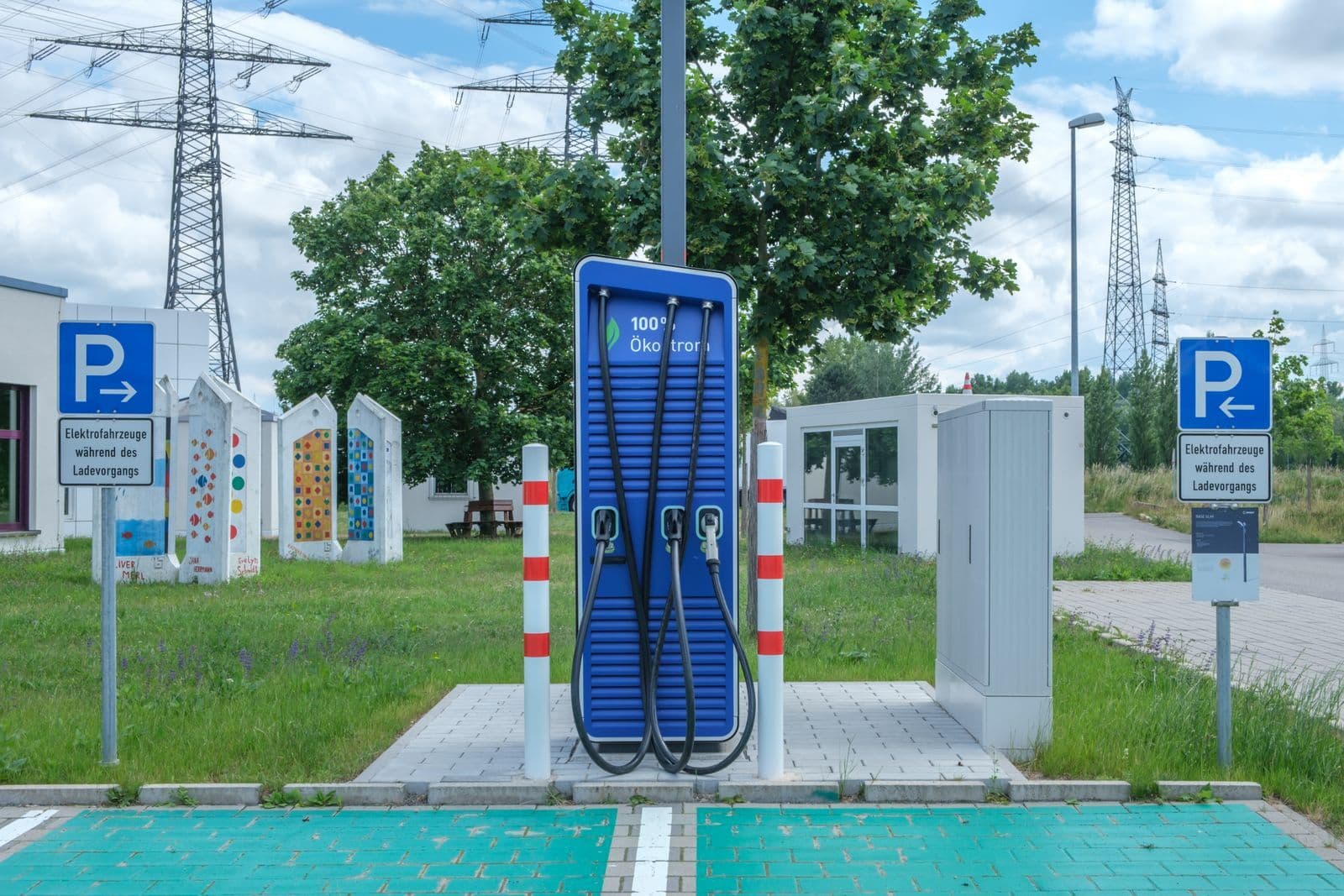
- DC fast charging (roadside) — the conversion happens in the charging station, which is a fridge-sized cabinet precisely because it holds the heavy electronics. It bypasses the onboard charger and feeds the battery directly, at anywhere from 25 to 350 kW (opens in a new tab) depending on the site.
So "fast charging" isn't a mode of your car so much as a different, much larger machine doing the work. How large the numbers can get comes down to physics: power = voltage × current. High current makes heat, so the big rates are achieved by raising voltage — newer 800-volt platforms (pioneered by cars like the Porsche Taycan and Hyundai/Kia's E-GMP models) move the same power at half the current of a 400-volt car, with cooler cables and shorter stops. Ultra-rapid stalls add liquid-cooled cables so the plug itself doesn't become the limit.
Why the gauge sprints, then crawls
Lithium batteries don't charge at a constant rate. The session runs roughly like this: the car pulls close to its maximum through the low-and-middle of the pack, then the battery management system winds the current progressively down as the cells fill — because a nearly-full cell accepts current poorly, and forcing it risks the plating damage above. The last 20% can take as long as the first 60%. That taper is deliberate protection, not a faulty charger.
This one curve explains most charging behaviour you'll see in the wild: why road-trippers unplug at 80% and drive to the next charger instead of waiting for 100%, why a session started at 60% never hits the advertised peak, and why the same car posts wildly different session times on different days.
Temperature bends the curve too. A cold pack accepts a fraction of its rated power, which is why modern EVs precondition — warm the battery on the way to a fast charger when you navigate to one in the car's own system. Skip that step on a winter morning and the "20-minute" car can quietly become a 40-minute car.
How to read the claims
The standard charging claims are rarely false — but each is framed to flatter. Five translations:
- "Up to 350 kW" is a peak, briefly. The peak holds for a slice of the curve — often only between low states of charge, on a warm battery. The number that predicts your stop is the average rate across 10–80%, which manufacturers rarely quote. A car with a modest peak but a flat curve can out-charge a car with a spectacular peak that tapers early.
- "10–80% in X minutes" excludes the slow parts on purpose. The window starts after the (slower) bottom and stops before the (much slower) top. It's a fair convention for comparing cars — but it is not "full in X minutes", and a full 0–100% session can take triple the quoted time.
- Percentage is not energy. 10–80% of a small battery is far less energy than 10–80% of a large one, so a small-pack car can post a quicker time while adding fewer kilometres. Compare km added, not minutes elapsed.
- "Km of range per minute" borrows the lab consumption figure. Those conversions typically assume the car's official (WLTP-style) efficiency; at real highway speeds the same kilowatt-hours buy noticeably fewer kilometres.
- The claim assumes a charger you may rarely see. A "350 kW-capable" car achieves its headline only on an ultra-rapid stall — and only delivers what the car can take: plug a 100 kW-limited car into a 350 kW unit and you get 100 kW. Much of the public network runs at 50–75 kW, where every modern EV charges at broadly similar speed and the brochure difference evaporates.
Fast vs slow: the honest trade-offs
DC fast charging — for: it's what makes road trips work; 20–30 minutes of charging per few hours of driving. Against: public fast charging usually costs several times a home off-peak rate per kWh; the taper punishes charging past 80%; queues happen at holiday peaks; and the degradation evidence is mixed — Recurrent's fleet study of Teslas found no statistically significant range difference between frequent and rare fast-chargers (opens in a new tab), while Geotab's 2026 analysis of 22,700 EVs across many brands (opens in a new tab) associated heavy reliance on 100 kW-plus charging with measurably faster annual degradation. The sensible reading: fast charge freely when travelling, but there's no reason to make it your routine if you don't have to.
AC slow charging — for: cheapest energy you can put in a car (off-peak tariffs or your own solar), gentlest on the pack, and zero minutes of your day — the car fills while it's parked anyway, which is most of its life. Against: it's slow in absolute terms (a near-empty big battery can want most of a day on 7 kW), it needs somewhere to plug in overnight, and it can't rescue you mid-trip.
For most owners the split settles at roughly slow-for-life, fast-for-trips — which is also the split that treats the battery best.
Why you can't fast charge at home
This is the constraint the brochure glosses over: the headline DC figure is unreachable from residential power. A typical Australian single-phase supply supports about 7 kW of continuous EV charging — around one-fiftieth of an ultra-rapid stall — and three-phase lifts that only to 22 kW of AC. The 350 kW cabinet on the highway draws more power than a suburban street; nothing like it connects to a house. So when you're weighing a car's charging specs, be honest about which number you'll actually live with: if you can charge at home or work, the car's AC onboard charger limit and overnight arithmetic matter far more than its DC peak, and our home charging guide (opens in a new tab) walks through the wallbox, wiring and tariff decisions. If you can't plug in at home, the DC curve — not the peak — is the spec that decides whether the car fits your life.
What this means if you're buying used
Charging behaviour is now a real part of a used EV's story. Ask which chemistry the pack is (LFP or nickel-based — it changes the charging advice you inherit), ask for a state-of-health report as our battery life and warranty guide (opens in a new tab) explains, and if the seller mentions heavy fast-charging use, weigh it against that report rather than assuming the worst. Then browse electric cars for sale (opens in a new tab) with the right question in hand: not "what's its peak kW?" but "how does it charge at the speeds I'll actually use?" Listing is free.
Related
- Home EV charging explained: wallboxes, installation costs and charging while you sleep (opens in a new tab)
- EV battery life, warranties and what a replacement really costs (opens in a new tab)
- Vehicle-to-grid and V2L in Australia: what actually works today (opens in a new tab)
FAQs
Why does EV charging slow down after 80%?
Because a nearly-full lithium cell accepts current poorly, the car's battery management system deliberately tapers the charging rate as the pack fills to prevent lithium plating — permanent metallic build-up that steals capacity. The last 20% can take as long as the first 60%, which is why fast-charging etiquette on road trips is to unplug at about 80% and move on.
Is fast charging bad for an EV battery?
The evidence is mixed and the honest answer is "not much, used sensibly". A large Tesla-fleet study found no significant degradation difference between frequent and rare fast-chargers, while a broader multi-brand study associated heavy reliance on very high-power charging with faster annual capacity loss. Modern cars manage temperature aggressively during fast charging, which is most of the protection. Fast charge freely when travelling; charge slowly at home when you can — it's cheaper anyway.
Why can't I get fast-charging speeds at home?
Fast chargers are DC machines the size of a fridge, drawing more power than a typical suburban street — residential wiring can't supply them. A home delivers AC through the car's onboard charger: roughly 2 kW from a standard powerpoint, about 7 kW from a single-phase wallbox, up to 22 kW on three-phase if the car accepts it. That's why a car's advertised DC time says nothing about home charging — overnight on AC is the realistic home scenario, and for daily driving it's usually all you need.