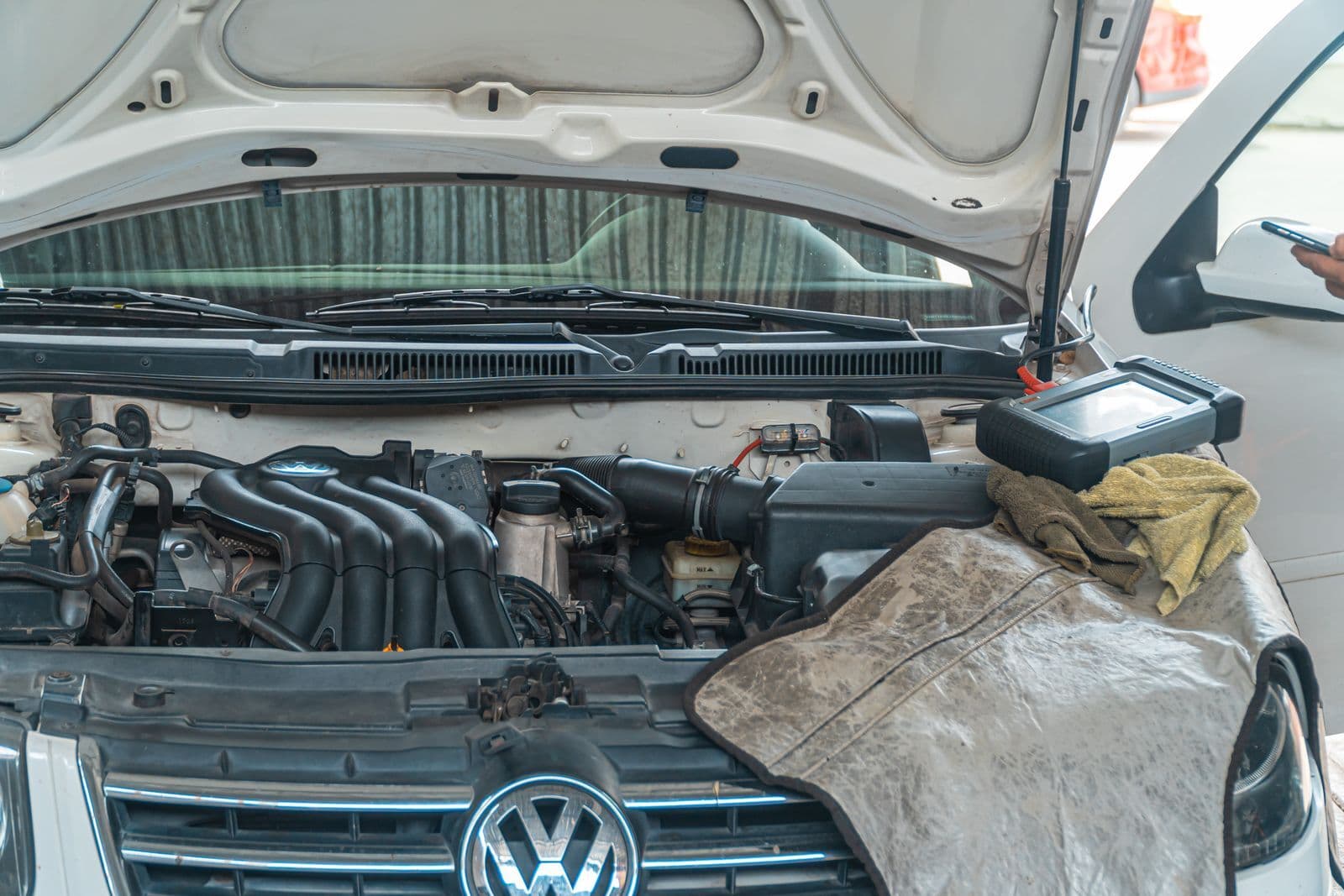
Carbon on the back of the intake valves is a well-known complaint of the direct-injection era. It is real, and at least three manufacturers have published service bulletins about removing it. What does not survive contact with those documents is most of the explanation that gets repeated around it.
- Applies to
- Petrol direct injection, and port injection too
- Evidence
- Manufacturer service bulletins and engine test reports
- Documented by
- Subaru, Audi, General Motors
- Australian safety recalls found
- None for petrol valve deposits
- Best-measured lever
- Engine oil formulation
What is actually on the valve
The usual explanation is that a port injector sprays fuel across the back of the intake valve and washes it clean, while a direct injector sprays into the cylinder so nothing washes the valve. The second half is right. The first half describes the wrong mechanism, and the difference decides which fixes can work at all.
What keeps a port-injected valve clean is not the fuel. It is the deposit-control detergent dissolved in the fuel, which can only act on surfaces the liquid fuel actually wets. Audi states this as a capability list rather than a theory: its bulletin for gasoline additive G 001770A2 (opens in a new tab) says the additive removes deposits from injectors on both MPI and FSI engines, and from combustion chambers on both, but from intake valves on "MPI engines only" - and for FSI intake valves it directs the technician to a separate mechanical procedure.
As for what the deposit is made of, the honest answer is that it is mixed. An SAE study of a 2.0L turbocharged direct-injection test vehicle analysed the deposits and found them to be a combination of engine oil, engine-wear elements, unburned fuel and exhaust gas contaminants (opens in a new tab), with the rate of accumulation also affected by the engine oil's formulation. That is four contributors and no ranking between them. That paper is closed access, so we read the published abstract rather than the full text. Anyone who tells you confidently that it is the crankcase ventilation system, or the valve stem seals, is going further than that study does.
The oil is the part with a measured lever attached. In a Lubrizol patent's worked examples (opens in a new tab), a Mitsubishi 1.8L direct-injection test engine laid down 1.398 g of total intake valve deposits on the reference oil and 0.835 g on the best test formulation, about 40% less, with the engine unchanged and only the oil swapped. A VW 1.1L FSI test in the same document ran 0.237 g against 0.104 g. These are experimental formulations on fixed test cycles, so read them as evidence that oil choice moves the number, not as a service-life prediction.
The bottle does not reach the valve
Audi's wording is worth reading twice, because it is a binary. Intake valves: MPI engines only. Anything delivered through the fuel tank reaches the injector tip and the combustion chamber of a direct-injection engine, and does not reach the back of the intake valve, because the fuel never goes there. That applies to retail in-tank cleaners as much as to a dealer additive.
Intake-tract sprays are a different product, and the most useful number we found for them comes from a company that sells one. In CRC Industries' own patent (opens in a new tab) for reducing intake valve deposits in direct-injection engines, the worked case study is a VW Jetta GLI 2.0L turbo with 10,000 miles of accumulation, treated with 200 g of cleaning agent and 100 g of propellant, held at 2,000 rpm with two excursions to 3,000 rpm, soaked for 60 minutes, then driven for 20 minutes at 60 mph. The result was approximately a 12% reduction by weight, and the patent's general claimed range is about 5% to about 20% by weight. That is a manufacturer describing its own product at its best, and it measures deposit mass only, not driveability or airflow.
Paying more for a car because its history file contains a receipt for a poured-in or sprayed-in decarbonising treatment: the maker of one such product measured about a 12% reduction in deposit weight in its own patent's case study.
What the factory repair looks like
The mechanical alternative is walnut blasting: crushed shell blasted at the closed valve with the intake manifold removed, and a vacuum pulling the debris back out.
Subaru of America published Service Bulletin 02-193-24R (opens in a new tab) on 16 February 2025, revised the following day, covering exactly that procedure. It addresses accumulated carbon on fuel injectors and internal engine components, described in the bulletin as "e.g. intake valves and / or manifold, and combustion chambers", and its applicability list runs by model and displacement across a wide slice of the range up to 2024 model years. Two details matter to an owner. The consumables are trivial: number 24 or SAE 18/40 walnut shell media, approximately 1 to 2 lb, with up to US$2.00 claimable as sublet. The time is not: labour operation A449-286 at 3.0 hours naturally aspirated and 3.6 hours turbocharged, which "may be submitted" for vehicles inside the Powertrain Limited Warranty period.
So the cost of this job is diagnosis, labour and gaskets, plus about two dollars of crushed nut. Multiply those hours by a local workshop rate and you have a defensible estimate. We could not find an Australian price at primary source, and the quoted figures we did find ranged from a few hundred dollars to over a thousand with nothing behind them.
It is also worth noting what these bulletins are not. No manufacturer document we reached schedules valve decarbonising as routine maintenance; every one of them triggers on a symptom or a fault code. GM's bulletin 16-NA-383 (opens in a new tab) sets a floor pointing the other way, stating that misfires from this cause "should not have appeared until accumulating at least 5,000 miles (8,000 kilometers) or more" - a threshold below which the diagnosis is implausible, not a figure for when trouble begins. And Subaru states plainly that "Fuel quality and how the vehicle is operated are both major contributing factors which will have a direct effect on carbon deposit accumulation."
Valve deposits are older than direct injection
This is the part that gets left out, and it cuts hard against the standard story.
Intake valve deposits were a large enough problem on port-injected engines that the United States legislated about them. US federal law has required deposit-control detergent in all petrol since 1 January 1995 under Clean Air Act s.211(l), and from 1 August 1997 all petrol sold to consumers had to contain a certified detergent, with certification requiring average intake valve deposits below 100 mg per valve in the ASTM D5500 test (opens in a new tab) plus no more than 5% injector flow restriction. Those rules cover petrol generally, not port injection specifically.
Take the detergent away and a port-injected engine fouls heavily. In CRC's January 2025 test development report (opens in a new tab), unadditised fuels produced approximately 900 mg per valve in the ASTM D6201 dynamometer test, with candidate base fuels reaching 588 and 1190 mg per valve, while detergent at 2.5 times the lowest additive concentration brought the figure down to 120.5 and 150.9 mg. In a GM LE9 2.4L port-injected test engine, unadditised fuels gave 200 to 375 mg per valve and 1x LAC gave 240 to 320 - overlapping ranges, which is a useful reminder of how much scatter these tests carry.
Two of the three bulletins point the same way. GM's covers Buick, Cadillac, Chevrolet and GMC petrol engines from model year 2000 to 2018 with no direct-injection qualifier at all, and Audi's applies to all Audi vehicles from 2000 to 2019, MPI and FSI alike. Valve carbon causing rough running did not arrive with direct injection.
The size of the gap between the two designs is less settled than it sounds, too. A 2009 review of spark-ignition deposit testing reports that direct-injection engines produce over twice the intake valve deposits of port injection under comparable lean-cycle conditions on base fuel (opens in a new tab), and that fuel effects on intake valve deposits are reversed between the two. Those numbers and CRC's are not comparable with each other - different engines, fuels, protocols and eras - which is the point. There is no single figure for how much worse direct injection is.
And nobody has published what the deposit costs you. The same review states that the performance effects of engine deposits "are complex, different in different engines and not always harmful", and we could not find a primary measurement anywhere linking a given intake valve deposit mass to a quantified power, torque or airflow loss on a direct-injection engine. Manufacturers describe reduced performance qualitatively. No number behind it is substantiated.
What we could not find
Absence is information, so here is the list.
- A cleaning interval. No manufacturer document we reached schedules valve decarbonising by kilometres or years.
- A performance figure. No primary measurement correlating deposit mass with lost power, torque or airflow.
- Evidence for an oil catch can. We found no controlled test measuring deposit mass with and without one.
- Evidence that thin oils make it worse by running down the valve guides. Widely repeated, unsupported at primary source, and awkward against a deposit composition that includes unburned fuel and exhaust contaminants alongside oil.
- A source for "drive it hard and the valves stay clean". Deposit formation does depend strongly on surface temperature, with more forming on colder surfaces, but the paper establishing that (opens in a new tab) reviews port-injected and carburetted engines, its quantified thresholds are combustion-chamber figures, and it makes no claim about engine load at all. The mechanism is real. The driving advice stacked on top of it is not sourced.
- A documented carbon motive for dual injection. Ford's 2017 F-150 3.5L EcoBoost added a port injector beside the direct one, and the reasons given in the announcement (opens in a new tab) were power output, efficiency, emissions and reduced particulate output at part load. Cleaner valves may follow from it, but that is not the stated motive, and we found no primary measurement of intake valve deposits on a dual-injection engine.
What this means for an Australian buyer
The mitigation the bulletins recommend is not sold here. Audi and GM both tell owners to use TOP TIER Detergent Gasoline, and Audi's bulletin prints the participating retailers (opens in a new tab), all of them American. TOP TIER is a North American retail programme and we could not find an Australian equivalent certification mark. We also could not verify at source whether Australian fuel standards require a detergent additive, because we could not retrieve the current petrol determination, so treat "Australian petrol has no detergent" as unverified rather than established.
What is checkable is which fuel properties matter. CRC identifies four parameters that drive intake valve deposit formation (opens in a new tab): aromatics, olefins, sulfur and T90, the heavy-end distillation temperature. Fuel severity dominated its results, with two of its four candidate base fuels differing by roughly twice in deposit mass.
This is a running-cost matter rather than a safety matter. We could not find an Australian safety recall for petrol direct-injection intake valve deposits. The carbon-deposit engine recall we found on the register is Mazda's REC-000894 of 9 October 2019 (opens in a new tab), covering more than 34,000 Mazda3, Mazda6 and CX-5 vehicles, and it is a diesel intake shutter valve issue that should not be read as evidence about petrol direct injection. For an unhappy buyer, the framework is the consumer guarantees, not a recall notice.
Which leaves the practical questions. Subaru's own sentence names fuel quality and how the car has been operated, but no document we reached says by how much or which patterns, so the questions with paper behind them are narrower: which oil the car has had, how often it was changed, and whether any decarbonising work has been done and by which method. A receipt for walnut blasting tells you far more than a receipt for a bottle.