A modern automatic often arrives with no dipstick, no drain interval in the logbook, and the phrase "filled for life". The company that designs and builds a great many of those transmissions says two things about them in the same document: that they are filled maintenance-free, and that it recommends an oil change after 150,000 km.
- Applies to
- Sealed passenger-car automatics, CVTs and integrated differentials
- Evidence
- Manufacturer lubricant specification and service bulletins
- The designer's number
- Oil change after 150,000 km, no time limit stated
- Not established
- Any published definition of what lifetime means
- Australian angle
- A durability claim helps the buyer under the ACL, not the seller
Two sentences, one page
ZF Friedrichshafen's current List of Lubricants TE-ML 11, edition 01.07.2026 (opens in a new tab) states that "ZF 5-, 6-, 8- and 9-speed as well as the ZF 4HP20 automatic transmissions are filled maintenance-free with specially developed semi-synthetic ATF oils. However, due to the many factors influencing the service life of transmissions in individual operation, ZF recommends an oil change after 150,000 km for its transmissions." The same passage adds that "in operating conditions with high temperatures and loads, or with unknown vehicle use in the past, it can make sense to change the transmission oil at shorter intervals". No limit in years is stated anywhere in it.
That is not a contradiction so much as a description of how the unit was engineered. The charge of fluid is specified against an assumed duty cycle. ZF's own reason for naming a number anyway is "the many factors influencing the service life of transmissions in individual operation" - the design assumption is an average, and real cars sit either side of it. Where an older gearbox carried a tolerance and a dipstick so you could see where you stood, a sealed unit carries a specification instead, and the specification is the only thing that tells you.
ZF's 8HP service information (opens in a new tab) names what pushes a car to the wrong side of that assumption: "At very high operating temperatures, the oil ages faster than under normal conditions. Examples: Many trips at high speeds; Many trips while towing a trailer; Sporty driving". What it does not publish is any number attached to those conditions - the statement is directional only, so nobody can tell you what towing a caravan across the Nullarbor in February costs you in kilometres.
Sealed is a procedure, not a welded box
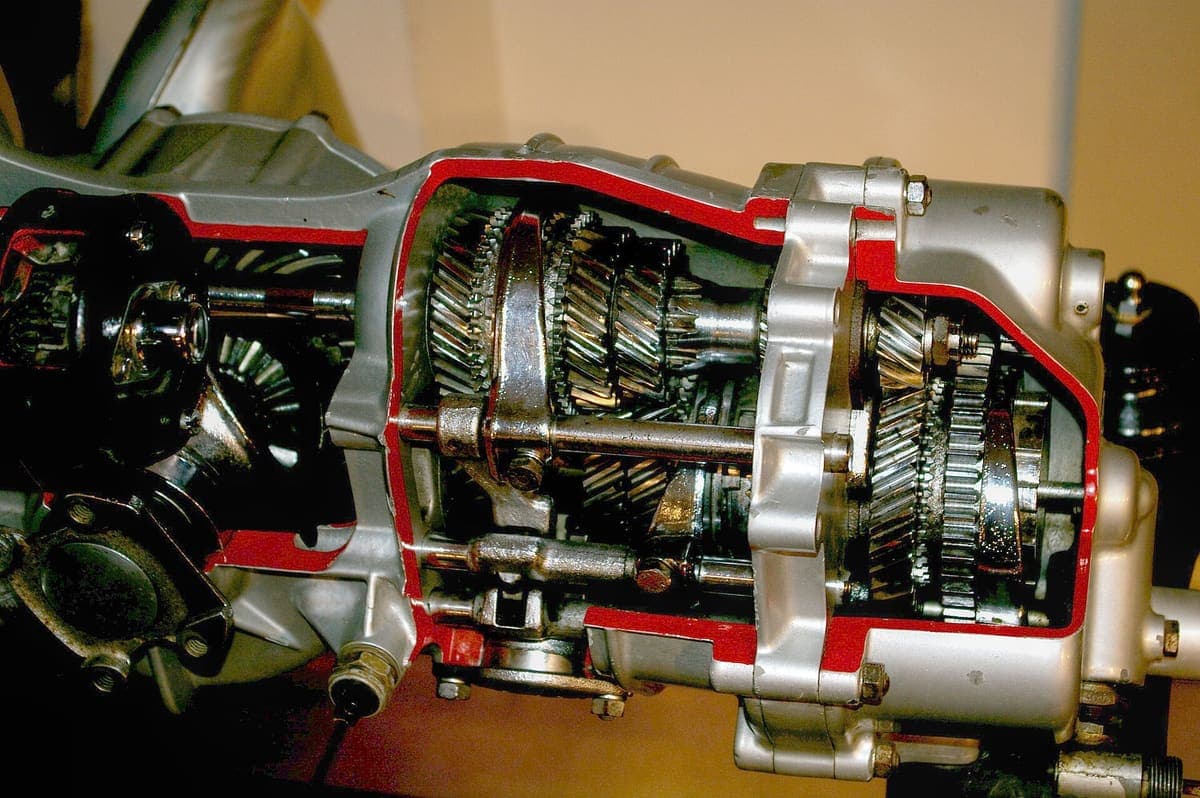
The popular claim that these transmissions have no drain plug and cannot be serviced is contradicted at source. ZF's 8HP service information (opens in a new tab) publishes a full oil pan removal, fill and level procedure with a crosswise bolting sequence and torque figures. Nissan's own CVT repair bulletin (opens in a new tab) lists an oil pan, a drain plug, a drain plug gasket and a replaceable CVT fluid filter, and includes a fluid cooler flush procedure.
What makes it a workshop job is the fill. There is no dipstick, so ZF (opens in a new tab) sets the level by temperature: oil temperature between 30 °C and 50 °C (50 °C to 60 °C on Maserati applications), engine idling after being held at 2,000 rpm for 30 seconds to fill the torque converter, the selector cycled through P, R, D and manual, the vehicle horizontal on a hoist, and a "testing device to read the transmission oil temperature is connected". ZF's warning is blunt: "If the oil level is too low, the transmission will be damaged. If the oil level is too high, the excess oil will leak from the transmission through the overflow when heated. The escaping oil can ignite on hot parts (e.g. exhaust system)."
So the barrier is instrumentation, procedure and information. Not construction.
ZF states that additives added to the oil later "change the oil in a manner that is unpredictable, and they are therefore not permitted", and that "no liability of any kind will be accepted by ZF for any damage resulting from the use of such additives" - so a bottle of shudder fix is the cheapest way to make an expensive problem your own.
The counter-evidence: the designer is the least strict voice here
The obvious story - that carmakers removed a service the fluid still needs, and independent workshops are restoring it - runs into the source material.
ZF's 150,000 km recommendation is substantially longer than the intervals independent transmission shops commonly urge, which sit somewhere around 60,000 to 80,000 km. We could not find a primary source behind the shop figure either, but note the direction: the specialist position is more conservative than the transmission designer's, not less. ZF also closes the section with "Please consider also the service specification of the vehicle manufacturer" - it positions its number as complementary to the carmaker's schedule, and we found no ZF statement accusing any carmaker of specifying an unsafe interval.
The two best-documented sealed-transmission problems were not fluid-interval problems either. GM's bulletin 18-NA-355 (opens in a new tab) changed the fluid formulation, not the interval. Nissan's documented remedy for CVT judder in its 117-page service bulletin (opens in a new tab) is inspection and replacement of the chain, pulleys, valve body and oil pump, with a transmission control module check alongside it - hardware and software, not a skipped fluid change.
Even the laboratory evidence cuts across the folk explanation. In pin-on-disk tests using real wet-clutch friction material and ATF oxidised by an accelerated laboratory process, Farfan-Cabrera et al. (Friction 9(2), 2021) (opens in a new tab) measured higher friction coefficients with oxidised fluid, while the friction-versus-velocity slope fell in most cases - which the authors say "can enhance torque capacity of the wet clutch, but it could reduce anti-shudder property". Note the limits: it is a bench contact test at the running-in stage with lab-aged fluid, not a used transmission. Take it as a reason not to assume old fluid simply slips, not as a prediction about any particular car.
What manufacturers actually documented
GM's Service Bulletin 18-NA-355 (opens in a new tab) (August 2019) addresses shake or shudder during light-throttle acceleration between 25 and 80 mph at steady speed on 8L45 and 8L90 automatics, attributing it to torque converter clutch shudder, and says affected vehicles "should have the appropriate fluid exchange procedure completed" using new blue label Mobil 1 Synthetic LV ATF HP fluid. Date breakpoints apply to some model lines only - 1 February 2019 for Cadillac ATS/CTS, Chevrolet Camaro and Corvette, 1 March 2019 for Colorado and Canyon - after which "these vehicles are already equipped with the latest HP fluid". Critically for readers here, the bulletin states it "only applies to vehicles sold in the U.S., Canada and Middle East Operations (MEO)", so it does not cover Australian-delivered cars, and GM warns readers not to assume any bulletin applies to their own vehicle.
Nissan North America extended CVT warranty coverage on certain models in the United States. Its campaign bulletin of 30 August 2022 (opens in a new tab) covers the 2015 Rogue Select, 2014-2018 Rogue and 2015-2018 Pathfinder, extending cover "from its original duration of 60 months/60,000 miles to 84 months/84,000 miles", and gives the reason as "to assure customer satisfaction, demonstrate our confidence in continuously variable transmissions (CVTs), and to address customer concerns including those expressed by customers in the class actions". Asked "Is this a safety recall or campaign?", Nissan answers "No. This is a warranty extension." It is a United States programme tied to a US class-action settlement, coverage must be checked per VIN because some owners opted out, and it confers nothing on an Australian-delivered car.
On cost, a small number of unverified owner complaints to NHTSA (opens in a new tab) about the 2015 Pathfinder and Rogue report CVT replacement bills or dealer quotes of roughly US$3,000 to US$8,000, at reported mileages spanning about 33,500 to 127,000 miles. Fewer than a dozen state a price, several are quotes rather than money paid, none attribute the failure to a sealed or filled-for-life design, and US prices are not a guide to Australian repair costs.
Repeated everywhere, sourced nowhere
Several confident claims about sealed transmissions could not be traced to any primary document in this research.
- "ZF recommends 80,000 to 120,000 km, or 8 years at the latest." Widely repeated by workshops and parts suppliers. It is not what TE-ML 11 (opens in a new tab) says; that document states 150,000 km and gives no time limit at all.
- "Lifetime officially means the warranty period", or 8 years, or 160,000 km. We could not find any manufacturer specification, industry standard or regulator document defining the term numerically. ZF's actual wording is "filled maintenance-free", which is undefined.
- "Manufacturer X quietly reversed its lifetime-fill position." No primary document establishing either an original lifetime designation or a later reversal was located for the brands this is usually said about.
- "They specify lifetime fill so it fails just after warranty." No evidence located, and ZF's own figure exceeds most new-car warranty distances.
- "Differentials are filled for life." We found no manufacturer document declaring a differential a lifetime fill, and none stating a change interval for one.
- Both halves of the workshop folklore - that changing fluid on a high-kilometre sealed unit causes failure, and that changing it prevents failure. Neither direction was substantiated by any primary technical source we found.
Where Australian law lands
The marketing phrase is not a shield here. The ACCC (opens in a new tab) states that a product "must be of acceptable quality", which "means the product: is safe, durable and free from defects", and among the factors for judging that it asks "Did the business or manufacturer make any claims about quality, or how long the product could last for?" A transmission sold as filled for life therefore raises what a buyer is entitled to expect rather than capping it. The ACCC also states that "consumer guarantees are automatic and can't be taken away", so a schedule saying no fluid change is needed cannot contract out of them - and equally, that "there are no set rules for deciding whether a product is of acceptable quality, or how long a product should last for", so nobody can quote you a kilometre figure as if it were law.
Independent servicing of these units has a statutory basis in Australia. Under the motor vehicle service and repair information sharing scheme (opens in a new tab), mandatory since 1 July 2022 for passenger and light goods vehicles built on or after 1 January 2002, manufacturers must supply service and repair information, diagnostic codes and part-pairing software to Australian repairers at a price that does not exceed fair market value. Given that a ZF fill cannot be set without a tool reading transmission oil temperature, that scheme is the practical reason an independent shop can do this work at all. One limit worth knowing: "consumers who repair their own vehicles as a hobby cannot access service and repair information under this scheme."
The local precedent people reach for is the Ford PowerShift matter, and it does not fit. The ACCC (opens in a new tab) announced in April 2018 that the Federal Court declared Ford engaged in unconscionable conduct in responding to complaints, with a $10 million penalty, over 70,000 affected vehicles supplied and 37% requiring at least one clutch replacement. That was a finding about how complaints were handled, on a dry dual-clutch transmission where lubricated fluid degradation is not the wear mechanism. It is not a lifetime-fluid case.
The honest summary is narrower than the internet's version and more useful. The unit is serviceable. The designer publishes a number and names the conditions that shorten it without quantifying them. And the gap that actually exists is between 150,000 km and never, which is a real gap worth a conversation with a workshop - not the scandal it gets sold as.