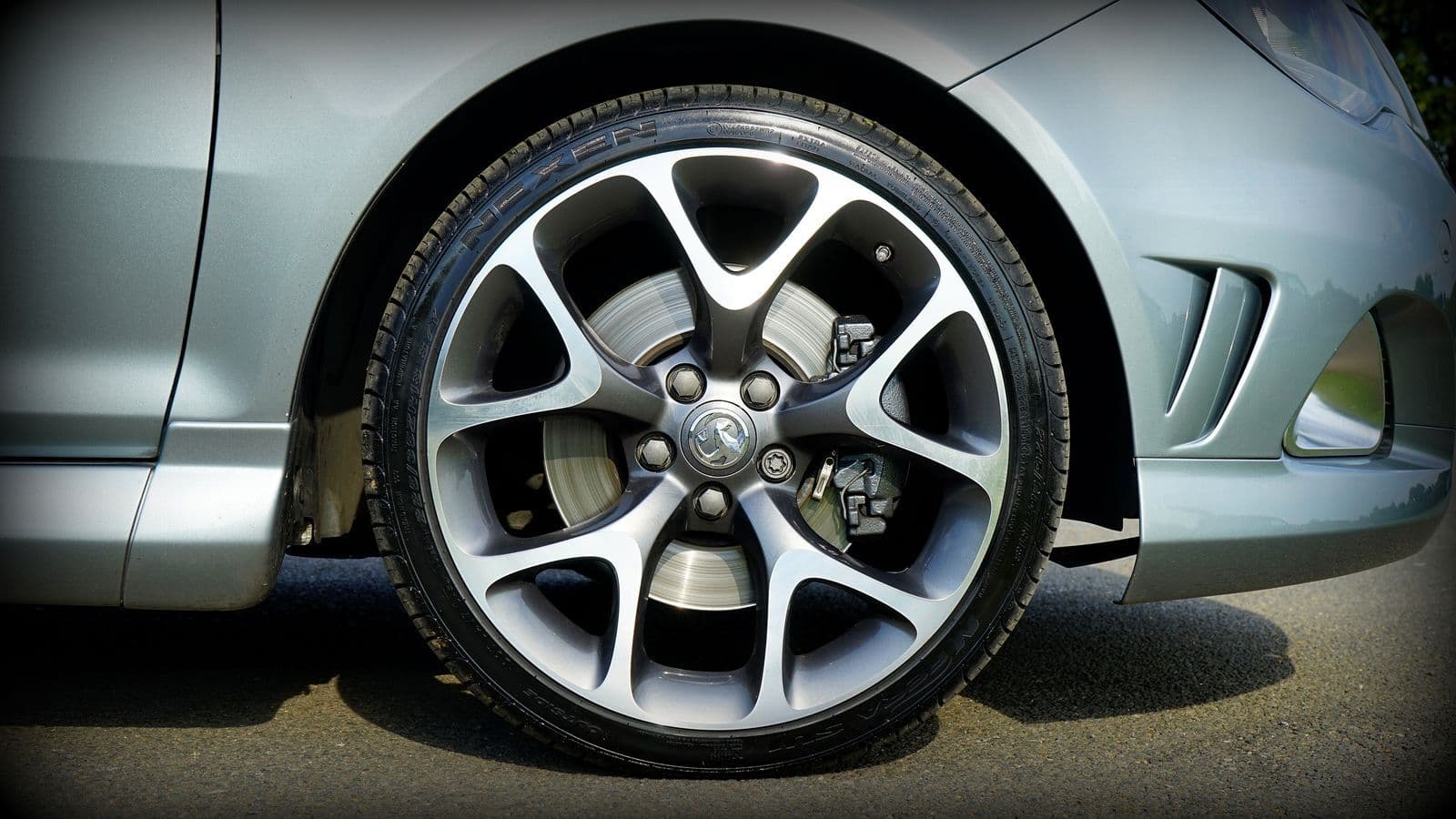
Nearly every car sold today offers bigger wheels somewhere up the option list, and they nearly always look better. What the brochure does not spell out is that the wheel is only half the change. Fit a larger rim and keep the same overall diameter — which you generally must — and the tyre's sidewall has to get shorter to make room.
That shorter sidewall is where all the consequences live, good and bad.
Going up a rim size is not a wheel decision. It is a suspension decision, because the tyre sidewall is a spring, and you are making it stiffer.
The maths of plus-sizing
The convention is called plus sizing: go up an inch in rim diameter, and compensate by making the tyre wider and reducing its aspect ratio so the overall rolling diameter stays close to standard.
A worked example on a common size:
- Standard: 205/55 R16. Sidewall height is 55% of 205 mm, about 113 mm. Overall diameter is roughly 632 mm.
- Plus one: 225/45 R17. Sidewall height is 45% of 225 mm, about 101 mm. Overall diameter is roughly 634 mm.
- Plus two: 235/40 R18. Sidewall height is 40% of 235 mm, about 94 mm. Overall diameter is roughly 645 mm.
The rolling diameter barely moves, which keeps the speedometer honest and the gearing unchanged. Meanwhile the sidewall has shrunk from 113 mm to 94 mm — around 17% less rubber between the rim and the road.
What you gain
- Sharper steering response. A short sidewall deflects less under cornering load, so the tyre reacts to steering input with less delay and the car feels more immediate off centre. This is a genuine improvement and it is what most people notice first.
- More contact patch under cornering. A wider tyre with a stiffer sidewall keeps its tread flatter on the road when the car leans, so peak dry grip usually rises.
- Less body movement feel. The reduced sidewall compliance makes the car feel more tied down, which flatters a sporting chassis.
- Room for larger brakes, which matters on performance cars and not at all on most others.
- Appearance. Worth stating plainly, because it is the actual motivation most of the time, and there is nothing wrong with that as long as the costs are understood.
What you give up
- Ride comfort. The sidewall absorbs small, sharp impacts that the suspension is too slow to react to — expansion joints, patched bitumen, the edge of a pothole. Take 17% of it away and those impacts arrive in the cabin instead. On Australian suburban roads this is the change owners most often regret.
- Wheel and tyre damage. Less sidewall means less protection for the rim. A pothole that a tall-sidewall tyre absorbs can crack or buckle a large-diameter rim, and bent rims are expensive.
- Unsprung mass. Larger wheels are generally heavier, and weight at the wheel is the worst place to add it. The suspension has to accelerate that mass over every bump, so a heavy wheel follows the road surface less faithfully, which costs both ride quality and grip on rough roads. Construction matters as much as size here — a well-made large wheel can weigh less than a poorly-made smaller one.
- Cost, repeatedly. Low-profile tyres in large sizes cost substantially more than common small sizes, and there are fewer options at the sensible end of the market. This is a recurring cost every time the car needs tyres, not a one-off.
- Tyre noise. Wider tyres generally generate more road noise.
The frequently overlooked point: on a rough road, a smaller wheel with a taller tyre can produce more grip, not less, because the tyre stays in contact with a surface the stiffer setup skips across.
Staying inside the rules
Australian light vehicles are covered by a national code, with each state administering its own version, and the limits are real. Transport for NSW publishes clear guidance on alternative wheels and tyres, and other states run materially similar requirements.
The points that most often catch people out:
- Overall diameter. NSW guidance points to a compliance certificate being required where replacement tyres increase or decrease the overall tyre diameter by more than 7% of the original. Staying near standard diameter — which plus-sizing does by design — keeps you clear of this.
- Wheel track. An alternative wheel must not increase the wheel track of a passenger car by more than 25 mm beyond the manufacturer's maximum. For off-road four-wheel drives and goods vehicles in the MC, NA or NB categories the figure is 50 mm.
- Containment. The wheel and tyre must sit within the bodywork or mudguards, including any flares, with the wheels pointing straight ahead. They must not contact the body or suspension under any operating condition, including full steering lock with the suspension fully compressed.
- Rim width. You must not fit rims narrower than the minimum width the manufacturer fitted to that model.
- Load and speed ratings. The replacement tyre's load rating must equal or exceed the original. Speed rating should too, with a narrow exception for vehicles specified above 180 km/h.
- Matching across an axle. Every wheel on an axle must be the same construction, diameter, offset, width and mounting configuration — emergency spares excepted.
Rules vary between states and change over time, so confirm the current requirements with your own road authority before buying, particularly if you are going beyond a straightforward plus-one.
The speedometer point
Because plus-sizing holds rolling diameter roughly constant, the speedometer stays accurate. If you instead fit a genuinely larger overall diameter — common on four-wheel drives — the wheel covers more ground per revolution and the speedo reads lower than your true speed.
That direction matters. Australian Design Rules allow a speedometer to over-read by up to 10% plus 4 km/h but never to under-read, and manufacturers typically build in a few percent of over-read deliberately. Fitting substantially taller tyres eats that margin and can push the reading below true speed, which is a problem you discover in the post.
A reasonable position
For most cars on most Australian roads, one size up from standard is a defensible trade: worthwhile gain in steering feel, modest loss of comfort, manageable cost. Two sizes up is where ride quality, rim damage and tyre prices all start to bite, and where the daily experience of the car often gets worse rather than better.
If the car came with an option of 17s and 19s, it is worth driving both before deciding — and worth remembering that a well-chosen tyre on the smaller rim will out-handle a mediocre tyre on the larger one.
Related
- Smooth or aggressive: how to choose a tread pattern
- How to read a tyre sidewall: size, load, speed and age
- What makes one tyre cost three times as much as another
FAQs
Do bigger wheels make a car ride worse?
Usually, yes. Keeping overall diameter constant means a larger rim requires a shorter tyre sidewall, and the sidewall is what absorbs sharp impacts the suspension cannot react to quickly enough. Going from a 55-series to a 40-series tyre removes roughly a sixth of the sidewall height, and rough urban roads are where owners notice it.
Does plus-sizing affect my speedometer?
Done properly, no. Plus-sizing deliberately pairs a larger rim with a lower-profile tyre so the overall rolling diameter stays close to standard, which keeps the speedometer accurate. Fitting taller overall tyres, as is common on four-wheel drives, makes the speedometer read lower than your true speed.
What are the legal limits on fitting bigger wheels in Australia?
Light vehicles are covered by a national code administered by each state. Common requirements include keeping the wheel and tyre inside the bodywork or mudguards, not increasing a passenger car's wheel track by more than 25 mm beyond the manufacturer's maximum, not fitting rims narrower than the manufacturer's minimum, and meeting or exceeding the original load rating. Larger changes to overall tyre diameter can require certification, so check with your state road authority first.
Are lighter wheels worth paying for?
On rough roads and for handling response, weight at the wheel matters more than weight elsewhere in the car, because the suspension has to accelerate it over every bump. A lighter wheel lets the suspension keep the tyre in contact with an uneven surface more consistently. Whether the improvement justifies the price depends on the roads you drive and how sensitive you are to it.
Is a wider tyre always grippier?
Not on every surface. A wider tyre generally raises peak dry grip and cornering stability, but it can be worse in standing water because it has more width of water to push aside, and it adds rolling resistance and noise. On rough or loose surfaces a narrower tyre with a taller sidewall often maintains better contact with the road.