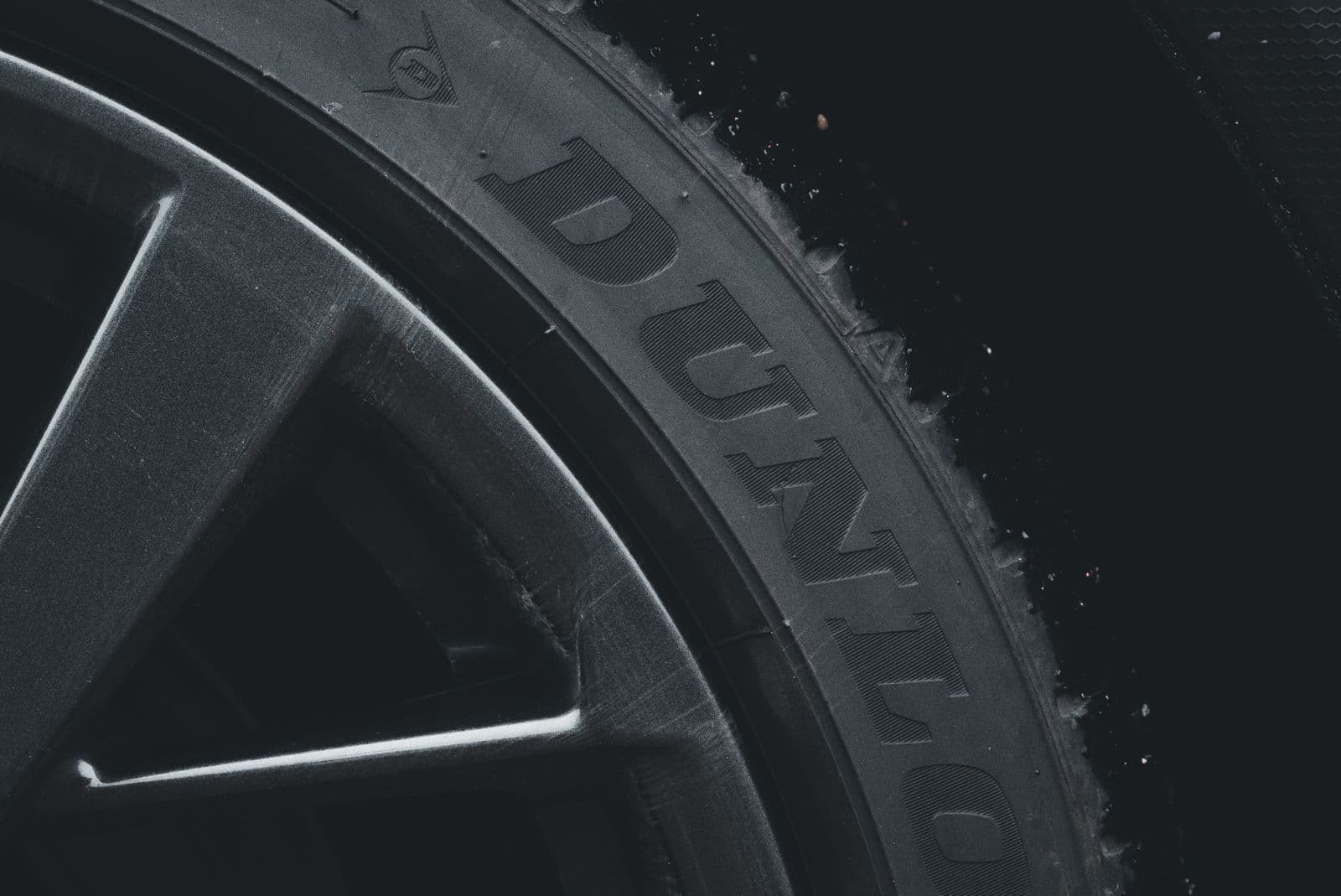
Everything you need to buy the right tyre is moulded into the side of the one already on your car. The trouble is that it is written in four different notations at once, in raised black rubber on a black background, and nobody is ever taught to read it.
Here is the whole sidewall, decoded, with the parts that are legally load-bearing in Australia flagged as we go.
Your car's required sizes and pressures are not on the tyre — they are on the tyre placard. Every vehicle built since 1973 has one, usually on a door pillar, in the glove box or in the engine bay. It is the authority; the sidewall only tells you what is currently fitted.
The size code: 205/55 R16 91V
Take a common size apart, piece by piece.
- 205 — the nominal section width in millimetres, measured across the widest part of the inflated tyre, sidewall bulge to sidewall bulge. Not the width of the tread touching the road, which is narrower.
- 55 — the aspect ratio, as a percentage. The sidewall height is 55% of the 205 mm width, so about 113 mm. This is the single most important number for ride comfort, and it is the one people ignore. A lower number means a shorter, stiffer sidewall.
- R — radial construction, where the body cords run across the tyre at 90 degrees to the direction of travel. Effectively everything on the road is radial now. The older cross-ply design put the cords in a criss-cross pattern, and you must never mix the two types on one axle.
- 16 — the rim diameter in inches, measured at the bead seat. The one imperial number in a metric code, for historical reasons nobody is going to fix.
- 91 — the load index, a lookup code for the maximum mass this tyre can carry when properly inflated. It is not kilograms. Index 91 is 615 kg; index 62 is 265 kg. Each tyre, so multiply by four for the axle set.
- V — the speed rating, also a lookup code. V is 240 km/h. H is 210, T is 190, W is 270.
The load index and speed rating are the two that regulators care about.
The load and speed ratings are a legal requirement, not advice
Transport for NSW's guidance on alternative wheels and tyres is explicit, and the other states run materially similar rules under the same national code:
- Load rating. Every replacement tyre must have a load rating equal to or higher than the rating of the original tyres specified by the vehicle manufacturer. Under-rating is not a trade-off you are allowed to make.
- Speed rating. The speed rating should also be equal to or higher than original. There is one narrow allowance: if the tyre specified for your vehicle is rated above 180 km/h, you may fit a lower-rated tyre, but not lower than the vehicle's own top speed — and where you do, a warning label of at least 40 mm × 40 mm is recommended on the vehicle, usually fitted by the tyre dealer.
Tyres fitted to an Australian vehicle must also meet the construction standards in Australian Design Rule 23. In practice any tyre a reputable fitter will sell you does, but it is why unbranded imports bought online occasionally cannot be legally fitted.
XL, HL and the reinforced markings
Some sidewalls carry XL or Reinforced after the size. That is a tyre built with a stronger casing so it can carry more load at a higher inflation pressure. The same nominal size in XL form typically gains three or four points of load index — a 225/45 R17 might be 91 standard and 94 in XL.
A newer marking, HL for High Load, goes a step further again. It exists largely because heavy electric vehicles pushed past what an XL tyre could support at sensible pressures.
The important rule: if your placard calls for XL or HL, a standard-load tyre in the same size is not a substitute, even though it will fit the rim perfectly and look identical.
The date code tells you how old it is
Look for DOT followed by a string of characters. The last four digits are the date of manufacture: the first two are the week, the last two the year. A tyre marked 3015 was built in week 30 of 2015.
This matters because rubber ages whether or not it is used, and a tyre can be sold as new years after it was made. Check it before the tyre goes on the car, not after.
The other markings worth knowing
- M+S, M.S or M&S — a mud and snow marking, self-declared by the manufacturer on the basis of the tread pattern. It is not a rigorous cold-weather certification. The three-peak mountain snowflake symbol is the tested one.
- Tread wear indicators — small raised bars set into the bottom of the main grooves, usually flagged by a triangle or the letters TWI on the shoulder. When the tread wears down level with the bars, the tyre is at its wear limit.
- UTQG — a three-part grading required for the North American market: a relative treadwear index, a wet traction grade (AA, A, B or C) and a temperature grade. The tests are run and reported by the manufacturers themselves, so the numbers compare best within a single brand.
- A rotation arrow on a directional tyre, or Outside / Inside on an asymmetric one. Fitted backwards, the tyre loses a significant part of what you paid for.
- Max pressure — the maximum the casing is rated for, not the pressure you should run. Use the placard figure.
Where people get it wrong
- Reading the load index as kilograms. Index 91 is not 91 kg. It is 615 kg.
- Running the sidewall's maximum pressure. That number is a structural limit. The placard pressure is set for your car's weight, suspension tuning and handling balance.
- Assuming any tyre in the size will do. Size, load index and speed rating are three separate requirements, and a tyre can match the first and fail the other two.
- Fitting different sizes across one axle. Tyre types and sizes must not be mixed on an axle, other than with an emergency spare.
Once you can read the sidewall, the next question is usually what the numbers should be rather than what they are — and that starts with understanding what actually separates a cheap tyre from an expensive one.
Related
- What makes one tyre cost three times as much as another
- Used car inspection and test drive: your questions answered
FAQs
What does 205/55 R16 91V mean?
The tyre is 205 mm wide across its section, its sidewall height is 55% of that width, it is of radial construction, and it fits a 16-inch rim. The 91 is a load index corresponding to 615 kg per tyre, and the V is a speed rating of 240 km/h. The first three figures describe the size; the last two describe its capability.
Where do I find the right tyre size for my car?
On the tyre placard, which every Australian vehicle built since 1973 carries — commonly on the driver's door pillar, inside the glove box or in the engine bay. It lists the manufacturer's approved wheel and tyre combinations along with the load capacity, speed rating and the inflation pressures. Use it in preference to whatever happens to be fitted, since the previous owner may have fitted something wrong.
Can I fit a tyre with a lower speed rating than the original?
Generally the replacement must match or exceed the original rating. Transport for NSW allows one exception: where the specified tyre is rated above 180 km/h you may go lower, provided the rating still exceeds the vehicle's top speed, and a warning label should be fitted to the vehicle. Load rating has no equivalent exception and must always be met or exceeded.
How do I tell how old a tyre is?
Find the DOT code on the sidewall and read the final four digits. They give the week and year of manufacture, so 2224 means the twenty-second week of 2024. Rubber degrades with age regardless of use, so the date matters on a low-kilometre car and on any tyre being sold to you as new.
What is the difference between an XL tyre and a standard one?
An XL, or Extra Load, tyre has a reinforced casing that lets it carry more weight at a higher inflation pressure, usually gaining three or four points of load index over the standard version of the same size. If your placard specifies XL, fitting a standard-load tyre leaves the car under-rated for its own kerb weight even though the tyre physically fits.