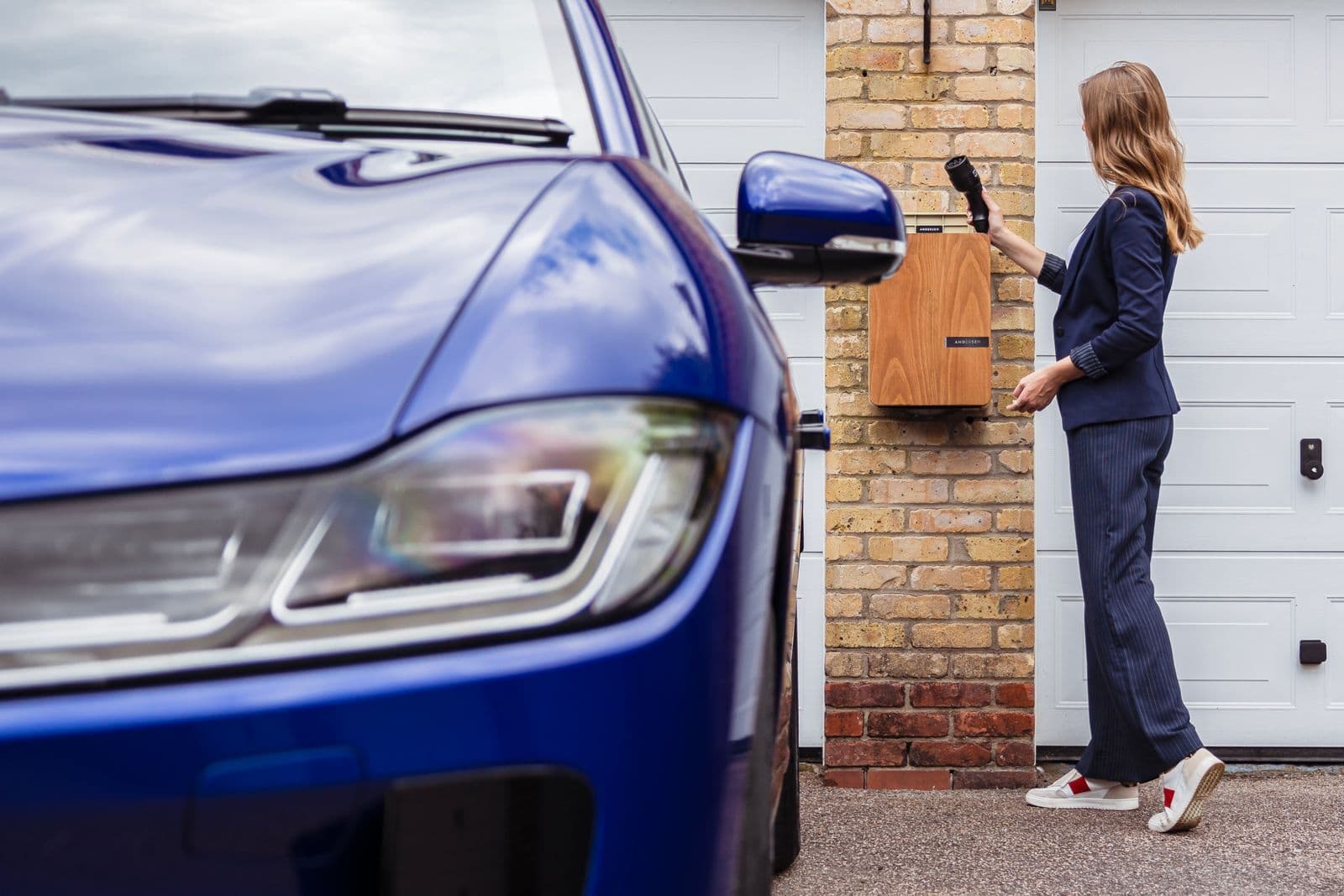
Home charging is what makes an electric car cheap to run, and the question of whether you can do it should come before the question of which car you want.
A normal power point is enough for a lot of people
A standard 240V power point delivers a maximum of 2.4 kW. That is Level 1, or trickle charging, and it adds 10 to 20 km of range per hour plugged in. A full recharge from empty can take up to 24 hours.
That sounds slow until you compare it with how far people actually drive. The average Australian travels about 33 km a day, which typically uses no more than 10% of an EV battery. Plugged in overnight, a normal power point replaces that several times over.
For a large share of drivers, no installation is needed at all. Plug the supplied cable into an existing outlet and the car is full every morning.
Two safety points from the Government’s own guidance. Plug the charging cable directly into the power point rather than through an extension cord or power board. And have a licensed electrician check the outlet and circuit before you rely on it — the Government advises confirming your existing set-up is safe for EV charging, because a charger draws near-maximum current for hours at a time.
When a wallbox is worth it
A dedicated home charger runs at 7 to 22 kW and adds roughly 30 to 80 km of range per hour on the Government's conservative figures, or 40 to 100 km on the Electric Vehicle Council's. Broadly, expect around 40 km an hour from a 7 kW unit, and up to about 100 km an hour from a 22 kW three-phase one — but only if your car can take it. The car’s onboard AC charger sets the ceiling: many EVs sold here accept only 7 kW or 11 kW AC, so check your model’s maximum AC charge rate before paying for a 22 kW unit or a three-phase supply upgrade.
It is worth it if you drive well above average distances, if you have a second EV, if you want to soak up solar automatically, or if you regularly arrive home near empty and leave early.
The practical ceiling for most homes is 7.4 kW, because most Australian homes are single-phase. A 22 kW charger needs three-phase supply.
What installation involves
A licensed electrician is required, and the Government notes it may also require a switchboard and supply connection upgrade. Installation must comply with AS/NZS 3000, the wiring rules. Fire and Rescue NSW additionally recommends a smoke or heat alarm in garages where EVs are regularly parked or charged.
On cost, the only figures available come from charger retailers and installers rather than an independent source, so treat them as indicative: broadly $1,600 to $3,300 installed for a 7 kW single-phase unit, with a switchboard upgrade adding perhaps $1,500 to $2,500 if one is needed. Going from single-phase to three-phase supply is a much larger job.
Get quotes rather than relying on a range. And have the charger inspected by a licensed electrician every few years.
Solar
If you have rooftop solar, charging while the sun is up is the cheapest energy you will ever put in a car. The Government recommends a smart charger or energy management system that charges when electricity is cheapest or when your solar is generating surplus.
Any charger works if you plug in manually during daylight. To follow the sun automatically you need a charger that can modulate to real-time surplus, which means a current sensor, direct inverter integration or smart control. A simple timer can be scheduled for daylight hours but cannot respond to a cloud.
Sizing: a rooftop system makes roughly 4 kWh a day per 1 kW installed. A typical EV needs 5 to 7 kWh a day at average distances. Most household systems have room.
Renters
If you rent a house with off-street parking, the practical answer is usually the portable cable and an existing power point — no electrical work, so nothing to approve.
A fixed charger is a different matter. It is a fixture rather than a minor modification, so you generally need the lessor's written approval and a licensed electrician. Queensland’s Residential Tenancies Authority has published guidance on this: a charger is a fixture, so approval is required and is entirely at the owner’s discretion, the work must be electrically compliant and done by a qualified electrician, and if the owner’s home insurance premium rises as a result that cost cannot be passed on to the tenant. Rules differ by state — check your own.
Apartments and strata
This is where the honest answer is often "not yet".
The Australian Government's position is that if you live in an apartment or shared building you may need permission from your strata body, and that the laws governing strata buildings and electrical infrastructure are made by states and territories. Its charging options page (opens in a new tab) links per-jurisdiction guides for owners' corporations and, separately, for residents and tenants. That is the right starting point, because summarising eight regimes accurately is not possible in a paragraph.
Be aware that the NSW EV Ready Buildings Grant has closed — applications ran from October to December 2023, and 124 recipients shared just under $7 million. Do not plan around it.
If you cannot get charging approved where you park, that is a strong argument for a conventional hybrid rather than an EV. It needs no infrastructure at all, and it is a legitimate choice rather than a compromise — see electric, hybrid or petrol.
What to check before you buy the car
- Confirm the portable cable is included with a used EV, and ideally a Type 2 to Type 2 lead as well — most public AC chargers do not have one attached.
- Check what your switchboard looks like if you are planning a wallbox, before you commit to a budget.
- Look at your electricity plan. An off-peak or EV-specific tariff changes the running cost more than the car's efficiency does — see what an electric car actually costs to run.