The claim is that continuously variable transmissions are fragile. The record shows something narrower and more useful: belt and chain CVTs have one well-understood way of failing, it has produced safety recalls, a technical bulletin and a court-approved settlement, and we could not find a published failure rate for any CVT population from any manufacturer or regulator. The largest transmission failure rate an Australian regulator has stated belongs to a dual-clutch, not a CVT.
- Applies to
- Belt and chain CVTs, not hybrid eCVTs
- Mechanism
- Clamping force lost, belt or chain macro-slips, adhesive wear follows
- Evidence
- Safety recalls, manufacturer bulletins, class settlement
- Published failure rate
- We could not find one for any CVT population
- Australian court penalty
- Ford dry dual-clutch, $10 million, 2018
What a belt CVT is actually holding on to
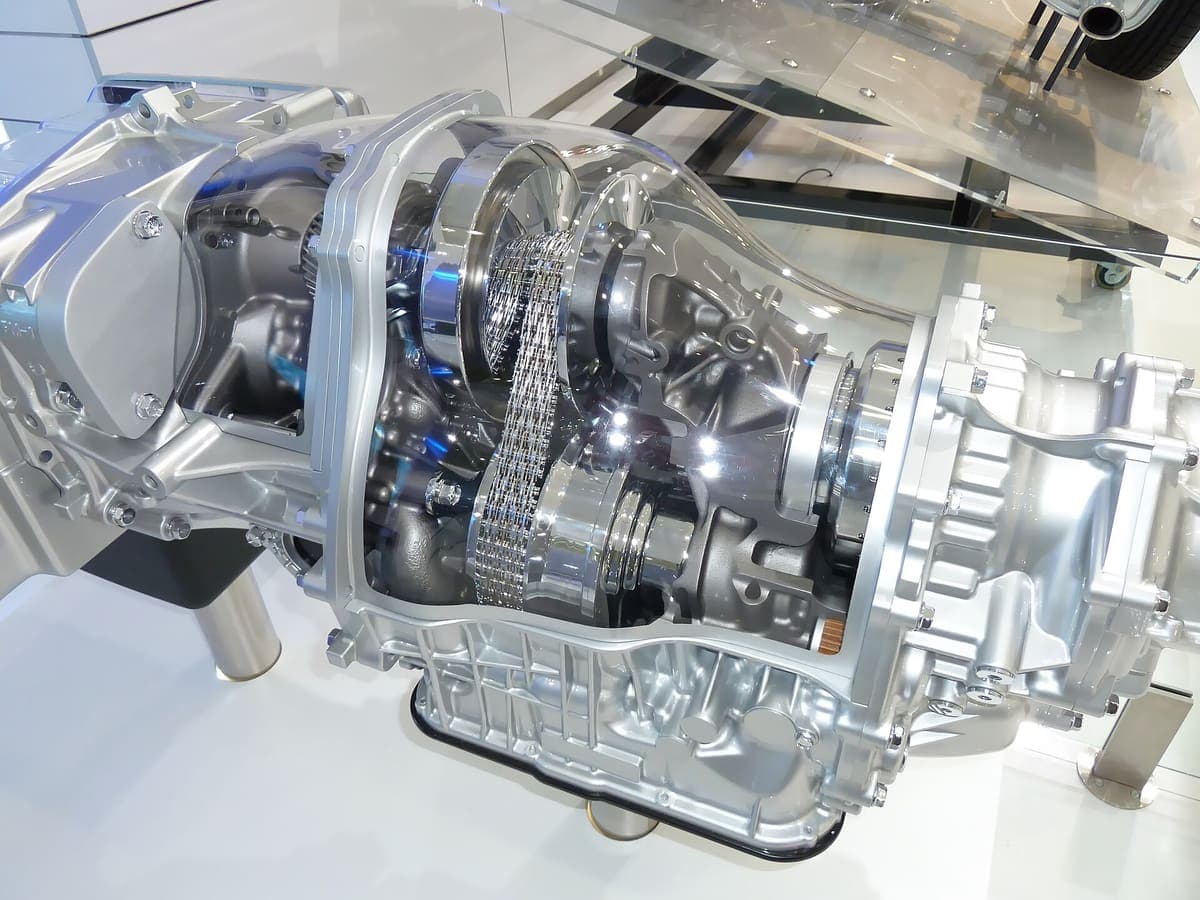
A belt or chain CVT has no gear teeth to mesh. Two pairs of cones squeeze a steel pushbelt or chain, and the torque that reaches the wheels is set by the friction available at that clamped metal-on-metal contact, multiplied by the clamping force and the running radius. Below the traction limit the belt creeps elastically against the pulley face, and that is harmless: Bonsen's TU Eindhoven doctoral work (opens in a new tab) measured variator efficiency above 90% at higher torque levels, with peak efficiency at roughly 1% slip. A small amount of slip is not a fault. It is the efficient operating point.
Above the traction limit the belt stops creeping and starts sliding, and that is where damage begins. van Drogen and van der Laan established the boundary experimentally on a variator rig (opens in a new tab): as the product of element normal force and slip speed rises, the contact crosses from mild wear into adhesive wear, where the lubricant film collapses and metal transfers between belt and pulley - and that wear itself then lowers the friction the design was relying on. Their own conclusion is hedged, and worth keeping hedged: macro slip is acceptable to a certain extent.
So the real design question is how a CVT holds clamping force through a torque spike. Bonsen's answer (opens in a new tab) is that production units largely do not react - they over-clamp in advance. A conventional safety strategy sets clamping from a safety factor of about 2.0 on input torque, because the hydraulic actuation he measured on a production transmission began losing gain at about 5 Hz and reached 180 degrees of phase lag by about 8 Hz. Disturbances faster than that cannot be answered by the controller, so the reserve clamping absorbs them instead. The disturbances he names are entirely ordinary: the accelerator pressed suddenly, moving from a slippery surface onto a grippy one, and hitting a pothole.
That reserve is finite, and it is capped by something other than friction. Because the steel bands are continuously bent and stretched as they wrap the pulleys, "fatigue resistance specifications limit the torque capacity of the variator, because the maximum clamping forces are limited" (opens in a new tab) (section 1.1.2, page 6). That is the pattern this series keeps finding: the margin is deliberate, it is bounded, and it is specified rather than generous.
The recalls describe the failure the physics predicts
The CVT internal-component safety recalls we found are Subaru's, and their cause is instructive: not a worn-out chain, but a lost pressure signal. In NHTSA campaign 19V855000, covering 76,842 vehicles (opens in a new tab), Subaru reported that a mid-joint in the transmission hydraulic sensor harness was made from dissimilar metals, tinplate and copper; an oxide film forms, resistance rises, and the sensor reports a higher fluid pressure than actually exists. The transmission control unit, whose programming Subaru stated was "not robust enough to compensate for variation", then commands lower pressure - reducing drive-chain tension until the chain can slip. A follow-on campaign, 21V955000, covered a further 198,255 vehicles (opens in a new tab) where TCU programming could allow clutch engagement before the drive chain was fully secured.
Read that carefully, because it is easy to mis-state. These campaigns concern a harness and a calibration on specific build ranges. Chain slippage is the consequence the documents describe if the fault goes unremedied, not an observed general behaviour of Subaru chain CVTs.
Nissan's 116-page technician bulletin on CVT judder (opens in a new tab) points at the same interface from the other end. Where a judder complaint is accompanied by fault code P17F1, the technician removes the valve body and inspects all 360 degrees of both chain-to-pulley contact faces with a borescope - damage at the traction surface, presenting to the driver as shudder. The bulletin covers 2013-2018 Altima, 2013-2019 Pathfinder, 2015-2019 Murano, 2015-2017 Quest and 2016-2019 Maxima, and states "CVT with V6 engine only". That scopes a repair procedure and nothing more; it is not a manufacturer statement that four-cylinder units are sound.
The fluid is a specification, not a consumable
If torque capacity is friction times clamping force, then the fluid sets one of the two terms. A CVT fluid's friction modifiers are formulated to raise metal-on-metal friction, which is the opposite of a wet-clutch automatic fluid's job. Hyundai and Kia's patent on push-belt CVT oil (opens in a new tab) states that with the correct friction-control chemistry "the friction between the metal belt and the pulley of the push belt CVT may be increased", reports transmissible torque increased by up to 80 Nm in their testing, and notes that the higher allowance lets pulley pressure be reduced. Bosch/Van Doorne's own fluid-qualification work makes the same point negatively: automatic transmission fluid test standards are not sufficient for selecting push-belt CVT fluids because they do not incorporate belt-pulley behaviour (Pennings et al., "Van Doorne CVT Fluid Test", SAE 2003-01-3253), which is why a belt-pulley-level durability test was built instead.
That is why manufacturers name a fluid rather than a grade. Nissan's bulletin specifies NS-3 CVT fluid (opens in a new tab), required for warranty repairs, with NS-3 or an equivalent recommended for customer-pay work, and mandates a cooler flush after a valve-body or assembly replacement because wear debris circulates through the cooler circuit.
Filling or topping a belt CVT with a generic automatic transmission fluid changes the friction coefficient the entire clamping calculation was designed around - and the repair that follows is the transmission, not the fluid.
What the manufacturers changed
Both halves of the mechanism have been engineered against. Bonsen showed (opens in a new tab) that active slip control cut the required clamping safety factor from about 2.0 to an effective 1.0 while keeping slip peaks bounded, and higher actuation bandwidth reduced a slip peak to about 10% - so sensing and actuation bandwidth, not the concept, decide how close a given unit runs to the wear boundary.
Toyota went at it structurally. Its 2018 Direct Shift-CVT adds a physical launch gear (opens in a new tab) that carries the vehicle from rest before handing over to belt drive, and Toyota states plainly that "the adoption of launch gears reduces the belt load". That is a manufacturer taking the highest-load regime away from the belt entirely. Toyota's published figures alongside it - 15% wider ratio spread, belt angle from 11 to 9 degrees, 20% faster shift speed, 40% less pulley inertia, 6% better fuel efficiency - are its own numbers measured against its own earlier transmission, and they describe efficiency and responsiveness, not durability. Toyota publishes no failure rate either.
The practical consequence for a buyer is that "CVT" is not one reliability category, and a 2013-era unit is weak evidence about a current one.
The evidence that cuts against this article
Everything above describes a real mechanism. What it does not do is show that CVTs fail more often than the alternatives, and the strongest evidence runs the other way.
The worst transmission failure rate an Australian regulator has established belongs to a dry dual-clutch. The Federal Court declared by consent that Ford engaged in unconscionable conduct in handling PowerShift complaints, and the ACCC records that Ford supplied over 70,000 Fiesta, Focus and EcoSport vehicles with the six-speed dry dual-clutch between 2011 and 2016, of which 37% had at least one clutch replacement (opens in a new tab), with a $10 million penalty imposed on 26 April 2018. Owners described shudder, noise, delayed acceleration and jerking - the same words used about CVTs. We could not find any comparable regulator-stated failure rate for any CVT population, which means no honest CVT-versus-DCT-versus-automatic comparison can be written.
The largest recent US transmission class action is a conventional torque-converter automatic, and the alleged cause was the fluid. In Speerly v. General Motors (opens in a new tab), 26 state-wide subclasses covering more than 800,000 buyers of 2015-2019 model GM vehicles with 8L45 and 8L90 eight-speed automatics were certified, then vacated 9-7 by the Sixth Circuit sitting en banc on 27 June 2025 - a procedural ruling on whether the claims can be tried together, not a finding that no defect existed. Plaintiffs' expert alleged the fluid degraded prematurely in the presence of water from ordinary humidity; GM replaced its earlier fluid with a reformulation called "Mod1a" in December 2018, which the court recorded as correcting the torque-converter-clutch shudder, though it did not resolve a separate shift-quality complaint. Fluid sensitivity is a modern-transmission problem, not a CVT problem.
Complaint volume also proves less than it looks. In NHTSA defect petition DP 12-004 (opens in a new tab), 2,505 complaints across a population of 857,432 conventional-automatic Nissan Frontier, Xterra and Pathfinder vehicles - 638 of them safety-related - ended with the petition denied on 22 October 2016.
Two more distinctions matter. Toyota's Direct Shift-CVT, the design usually held up as the CVT done right, carries an Australian recall for the torque converter, not the belt (opens in a new tab): REC-003862, 2,640 Corollas, where inadequately assembled torque converters may fail under frequent high-load operation such as rapid acceleration from low speed. That recall is also a reminder that a CVT is not only a variator: the unit named in it is paired with a torque converter, so "CVT versus torque-converter automatic" is not a clean component-level split. Check what the specific unit in front of you actually contains. And a Toyota or Lexus hybrid eCVT contains no belt, no chain and no variator at all - it is a motor and generator through a planetary gearset (opens in a new tab) - so its durability record says nothing about belt CVTs in either direction.
What to check on a used CVT car
Nissan's own settlement paperwork sets the tone: in extending CVT coverage on 2014-2018 Rogue and 2015-2018 Pathfinder from 60 months/60,000 miles to 84 months/84,000 miles under a settlement approved on 23 March 2022 (opens in a new tab), Nissan stated that this is not a safety recall or service campaign, involves no admission of a defect, and that the vast majority of CVT owners will not experience any issue. That extension applies to vehicles purchased or leased in the US and its territories, and expressly excludes Rogue Hybrid and Pathfinder Hybrid - an Australian owner of the same model has no claim under it.
That is not the remedy an Australian buyer would be reaching for anyway. In its media release on the $10 million Ford penalty (opens in a new tab), the ACCC recorded that Ford told consumers refunds and replacement vehicles were not an option when they may have been legally entitled to those remedies - which is a reminder that what a seller says is available and what the law makes available are not the same thing. If a major transmission failure is refused, check the position with the ACCC or a state consumer affairs office rather than taking the refusal at face value.
So, practically:
- Ask for the transmission service history and confirm the fluid used was the one the manufacturer specifies for that unit. We could not find a primary maintenance interval to quote, because it is model and duty specific - check the vehicle's own schedule rather than a figure from the internet.
- Treat judder or shudder under light acceleration as a reason for a pre-purchase inspection, not as a quirk of the type.
- Check the VIN against the Australian Government vehicle recall register at vehiclerecalls.gov.au before you buy.
- Do not assume a failed CVT means a new transmission. Nissan's own bulletin documents dealer-level repair short of that, including valve body replacement and replacement of the side cover, pulleys and chain sub-assembly, with the unit rebuilt in its case.
And treat any figure for how long a CVT will last with suspicion, including one offered by a seller. No manufacturer, regulator or court document we reached states a failure distance or a failure rate for any CVT population.