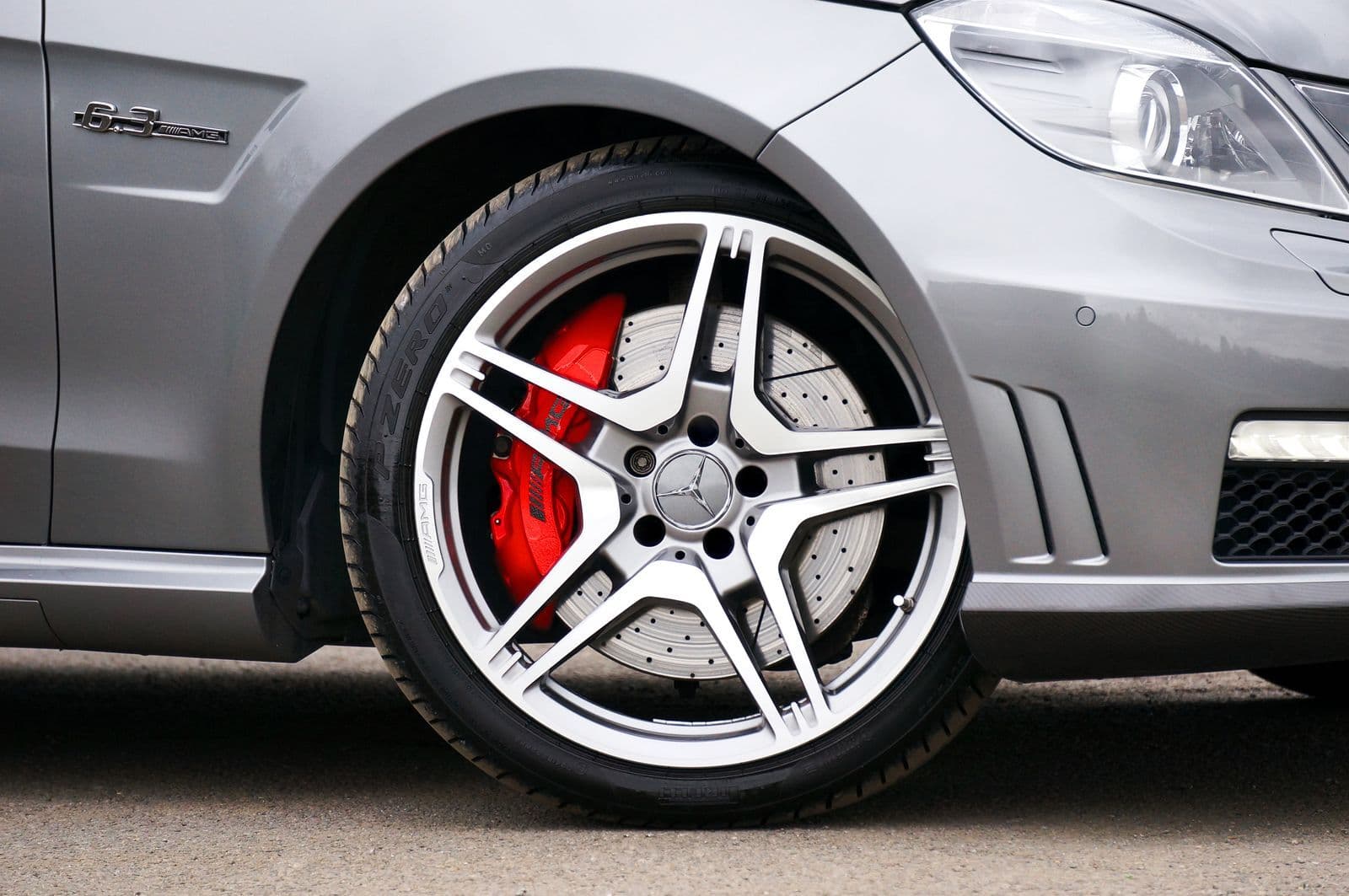
Two wheels of identical diameter and width, both aluminium, both looking much alike behind a brake caliper, can differ by five kilograms each and by a factor of ten in price. The difference is in how the metal was formed, and that determines its internal grain structure — which is what decides whether the wheel bends, cracks or holds when it meets a pothole at speed.
Weight at the wheel is worth more than weight anywhere else in the car. It is unsprung mass and rotating mass at the same time, so the suspension has to control it over every bump and the engine has to spin it up at every set of lights.
Steel
Pressed from sheet steel, welded, painted. Heavy, cheap, and rather better than their reputation.
The advantage nobody mentions is failure behaviour: a steel wheel that takes a serious impact tends to bend rather than crack, which often leaves it holding air long enough to get you somewhere, and a bent steel rim can frequently be straightened. That is why they remain standard on work vehicles and why a set of steel wheels is a sensible choice for a winter or off-road spare set.
The costs are weight, limited styling and a tendency to corrode where the paint is chipped.
Gravity cast
Molten aluminium poured into a mould under nothing but gravity. It is the cheapest way to make an alloy wheel and it is where most budget aftermarket wheels come from.
The metallurgical problem is porosity. Metal that solidifies without pressure traps small voids as it cools, and the resulting casting is less dense and less consistent than it could be. Manufacturers compensate the only way available: by using more material. So a gravity-cast wheel reaches acceptable strength by being thicker and heavier.
Porosity also changes how the wheel fails. Voids are stress concentrators, so a cast wheel under a sharp impact is more likely to crack than to bend — and a cracked alloy wheel loses air quickly and is generally not repairable in a way anyone should trust at speed.
Low-pressure cast
The same idea with the aluminium pushed into the mould under positive pressure. Denser metal, less porosity, better consistency, and so a lighter wheel for the same strength. This is where a great deal of original equipment sits, and for most cars it is entirely sufficient.
Flow formed
A hybrid, and the value sweet spot for many buyers. The wheel starts as a casting, then goes into a machine that spins it while steel rollers press against the rim area under heat and pressure, stretching the barrel out to its final width and shape.
That rolling process does something metallurgically significant: it compresses the material and aligns the grain along the rim, producing rim strength approaching a forged wheel without the cost of forging. Because the rim can be thinner for the same strength, the wheel is lighter — and the rim is the part farthest from the centre, so weight saved there matters most for rotational inertia.
The centre of the wheel remains cast. Flow forming improves the barrel, not the whole wheel, which is exactly why it costs less than forging.
Forged
A solid billet of aluminium alloy is heated and squeezed between dies under enormous pressure until it takes the wheel's shape, then machined to final form.
Forging leaves essentially no porosity and forces the metal's grain to follow the wheel's contours rather than being randomly oriented. The result is the best strength-to-weight ratio available: spokes and barrel walls can be made thin, so a forged wheel can be dramatically lighter than a cast one of the same size and still stronger.
The costs are the press, the tooling, the machining time and the material wasted as swarf. Forged wheels are correspondingly expensive, which is why they appear on performance cars, motorsport and the top of the aftermarket.
Multi-piece
Two or three separately-made components — centre, and one or two rim halves — bolted together. Common in motorsport and high-end fitment because each piece can be specified independently, which allows unusual widths and offsets and lets a damaged rim half be replaced rather than the whole wheel. More expensive, and the joint needs sealing to hold air.
What this means when you are buying
- Do not treat weight as a detail. Ask for the weight of the wheel in the size you want. A reputable seller will know it. A five-kilogram-per-corner difference is felt in ride quality, steering response and braking.
- Be careful with cheap replica wheels. Copies of famous designs are made cheaply for the look, and the metallurgy behind the styling is often not disclosed. The wheel is a structural component holding the car off the road.
- Ask about load rating. A wheel has a load rating just as a tyre does, and it must suit the vehicle. This matters most for heavy vehicles, towing and four-wheel drives, where a wheel intended for a light passenger car is genuinely dangerous.
- Check what happens if one gets damaged. With a set of four in a common size, replacing one is easy. With an unusual or discontinued design it may not be, and a mismatched replacement is not acceptable — every wheel on an axle must be of the same construction, diameter, offset, width and mounting configuration.
Two rules people are surprised by
Transport for NSW's guidance on alternative wheels includes a couple of requirements that catch out buyers of aftermarket wheels:
- The rim must not carry a circumferential weld other than the one attaching the rim to the wheel centre. This rules out some cheaply-repaired and some fabricated wheels.
- Wheels with slotted stud holes must not be used. Slotted holes are how a wheel is made to fit several different bolt patterns, and multi-fit wheels of that kind are not acceptable.
Rules differ by state and change over time, so confirm the current requirements with your own road authority before committing to a set.
Repairs
A bent steel wheel can often be straightened. A buckled alloy sometimes can, by a specialist, depending on where and how badly. A cracked alloy is a different matter: welding an alloy wheel changes the metal's properties around the weld in ways that cannot be verified visually, and a wheel that fails at speed is a serious event. Treat a cracked wheel as scrap unless a specialist you trust says otherwise in writing.
Kerb rash on the outer lip is cosmetic and can be refinished. Damage to the bead seat, where the tyre seals, is not cosmetic — it causes slow leaks that are frequently misdiagnosed as a puncture.
Related
- Bigger wheels, thinner tyres: what plus-sizing actually changes
- Smooth or aggressive: how to choose a tread pattern
- What makes one tyre cost three times as much as another
FAQs
Are forged wheels worth the money?
For strength-to-weight, forging is measurably better: the grain structure follows the wheel's shape and there is essentially no porosity, so material can be thinner while remaining stronger. Whether that justifies the price depends on the car. On a track car or a performance car the reduction in unsprung and rotating mass is meaningful; on a family hatchback a good low-pressure cast or flow-formed wheel is entirely adequate.
What is a flow-formed wheel?
It starts as a casting, then the rim area is spun against steel rollers under heat and pressure, which stretches it to final shape while compressing and aligning the grain. That gives the barrel strength approaching forged for a fraction of the cost, allowing a thinner and lighter rim. The centre stays cast, which is why it sits between cast and forged in both performance and price.
Are steel wheels better than alloys in any way?
In two ways. They are cheaper, and they tend to bend rather than crack under a heavy impact, which often means the wheel still holds air and can sometimes be straightened. That failure mode is why steel wheels remain popular for work vehicles, off-road spares and winter sets. Alloys win on weight, heat dissipation and appearance.
Can a cracked alloy wheel be repaired?
Treat a cracked alloy as scrap unless a specialist assesses it and takes responsibility for the repair. Welding aluminium alters the metal's properties in a heat-affected zone around the weld, and the result cannot be verified by looking at it. Bends and kerb rash are a different matter and can often be repaired properly.
Do replica wheels perform as well as the originals?
Not necessarily, and the difficulty is that you cannot tell by looking. A replica copies the appearance, not the engineering, and the casting quality, alloy specification and load rating behind it are often undisclosed. Ask for the load rating and the manufacturing method, and buy from a supplier who can answer both.