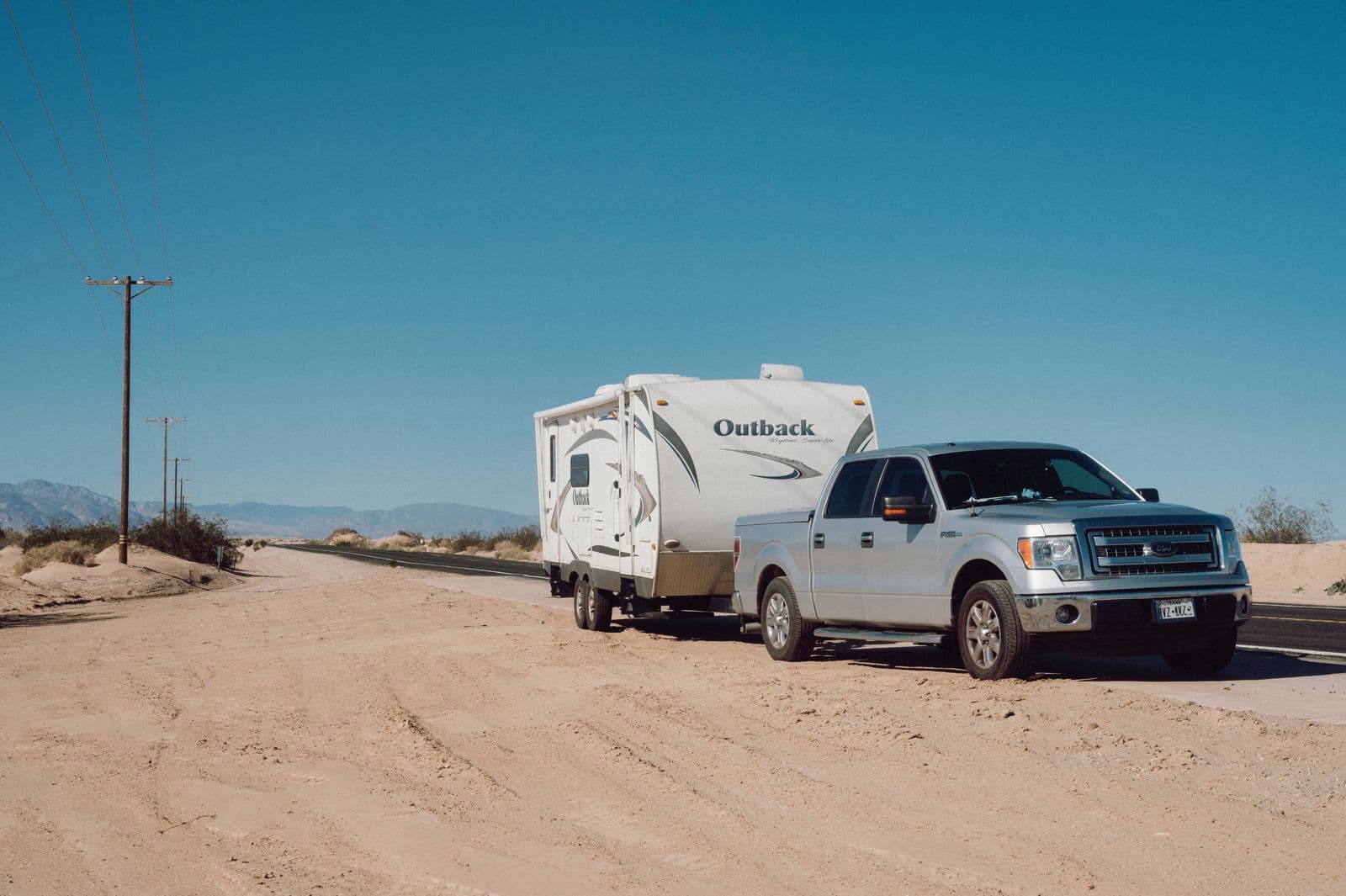
Towing capacity explained properly starts with an uncomfortable truth: the big number on the brochure is only one ceiling of five. Whether your car can legally tow a given caravan comes down to how towball mass, ATM, GTM, GVM and GCM interact once everything is loaded — passengers, water tanks, fridge and all. Get one of them wrong and the rig is overweight even when the towing number looks comfortable.
Five weights, five different ceilings
Start with the car side. Kerb weight is the unladen mass of a vehicle with all fluids and a full tank of fuel, sitting ready for a driver — distinct from tare, which RAC WA explains (opens in a new tab) is measured with only about ten litres of fuel aboard, so the two figures differ slightly. Payload (sometimes called load capacity) is the gap between kerb weight and the GVM, or gross vehicle mass — defined by the South Australian Department for Infrastructure and Transport (opens in a new tab) as the maximum loaded mass of the motor vehicle set by its manufacturer. Payload has to cover people, luggage, accessories and, crucially, the downward weight a trailer puts on the towball — RAC WA notes that load capacity is partly eaten up by the trailer's hitch before anyone climbs aboard.
GCM, gross combination mass, is the total maximum loaded mass of the vehicle plus anything it tows (opens in a new tab), as specified by the registration authority or the manufacturer. The National Heavy Vehicle Regulator adds two practical points: you will find GVM and GCM on the compliance plate of vehicles built before 1 July 2021 or via the Register of Approved Vehicles for newer builds, and the effective limit is the lesser of the manufacturer's figures, statutory limits, or restrictions such as bridge signs.
Now the van side. ATM — aggregate trailer mass — is the total mass of the trailer carrying its maximum recommended load, including any mass imposed onto the towing vehicle (opens in a new tab): think of the fully loaded van resting on its jockey wheel and tyres. Hitch up, and some of that weight transfers forward through the coupling — that transfer is the towball mass (TBM), capped by the car's maximum tow ball mass rating. What remains on the trailer's own axles is the GTM, gross trailer mass, which the South Australian transport department defines (opens in a new tab) as the maximum loaded mass transmitted to the ground by the trailer's axle or axles when coupled. In short: ATM = GTM + towball mass.
A towbar rated for three and a half tonnes does not make your car a three-and-a-half-tonne tower. Every plate — car, towbar, coupling, van — sets its own ceiling, and the lowest one in the chain wins.
A worked example: how the loads stack up
All figures below are invented round numbers chosen to illustrate the maths — they describe no real model.
Suppose your towcar has a kerb weight of 2,000 kg, a GVM of 2,500 kg, a maximum braked towing rating of 2,500 kg, a GCM of 4,500 kg and a maximum towball mass of 250 kg. Your caravan has a tare of 1,800 kg and an ATM of 2,400 kg.
You pack for a trip. Weighed on a public scale, the van comes in at 2,000 kg all-up, with 200 kg pressing on the towball, and the car weighs 2,350 kg ready to travel — fuel, four occupants' worth of load and holiday gear included. Run the checks:
- Van against its own plate: 2,000 kg ≤ 2,400 kg ATM. Passes.
- Van against the car's towing rating: 2,000 kg ≤ 2,500 kg, and the towbar and coupling are rated accordingly. Passes.
- Ball weight: 200 kg ≤ 250 kg maximum. Passes.
- Combination: 2,550 kg of car + 1,800 kg on the van's axles = 4,350 kg ≤ 4,500 kg GCM. Passes.
- The car itself: 2,350 kg + 200 kg of ball weight = 2,550 kg against a 2,500 kg GVM. Fails — by 50 kg.
Every headline number passed, and the rig was still illegal, because nobody added the towball download to the car's payload. That is the loaded-maths trap in miniature: payload available was 500 kg (GVM minus kerb), and the trip consumed 350 kg of people and gear plus 200 kg hanging off the back — 550 kg in total. This is also why RAC WA cautions (opens in a new tab) that manufacturers rarely let GVM and maximum towing apply simultaneously; something usually has to give.
How you load matters as much as how much. The NSW Government's loading guidance (opens in a new tab) directs heavy items low and close to the axle with roughly 60 per cent of the load forward of the axle centre, and suggests about 5–10 per cent of the trailer-plus-load mass should be supported through the coupling — a band consistent with RAC WA's observation that ball weight around 10 per cent of the trailer's under-tow weight tends to be the sweet spot. Too little nose weight invites sway; too much quietly eats the payload in our example above.
Braked versus unbraked
Trailer brakes change everything, and the thresholds are set out plainly by the NSW Government's towing rules (opens in a new tab): a trailer of 0–750 kg GTM needs no brakes (any fitted must comply); from 751–2,000 kg GTM an efficient braking system is required on both wheels of at least one axle; from 2,001–4,500 kg GTM, brakes are required on all wheels. Trailers over 2 tonnes GTM must carry an automatic breakaway system, and trailer brakes must be operable from the driver's seat. SA's regulations agree on the trigger (opens in a new tab) — brakes are mandatory once GTM exceeds 750 kg — with override or over-run brakes acceptable up to 2 tonnes for trailers built to VSB1.
Unbraked ratings sit far lower. Most vehicles' unbraked limit is around 750 kg (opens in a new tab), which is why almost every caravan on the road needs the braked figure. And if a manufacturer never published ratings at all, fallback rules apply: SA allows (opens in a new tab) a driver-braked trailer up to 1.5 times the towcar's unloaded mass, but an unbraked trailer only up to the lesser of that mass or 750 kg GTM.
The 85 per cent rule: convention, not law
Alongside the legal ceilings you will meet a rule of thumb: keep the loaded van to about 85 per cent of the towcar's kerb weight, especially while you are new to towing, easing toward 100 per cent only with experience. It is quoted widely across Australian caravanning clubs, dealers and publications because a lighter van relative to the car is more stable and more forgiving of rookie mistakes.
Be clear-eyed about its status: it is industry convention rather than law — no Australian road authority sets it — and we could not point you to a government source that does. The plated legal limits take precedence wherever the two differ; treat 85 per cent as a comfort margin, not permission.
Speed, licences and other rules that move with the combo
Weight also changes how you may drive. In NSW, a combination whose GCM exceeds 4.5 tonnes is capped at 100 km/h regardless of the posted limit (opens in a new tab), and heavier rigs fall under heavy-vehicle rules rather than light-vehicle ones — the same threshold where SA's light-vehicle regulations stop applying (opens in a new tab). Rules genuinely differ between states and territories, so check the roads authority wherever you plan to drive.
Licence conditions bite earlier than many buyers expect. NSW prohibits learner drivers from towing entirely (opens in a new tab) and restricts P1 car licence holders to small trailers of up to 250 kg unloaded. Two more universal rules worth knowing: nobody may travel inside a caravan or trailer while it is being towed, and the loaded trailer must not exceed the lowest of the towbar rating, the coupling rating, the vehicle's maximum towing capacity and the trailer tyre rating.
What about electric towcars?
Electric cars tow unevenly. RAC WA notes (opens in a new tab) that most EVs are more limited than comparable combustion vehicles in what they may tow — some rated as little as 350 kg, others not rated at all — so the handbook matters doubly here. When a maker does fit a proper package the numbers can still be respectable: Tesla's Model Y gained a factory-fitted tow bar in Australia in May 2023, reported by carsales at the time (opens in a new tab) as rated for up to 1,600 kg braked or 750 kg unbraked, with a 160 kg maximum towball weight. Check the specific model, variant and year — ratings move between them — and if electrification interests you beyond towing, our electric vs hybrid vs petrol comparison (opens in a new tab) covers the broader ownership trade-offs.
Matching the car to the van
So: can my car tow a caravan? Add up five numbers — van against ATM, van against the car's braked rating, ball weight against its limit, loaded car against GVM with the ball weight included, and the whole rig against GCM — and buy the van that passes all five with margin to spare. If you are shopping for the tug first, start with SUVs for sale (opens in a new tab) on MotorLoop, line candidates up side by side with Compare (opens in a new tab), and have any used prospect inspected against our used car inspection checklist (opens in a new tab) before money changes hands. Sellers list free.