"Electric cars need no servicing" is closer to true than most myths on this subject, but it is not true, and the things that remain are not the things people expect.
The Australian Government's figure is that EV drivers can expect to save around 40% on servicing costs against a comparable petrol car. That is a large saving. It is not 100%.
What genuinely goes away
An electric car has no engine oil, no oil filter, no spark plugs, no fuel filter, no timing belt, no exhaust or catalytic converter, and no conventional multi-speed gearbox. Every service item attached to those disappears, along with the failure modes.
That is most of a routine service, which is why the intervals are longer and the invoices shorter.
What remains
- Brake fluid. Hygroscopic, degrades on a time basis regardless of use, and still needs replacing to schedule. BYD’s own EV schedule, for instance, drains and replaces it every 2 years or 40,000 km, whichever comes first — so a low-kilometre car still needs it on the calendar.
- Brake calipers. The Government's guidance specifically notes calipers need cleaning and lubricating — see the section below on why this matters more on an EV.
- Coolant and battery cooling. Most EVs liquid-cool the battery and power electronics. Battery cooling systems need periodic inspection to confirm correct operation and to assess fluid level and condition.
- Cabin air filter. Unchanged from any other car.
- Tyres. More on these below.
- Wiper blades, washer fluid, suspension, steering, 12V battery. All ordinary.
- Software. Not all EVs update over the air; some need a dealer visit, and the Government advises keeping the car's computer current.
- The home charger. Should be inspected by a licensed electrician every few years.
The brake problem nobody warns you about
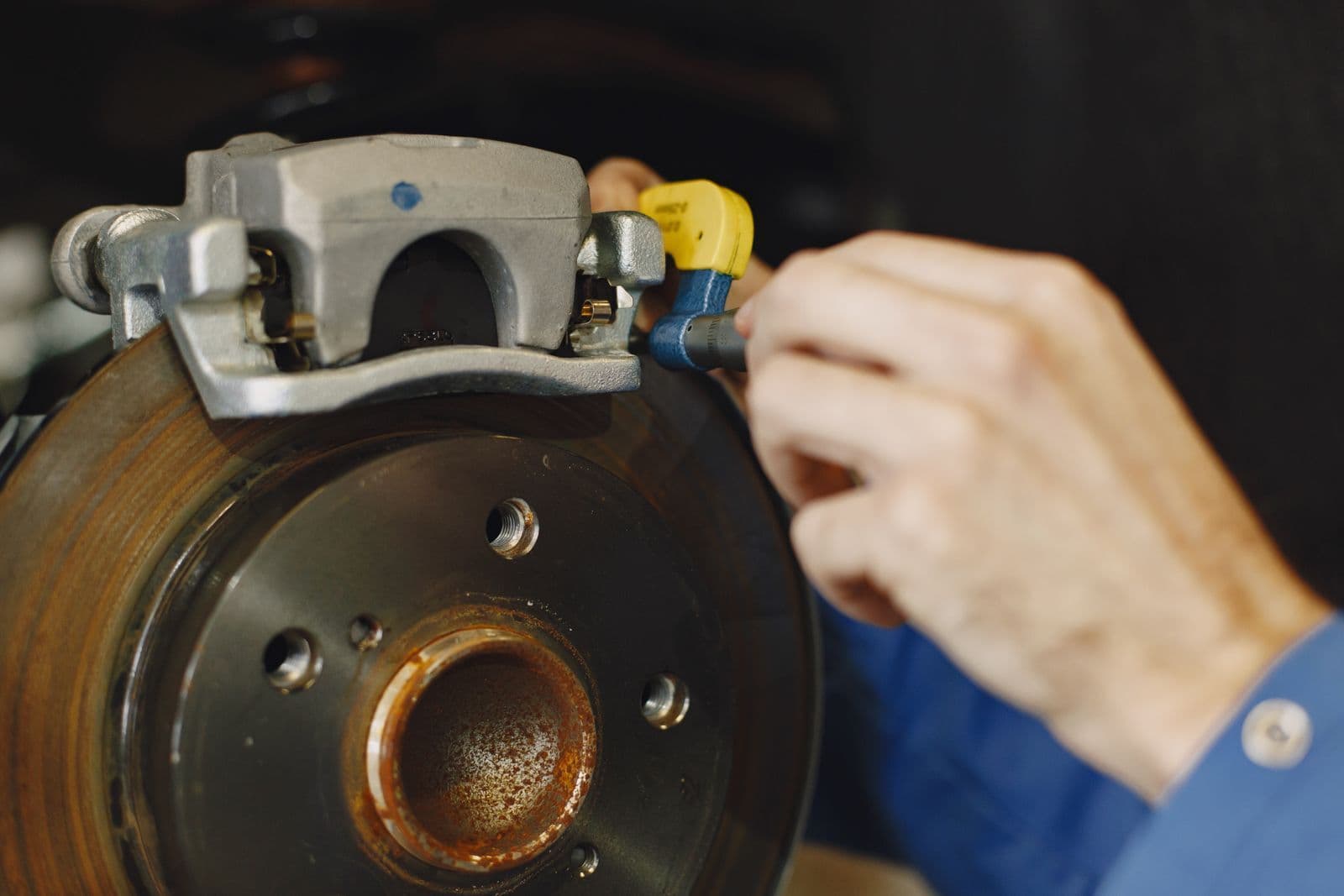
Regenerative braking does most of the slowing on an EV, so the friction brakes do far less work. Pads and discs last much longer — which sounds like an unambiguous win and is not.
Discs that are rarely used corrode. Rust builds on the disc face, caliper slide pins seize, and pads can bond to rotors. The result is that an EV is more likely to need brake work because the brakes were used too little than because they wore out.
This is why the Government's guidance says the braking system still needs regular inspection and that calipers need cleaning and lubricating, and why a used EV's disc faces are worth actually looking at rather than assuming a low-kilometre car has good brakes. It is on the checklist in buying a used electric car.
Occasionally using the friction brakes deliberately — a firm stop from speed on a clear road — helps keep the surfaces clean on a car driven mostly on regen. Brake manufacturers publish a burnishing procedure for exactly this, and Tesla schedules cleaning and lubrication of the brake calipers every year or 20,000 km for cars in areas where roads are salted in winter — a condition that rarely applies in Australia, though the underlying corrosion problem does.
Tyres
EVs are heavier than equivalent petrol cars and deliver torque instantly, which the Government notes places additional strain on tyres. Some models specify EV-specific tyres designed for the extra weight, lower rolling resistance and reduced noise, and those are typically not the cheapest option in the size.
Two practical consequences: budget for tyres somewhat more often than you would on a comparable petrol car, and check what the car actually specifies rather than fitting whatever is on special. Even unworn, tyres should generally be replaced every five to six years.
Also check whether the car has a spare at all — most EVs sold in Australia, including Tesla and BYD, carry only a repair kit, which does nothing for sidewall damage.
The 12V battery
An EV still has a conventional 12V battery, and it runs the locks, the infotainment and the computer that wakes the high-voltage pack. When it dies the car can be completely immobilised — will not unlock, will not wake, will not drive — with a full traction battery sitting underneath.
Cars that sit for long periods can kill one in two to three years. Hyundai, Toyota and MG each warrant the 12V battery separately for around two years, which tells you how they regard it: a consumable, not a component.
The high-voltage battery
Under normal ownership this is not a service item. It is worth knowing two things about it.
First, the warranty conditions. Several manufacturers make extended battery cover conditional on servicing — Toyota extends traction battery cover from five years to ten only if an annual battery health check and routine logbook maintenance are done at Toyota — and that cover excludes capacity degradation and commercial use. Hyundai and MG attach authorised-dealer servicing conditions to their extended VEHICLE warranties, but both battery terms are fixed regardless — Hyundai 8 years / 160,000 km (expressly excluded from the extension) and MG 7 years / 150,000 km. Toyota is the one that ties battery cover itself to servicing. Missing one service can cost far more than the service.
Second, replacing a battery is genuinely rare. Recurrent's data across more than 30,000 connected vehicles put replacements at under 4% across all years and models, falling to 0.3% for cars from 2022 onwards. More on that here.
What this means when buying used
Ask for the service history and read it against the manufacturer's own conditions, not the seller's description. Look at the brake discs. Ask when the 12V battery was last replaced. Check what tyres are fitted and when. None of that is exotic — it is just a different list from the one you would run on a petrol car.
For the running-cost side of ownership, see what an electric car actually costs to run.