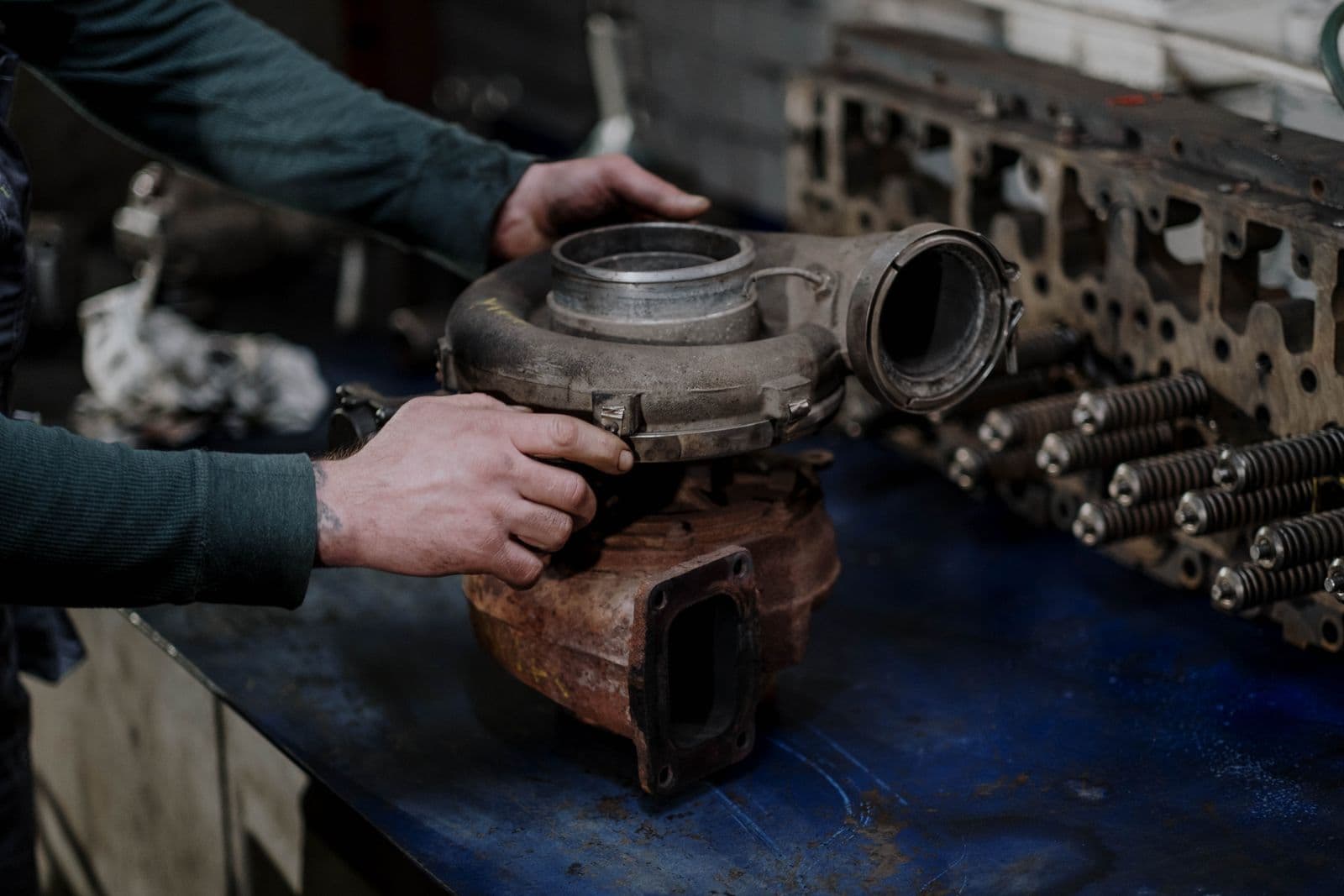
A modern 1.5 or 2.0 litre turbo petrol engine is asked to produce the output of the larger naturally aspirated engine it replaced. Regulatory technology modelling puts the load it was designed to carry at roughly double. That design decision produced one specific failure mode, and the oil industry answered it by writing a dedicated engine test into the specification every licensed petrol oil has to meet.
- Applies to
- Small turbocharged direct-injection petrol engines
- Failure mode
- Low-speed pre-ignition (LSPI)
- Evidence
- ASTM D8291 Sequence IX engine test standard
- Countermeasure
- Oil licensed to API SN PLUS, API SP or ILSAC GF-6
- How common the architecture is
- Over 44% of US MY2024 production was turbocharged petrol
From twelve bar to twenty-four
Brake mean effective pressure is the load a cylinder carries per unit of displacement per cycle, and it is the number that changed. ICCT's working paper on downsized, boosted petrol engines (opens in a new tab), drawing on the US EPA and NHTSA joint rulemaking analysis, treats a typical naturally aspirated petrol engine as around 12 bar BMEP, and models turbocharged replacement packages at 18 bar for 33% downsizing, 24 bar for 50%, and 27 bar for 56% downsizing with two-stage boosting and cooled exhaust gas recirculation. Replacing a V8 with a four was assessed in that same work as requiring 27 bar peak BMEP to hold equivalent performance.
Two honest caveats travel with those numbers. They are design-point peak figures from regulatory technology modelling rather than measured cylinder pressures, and they describe the top of the load map, not cruising. And the figure that circulates online instead - that turbo engines run peak cylinder pressures of about 130 bar against about 80 bar for a naturally aspirated engine - we could not reach at any primary document. Use BMEP, which is published; treat the peak-pressure comparison as unsourced.
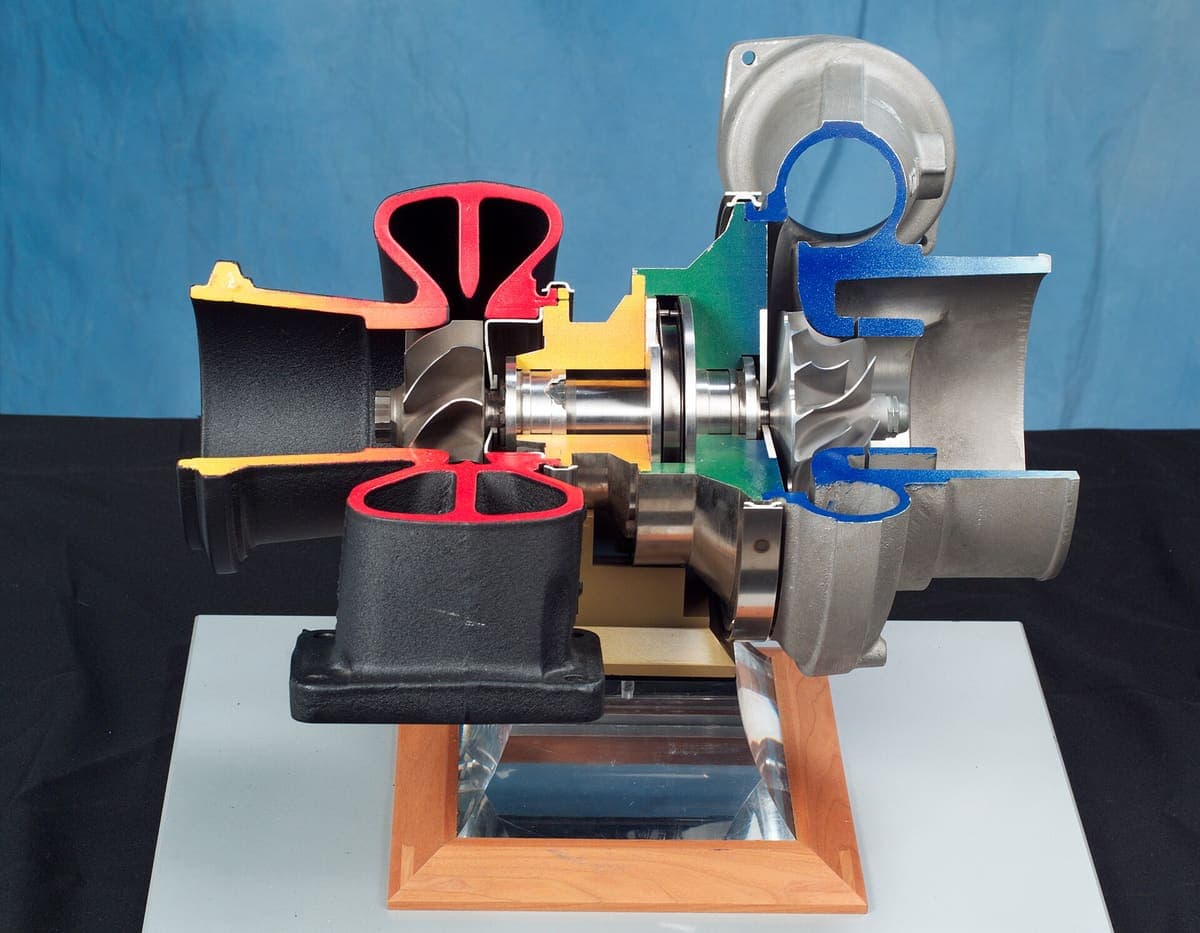
The failure that got its own engine test
Low-speed pre-ignition is combustion that starts before the spark fires, at low engine speed and high load. The popular account of it - oil and fuel droplets in the charge auto-igniting, and the resulting pressure spike breaking pistons and rings - we could not reach at a primary document, so treat that mechanism and that damage as unsourced.
It was serious enough to get a dedicated standard. ASTM D8291, the Sequence IX test method (opens in a new tab), runs a 2.0 litre four at 1750 r/min and 269 N.m - 16.9 bar BMEP - held steady with coolant and oil gallery at 95 plus or minus 0.5 degrees C, over four iterations of 175,000 ignition cycles per cylinder, and counts an event statistically as a cycle that is simultaneously a peak-pressure outlier and an early-combustion outlier.
Read what the test is actually for. Southwest Research Institute's specification sheet for the test (opens in a new tab) names the fixture as a "Ford 2.0L Ecoboost inline four-cylinder engine as found in the 2012 Ford Explorer", and states the objective as evaluating "the ability of a motor oil to mitigate pre-ignition". The engine is the fixed apparatus and the oil is the variable, run on a deliberately severe cycle with a prescribed reference fuel to generate enough events to tell one oil from another. A failure is an oil failure. Nothing in the standard is a finding about that engine in customer service, and the standard states no reason for the engine's selection.
Note too how measured ASTM's own language is. Pre-ignition, the standard says, "has occasionally occurred" in relatively small turbocharged direct-injection engines under low-speed, high-load conditions. That is not a description of a routine condition of small turbo engines, and the popular version - that they all suffer it - is not what the document says.
What the specification buys, and what it does not
Meeting the Sequence IX limits is a licensing condition. The pass criteria are an average of no more than 5 pre-ignition events per iteration, with a maximum of 8 in any single iteration applying to API SP and ILSAC GF-6, per the SwRI test specification (opens in a new tab). So an oil carrying API SN PLUS, API SP or ILSAC GF-6 arrives with detergent chemistry that has been tested against this failure mode.
That is the shape of the trade this series keeps finding. The margin was removed from the cylinder and replaced by a specification. The engine meets its specification indefinitely, and the risk sits with whether the specification is actually being met in service.
Two limits on how far that protection reaches are worth stating plainly. The requirement is category-scoped: it covers oils licensed to API SN PLUS, API SP or ILSAC GF-6, not oils carrying only ACEA or manufacturer-specific approvals - so the mark on the bottle is the thing to check, not the viscosity grade. And the test is the gate, not the countermeasure; the countermeasure is detergent chemistry. Any claim pairing thin oil and LSPI as cause and effect is not supported by the record we could find.
Oil specification has been carrying this kind of load for a while. Savant Labs' account of the TEOST test's evolution (opens in a new tab) records that TEOST 33C was developed in the early 1990s to screen oils for turbocharger coking, and that ASTM has now published a dedicated turbocharger method, D8447, which runs cooler at 290 to 320 degrees C - because improved turbocharger cooling has largely removed the high temperatures 33C was designed around, while lower-temperature oxidative deposits persist.
Servicing a small turbo direct-injection engine with an oil that does not carry API SN PLUS, API SP or ILSAC GF-6 means it has not been tested against the Sequence IX LSPI limits.
The evidence that cuts against this article
The strongest case against the framing above is that the cylinder itself did not get smaller. The 2025 EPA Automotive Trends Report (opens in a new tab) states that petrol displacement per cylinder has been roughly stable at about 34 cubic inches, around 0.6 litres, since 1980, and that the fall in total displacement "is almost entirely due to the shift towards engines with fewer cylinders". A 2.0 litre four has cylinders of similar size to the 3.0 litre six it replaced.
Nor is there a turbo-era discontinuity in output. The same EPA report finds specific power has risen by about 0.02 hp per cubic inch every year for 50 years, describing that linearity as "remarkably steady", with no step change at the point turbocharging became mainstream - and turbocharged petrol engines, per that report (opens in a new tab), passed 44% of US MY2024 production.
Regulators also impose no durability discount for boosting. Light vehicles are certified to the same criteria-pollutant useful life whether boosted or not, at 15 years or 150,000 miles for the larger light-duty categories and 10 years or 120,000 miles for LDV and LDT1, under the EPA MY2027 and later multi-pollutant rule (opens in a new tab). Heavy-duty on-highway diesel engines, which are essentially all turbocharged, carry a regulated useful life of 435,000 miles through MY2026, rising to 650,000 miles for MY2027 and later, under 40 CFR 1036.104 (opens in a new tab).
And the one turbo-versus-naturally-aspirated real-world comparison in this material found a small effect: ICCT reports (opens in a new tab) a 1.7% larger on-road shortfall against label for turbocharged vehicles, driven almost entirely by 67 turbocharged pickups, with the 542 turbocharged SUVs in the dataset showing no increased shortfall at all. That was motorist self-reported data, and ICCT's own conclusion was that "the effect may not be large."
What actually breaks turbochargers, according to the people who make them
Garrett Motion, which manufactures turbochargers, states (opens in a new tab) that "More than 90% of turbocharger failures are caused oil related either by oil starvation or oil contamination" and that "Less than 1% of turbos fail because of manufacturing defects". It names three main causes - oil starvation, oil contamination and foreign object damage - and separately lists prolonged idling, hard acceleration from cold, hot engine shutdown and over-revving as practices that cause failure.
Two things that page does not do. It says nothing about wear-out, service life or high-mileage failure, so it cannot tell a buyer how a turbocharger holds up at 150,000 km. And it never compares engine architectures, so it is not evidence that boosted engines last as long as naturally aspirated ones. The widely repeated 95% figure is not Garrett's either; the manufacturer's number is more than 90%.
What we could not find
- No primary source supporting the claim that turbocharged engines last half as long as naturally aspirated ones. Garrett publishes no expected service life in kilometres or hours at all.
- No specific idle-down duration from any primary source. Garrett names hot engine shutdown as a contributor to carbon build-up but publishes no number, so the mechanism is real and the "let it idle for two minutes" rule is folklore.
- No fleet-level reliability dataset from a regulator, insurer or consumer body isolating boosting as a variable. Recall registers list events, not rates per architecture.
- No primary source - no recall, bulletin, regulator action or study - linking Australian ambient temperature to turbocharger failure rates, and none connecting timing chain wear to boosting as opposed to service interval, oil specification or a particular tensioner design.
For a used small turbo, that points the inspection at the service record and the oil specification rather than at the badge on the boot.