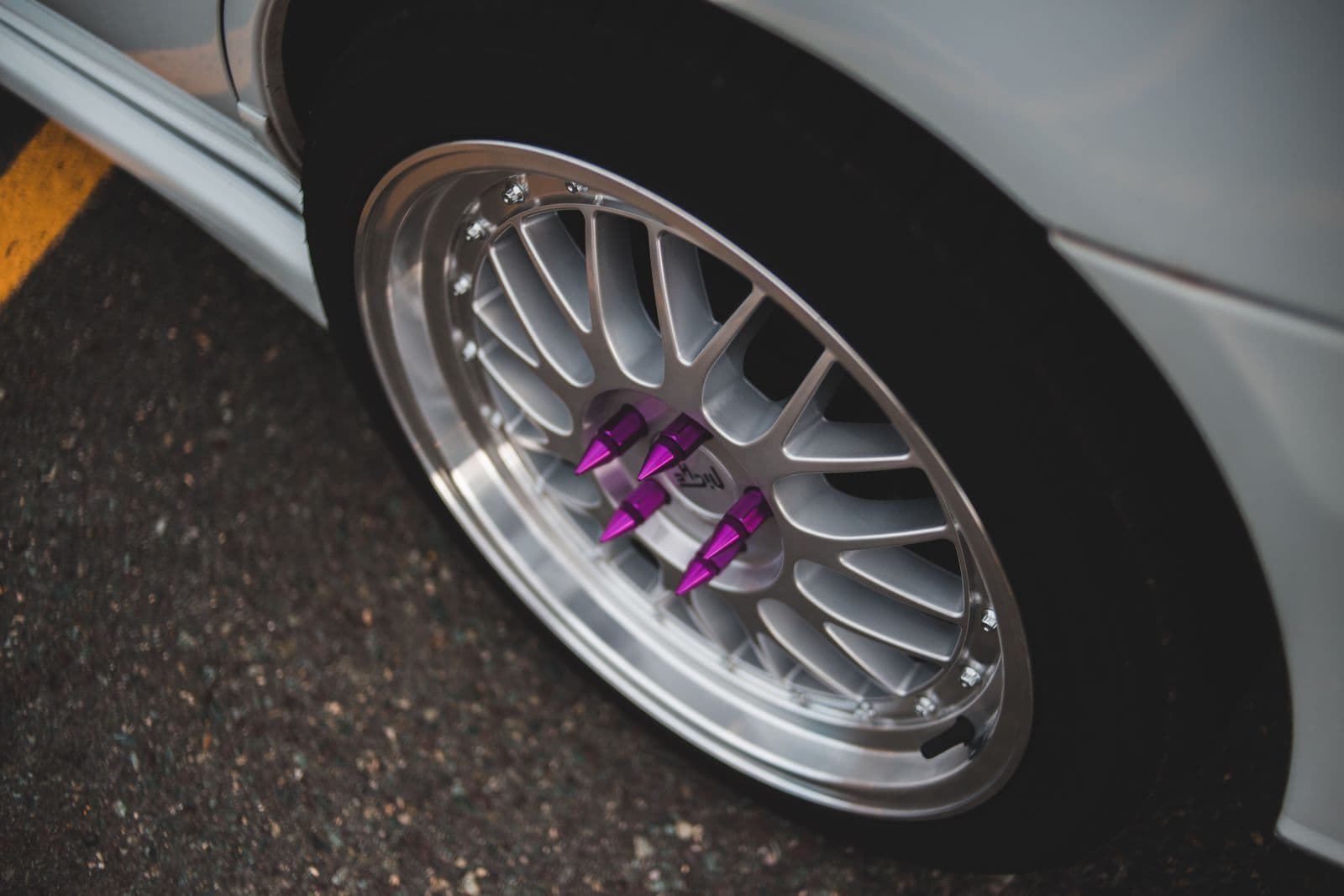
A wheel that bolts onto your car is not the same thing as a wheel that fits it. Three separate measurements have to be right, and each fails in a different way: get the bolt pattern wrong and it will not go on at all, get the centre bore wrong and it vibrates, get the offset wrong and it rubs, wears bearings, or puts the car outside the law.
Here is what each one is, and what happens when it is wrong.
A wheel only fits when the bolt pattern, the centre bore and the offset are all within the vehicle's tolerances. Matching one or two of the three is not fitment — it is the beginning of a problem.
PCD: the bolt pattern
Pitch circle diameter describes the studs: how many there are, and the diameter of the imaginary circle their centres sit on. It is written as two numbers — 5x114.3 means five studs on a 114.3 mm circle.
Two things about it catch people out.
First, similar patterns are not interchangeable. 5x114.3 and 5x120 look almost identical to the eye. A wheel with the wrong PCD can sometimes be forced onto the studs so that it appears to seat, while the studs are actually loading against the sides of the holes rather than centring the wheel. That arrangement fails, and it fails suddenly.
Second, the nut taper matters as much as the pattern. Wheel nuts seat against the wheel with a conical, ball or flat-seat face, and the wheel must be designed for the taper your car uses. A tapered nut in a flat-seat wheel contacts on a thin edge, does not hold clamping load properly, and works loose. Transport for NSW puts this directly: the wheel must be designed for the particular hub and axle in respect of both bolt pitch circle diameter and wheel nut tapers.
Wheels with slotted stud holes must not be used. Slotted holes are how a "multi-fit" wheel is made to suit several bolt patterns at once, and that is precisely why they are not acceptable.
Centre bore: what actually carries the car
The centre bore is the machined hole in the middle of the wheel that sits over the hub's centre spigot.
This is the measurement most often misunderstood. On a hub-centric fitment, the wheel's bore matches the hub spigot exactly, and that machined interface is what centres the wheel and carries the vertical load. The studs and nuts are there to clamp the wheel against the hub face, not to hold the car up.
Aftermarket wheels are frequently made with a deliberately oversized bore so one design can suit many cars. The correct remedy is a spigot ring (also called a hub-centric ring): a precision collar that fills the gap between the hub and the bore. Fitted properly it restores hub-centric location.
Without one, the wheel is centred only by whatever the nuts happen to do as they tighten. The usual symptom is a vibration through the steering at highway speed that survives every attempt at wheel balancing — because the wheel is not running true regardless of how well the tyre is balanced on it.
Offset: where the wheel sits in the arch
Offset, marked ET on most wheels from the German Einpresstiefe, is the distance in millimetres between the wheel's mounting face and its true centreline.
- Positive offset (ET+35, say) puts the mounting face towards the outside of the wheel, tucking the wheel inwards under the car. Front-wheel-drive cars generally use fairly high positive offsets.
- Zero offset puts the mounting face exactly on the centreline.
- Negative offset puts the mounting face inboard, pushing the wheel outwards. This is the aggressive, poking-out stance look.
Change the offset and you move the wheel sideways relative to the hub, which changes three things at once:
- Clearance. Move it inboard and it may foul the strut, the spring or the inner guard, sometimes only on full lock or full suspension compression. Move it outboard and the tyre may catch the guard lip.
- Wheel track and bearing load. Pushing the wheel outwards increases wheel track and moves the tyre's contact patch away from the centre of the bearing, increasing loads on wheel bearings, axles, suspension joints and steering tie rods. The car does not fall apart on the drive home; the bearings just fail earlier than they should.
- Steering feel. Offset changes the scrub radius, which alters how the steering reacts to bumps and braking, sometimes noticeably.
The Australian rules
Transport for NSW publishes clear requirements for alternative wheels, and other states run materially similar rules under the same national code. The ones that most often catch people:
- Wheel track. An alternative wheel must not increase the wheel track of a passenger car by more than 25 mm beyond the manufacturer's maximum. Off-road four-wheel drives and goods vehicles in the MC, NA or NB categories get 50 mm.
- Offset with non-original suspension. Where non-original axle or suspension components are fitted, wheel offset relative to the axle assembly must not increase by more than 12.5 mm each side.
- Containment. The wheel and tyre must be contained within the bodywork or mudguards, including flares, when the wheels are pointing straight ahead, and must not contact the body or suspension under any operating condition — including full steering lock with the suspension fully compressed.
- Rim width. Do not fit rims narrower than the minimum width the manufacturer used on that model.
- Same across an axle. Every wheel on an axle must be of the same construction, diameter, offset, width and mounting configuration, except an emergency spare.
- Stud engagement. The wheel must not prevent the wheel nuts from fully engaging their studs.
- Speedometer accuracy must be maintained, and adjusted where necessary.
- Spacers and adaptors. This is the one that surprises people most: wheel spacers or adaptors must not be used for wheel conversions between the wheel mounting face and the wheel, unless they were fitted as original equipment by the vehicle manufacturer.
That last point matters because spacers are widely sold and widely fitted. Confirm the current position with your own state road authority before buying anything that relies on one, since requirements differ between jurisdictions and change over time.
A practical checklist
Before you buy a set of wheels, get all of these in writing from the seller:
- PCD, exactly — including the decimal.
- Nut seat type, and whether your existing nuts suit it.
- Centre bore, and whether spigot rings are supplied.
- Offset (ET), compared against your car's standard figure.
- Width, and whether it suits the tyre size you intend.
- Load rating, particularly for a heavy vehicle, a four-wheel drive or anything that tows.
- Weight, because it is worth knowing and a good seller knows it.
Then check the tyre size against what the car's placard allows, and think about what the combination does to overall diameter — which is where plus-sizing and the ride-quality trade-off come in.
Related
- Steel, cast, flow-formed or forged: how wheels are actually made
- Bigger wheels, thinner tyres: what plus-sizing actually changes
- How to read a tyre sidewall: size, load, speed and age
FAQs
What does 5x114.3 mean on a wheel?
It is the bolt pattern, or pitch circle diameter. The wheel has five stud holes, and their centres sit on a circle 114.3 mm across. It must match your car's hub exactly — patterns such as 5x114.3 and 5x120 look similar but are not interchangeable, and forcing a mismatched wheel on leaves the studs loaded sideways instead of clamping the wheel properly.
Do I need hub-centric rings with aftermarket wheels?
If the wheel's centre bore is larger than your hub spigot, yes. The machined hub interface is what centres the wheel and carries the load; the nuts clamp it in place. Without a spigot ring the wheel is centred only by however the nuts happen to pull it, and the usual result is a steering vibration at highway speed that no amount of wheel balancing will fix.
What happens if the wheel offset is wrong?
The wheel sits too far in or too far out. Too far in and it can foul the strut, spring or inner guard, sometimes only at full lock or full suspension travel. Too far out and it can catch the guard, increase wheel track beyond the legal allowance, and move the contact patch away from the bearing centre, which increases loads on bearings, axles and steering components.
Are wheel spacers legal in Australia?
Transport for NSW's guidance states that wheel spacers or adaptors must not be used for wheel conversions between the wheel mounting face and the wheel unless they were fitted as original equipment by the vehicle manufacturer. Rules vary between states and change over time, so check the current requirements with your own road authority before fitting anything that depends on a spacer.
Can I fit wheels with a different bolt pattern using an adaptor?
Adaptors that change the bolt pattern fall under the same restriction as spacers, and they also add a second bolted joint between the hub and the wheel. Beyond the regulatory position, multi-fit wheels using slotted stud holes to suit several patterns are specifically not acceptable. The sound approach is to buy wheels made for your car's pattern and nut seat.