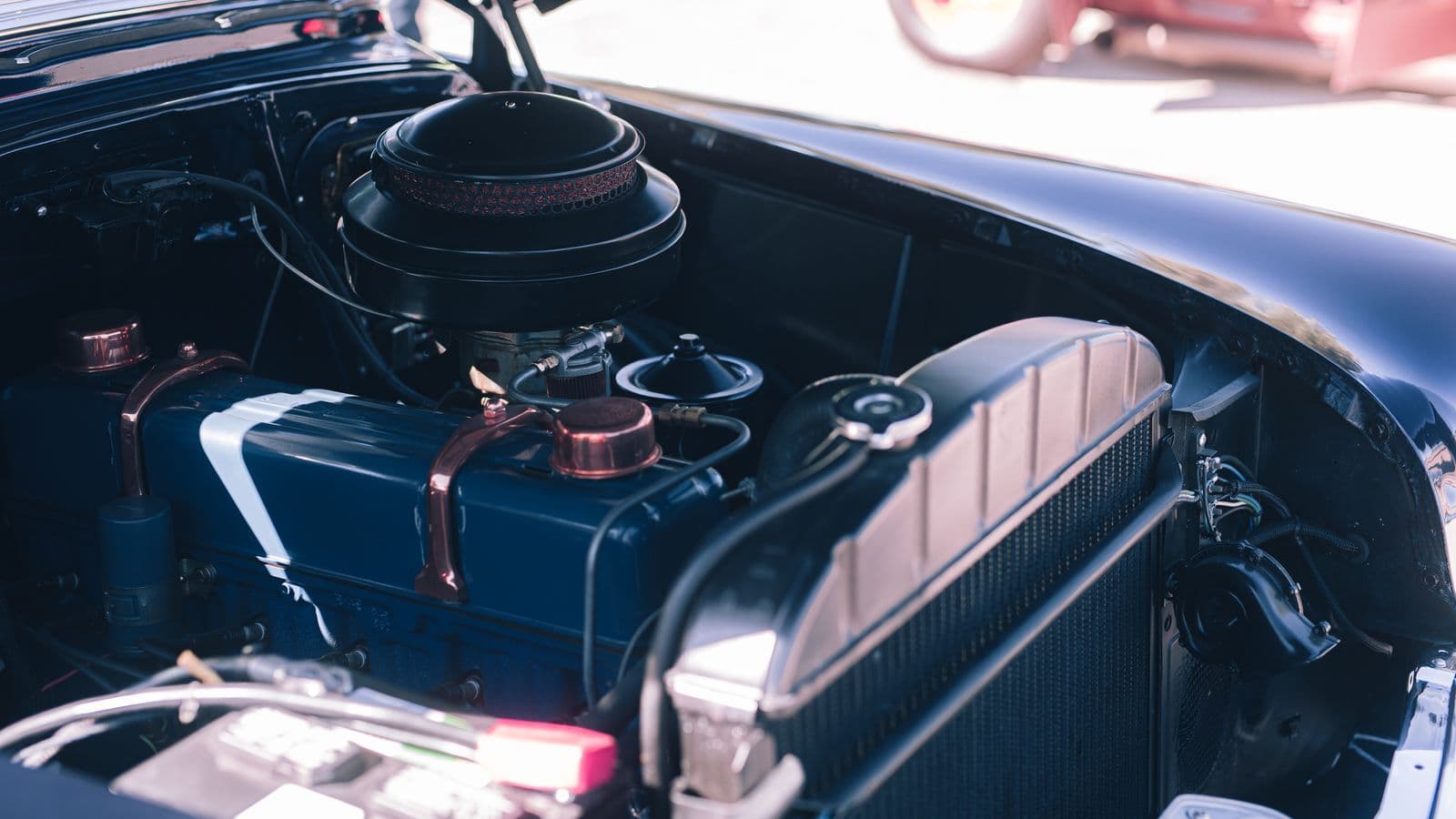
The car as we know it wasn't inevitable. At different moments over the last 120 years, steam led petrol, an Australian invention had the industry writing cheques, and Ford sketched a family car with a reactor in the boot. Most alternative-technology stories end the same way — not with suppression, but with a specific, nameable engineering or economic wall. Here are the great roads not taken, and the wall each one hit.
Almost every "lost" car technology died of something mundane: a competitor's price, a material that didn't exist, a fuel stop that took too long. The pattern is worth knowing — it's how you evaluate the miracle technologies being promised today.
Steam: the technology that was winning
In 1900, steam cars outsold petrol cars in parts of the United States, and they deserved to: no gearbox needed (steam delivers full torque from zero), near silence, and a fuel — kerosene or anything burnable — with no starting crank. In 1906 a streamlined Stanley steamer driven by Fred Marriott set a land speed record at over 200 km/h on Ormond Beach, a mark petrol cars took years to answer. The later Doble Model E started from cold in under a minute and crossed America effortlessly; steam's refinement was never the problem.
Three things killed it: the electric starter (1912) erased petrol's worst inconvenience; the Model T's price collapsed under everything else on the market; and steam's own ritual — water stops, boiler warm-up on cheaper models, freeze protection — stayed stubborn. By 1930 the steam car was gone. It made one last serious bid in the 1970s, when clean-air legislators funded steam prototypes as low-emission alternatives (steam's continuous external combustion burns very cleanly); the catalytic converter solved petrol's emissions problem more cheaply, and the revival ended.
Nuclear: the concept car with a reactor
The 1958 Ford Nucleon was a scale model, never a running car — a rakish concept with a swappable nuclear reactor where the boot should be, promising thousands of kilometres between "refuellings". It was the Atomic Age dreaming out loud. The walls here are absolute: no shielding light enough for a car exists (reactor shielding is measured in tonnes), no crash case is survivable, and the fuel-security problem needs no elaboration. The Nucleon survives as a museum piece and a reminder that concept cars are questions, not promises. The honest descendant of its promise — enormous range from energy-dense fuel, electric drive — is arguably the modern EV charged from a grid that may itself include nuclear power.
Australia's own: the Sarich orbital engine
In 1972, Perth engineer Ralph Sarich unveiled the orbital engine — a compact rotary-adjacent design in which a lobed rotor orbits without spinning — and briefly held the country's attention like few inventors before or since: BHP invested, a joint company was formed, and the engine was tipped to power a coming generation of cars. The orbital engine itself never reached production (sealing and cooling proved intractable — the same tip-seal curse that plagued the Wankel rotary (opens in a new tab)), but the story doesn't end in failure: Sarich's team pivoted to the Orbital Combustion Process — a direct fuel-injection system for two-stroke engines — which was licensed to marine and scooter manufacturers around the world and made Sarich one of Australia's wealthiest engineers. The invention that shipped wasn't the one on the poster; it rarely is.
Six-stroke, Stirling and the gallery of almosts
- Six-stroke engines add a second, steam-like expansion: after the normal four strokes, water injected into the hot cylinder flashes to steam for a bonus power stroke, recycling waste heat. American engine builder Bruce Crower demonstrated a working prototype in the 2000s, claiming meaningful fuel savings. The walls: water consumption, corrosion, and arriving just as electrification absorbed the industry's appetite for combustion innovation.
- Stirling engines — external combustion, closed cycle, theoretically superb efficiency and near silence — were seriously trialled in cars by Ford and GM under 1970s US government programs. The wall: they respond slowly to a throttle (the same transient curse as the turbine (opens in a new tab)), warm up slowly, and need large radiators. Stirlings found their niche in submarines and concentrated-solar plants instead.
- Two-stroke road cars — half the strokes, more power per litre — powered Saabs and DKWs into the 1960s and every second lawn mower since, but lubrication-oil emissions were unfixable at automotive standards without exactly the direct-injection rescue Sarich commercialised, which arrived too late for the road-car two-stroke.
The through-line: each technology's physics granted it a niche, and the car's brutal duty cycle — cold starts, stop-start traffic, decade-long ownership, five-minute refuelling — is the hardest niche of all. The technologies that hold the road earned it. And the ones that claim to have been suppressed rather than out-competed usually have a court record saying otherwise — see the Stan Meyer story (opens in a new tab).
What this means if you're buying or selling on MotorLoop
Automotive history's lesson for a used buyer is reassuring: the boring, dominant technology in any era is dominant because it survived this gauntlet. Whatever you're into — the winners or the beautiful losers — browse used cars, and if you own something with a story, a free MotorLoop showcase listing lets you tell it without selling it.
Related
- Stan Meyer and the water-powered car: the claims, the court case and the physics (opens in a new tab)
- Turbine cars: when Chrysler put a jet engine in the family sedan (opens in a new tab)
- Why Australian cars are different: right-hand drive and our own design rules (opens in a new tab)
FAQs
Were steam cars really better than early petrol cars?
In several ways, yes: full torque from standstill with no gearbox, near silence, and record-setting speed — a Stanley steamer exceeded 200 km/h in 1906. Petrol won on convenience and price once the electric starter (1912) and the mass-produced Model T arrived, while steam never shed its water stops and warm-up ritual.
Did Ford really build a nuclear-powered car?
Ford built the Nucleon as a scale-model concept in 1958 — it never ran, and no drivable nuclear car has ever existed. Reactor shielding weighs tonnes, no crash scenario is acceptable, and the concept survives purely as an artefact of Atomic Age optimism.
What happened to Australia's orbital engine?
Ralph Sarich's 1972 orbital engine attracted major investment but never overcame sealing and cooling problems. His company pivoted to the Orbital Combustion Process — direct injection that cleaned up two-stroke engines — which was licensed internationally for marine and scooter engines and became the invention's commercially successful legacy.