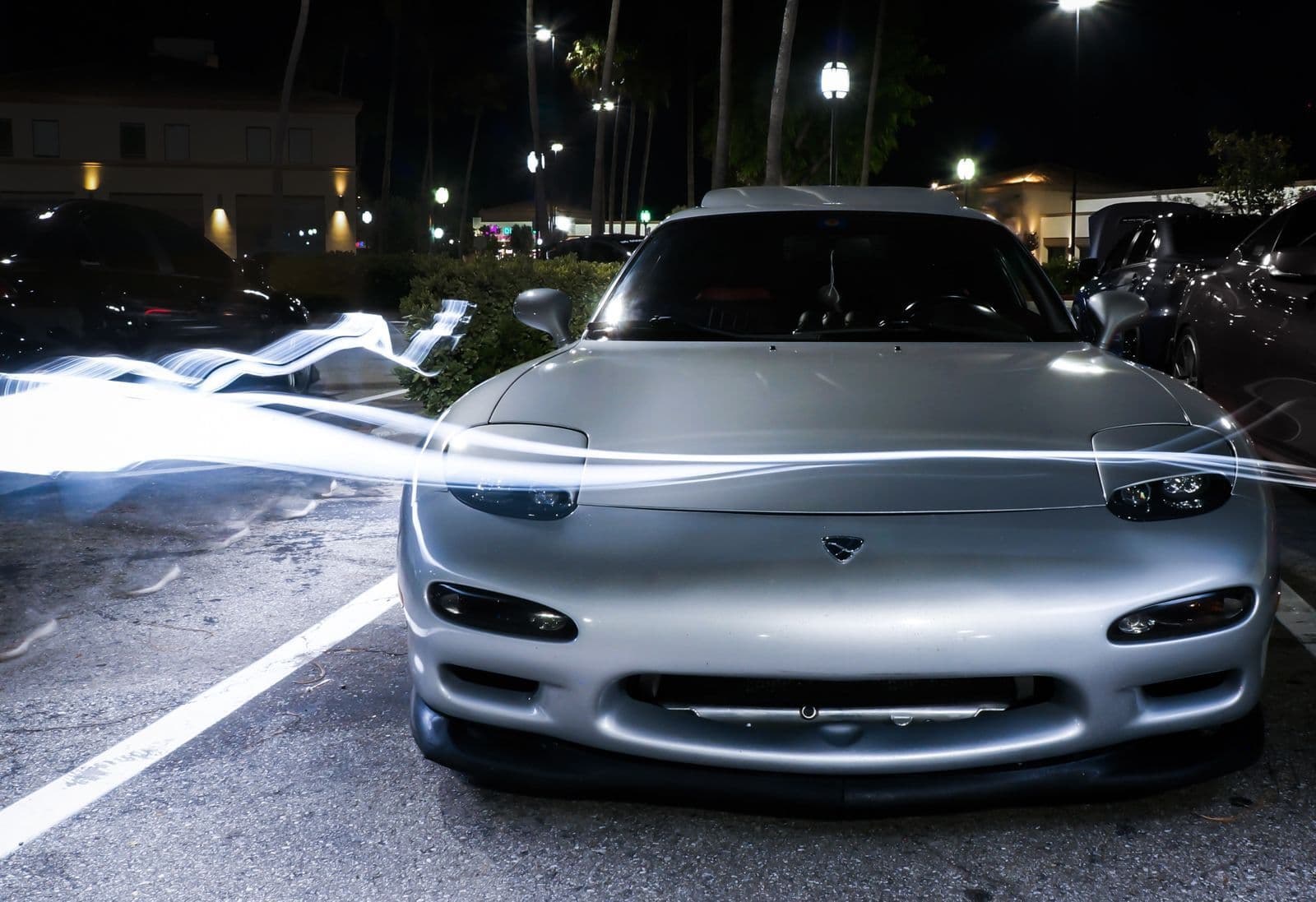
Most engines hammer: pistons stop, reverse and slam back thousands of times a minute, and everything else exists to survive that violence. The rotary engine glides instead — a curved triangle sweeping around a chamber, spinning smoothly to redlines that leave piston engines behind, from a package small and light enough to embarrass them. It's one of the genuinely different ideas in automotive history, exactly one company ever made it work at scale, and after a decade of extinction it's back in production — doing a job nobody predicted.
The rotary's whole story in one line: astonishing power from tiny size, in exchange for thirst, emissions and seals that wear — a trade the world accepted in 1970 and refused by 2012.
How a Wankel works
Patented by German engineer Felix Wankel in the 1950s and first developed by NSU, the rotary replaces pistons and valves with a three-sided rotor orbiting inside a peanut-shaped housing. As the rotor sweeps, the three pockets between its faces and the housing continuously expand and contract — performing intake, compression, combustion and exhaust in sequence, three power pulses per rotor revolution, with almost no reciprocating parts. The result: a 1.3-litre twin-rotor could rev past 8,000 rpm, weigh far less than an equivalent piston engine, and fit in a shoebox.
The catch lives at the rotor's three tips. The apex seals — thin strips maintaining contact with the housing — endure enormous rubbing speeds and thermal stress, and the combustion chamber's long, thin shape burns fuel less completely than a piston engine's compact one. Translation: wear, thirst, and unburned hydrocarbons in the exhaust.
The rise: NSU stumbles, Mazda commits
NSU's 1967 Ro80 sedan was beautiful, advanced — and an apex-seal catastrophe that helped end NSU as an independent company. Dozens of manufacturers licensed the Wankel in the 1960s (GM, Mercedes-Benz and others ran serious programs); nearly all walked away when the 1973 oil crisis made the rotary's thirst untenable.
Mazda didn't. The Hiroshima company had staked its identity on making the rotary durable — its engineers solved the early seal-wear ("chatter mark") problems that sank NSU — and it carried the flame alone: the 1967 Cosmo Sport, rotary sedans and utes (including one sold in Australia), then the cars that defined it: the RX-7 (1978–2002), whose turbocharged final generation remains a performance icon, and the RX-8 with its high-revving naturally-aspirated RENESIS engine. The competition crown came at Le Mans in 1991, when the four-rotor Mazda 787B won outright — the first overall Le Mans victory for a Japanese marque, and to date the sole one for a rotary engine.
The fall — and the strange resurrection
Tightening emissions standards and fuel-economy expectations did what the oil crisis started. The RX-8's engine, for all its 9,000 rpm charm, drank like something twice its size and consumed oil by design (rotaries inject oil to lubricate those seals); when Euro 5 emissions rules arrived, Mazda ended RX-8 production in 2012 and the rotary went extinct as a car engine.
The return, eleven years later, is a masterpiece of playing to strengths. In the MX-30 R-EV plug-in hybrid (2023), a single small rotary never drives the wheels at all — it's a generator, spinning at its favourite steady speed to recharge the battery, while electric motors do the driving. Every historic rotary weakness is neutralised: no transient thirst (steady-state running), emissions managed at one calibrated operating point, and the rotary's true superpowers — compactness, smoothness, light weight — are exactly what you want in an engine hiding under the floor. Mazda has since shown sports-car concepts (the Iconic SP) built around the same idea, so the triangle may yet have a louder second act.
Buying a used rotary in Australia
RX-7s have become blue-chip collectibles and RX-8s remain the affordable entry — with eyes open: compression testing (by a rotary specialist, with rotary-specific equipment) is the non-negotiable pre-purchase check, oil consumption is normal rather than a fault, short-trip city life kills them, and a documented rebuild is a feature, not a confession. Insurance and parts favour the well-known specialists. Treat any listing's "recent rebuild" claim as verifiable paperwork or nonexistent — and run the same PPSR and history checks (opens in a new tab) you'd run on anything.
What this means if you're selling on MotorLoop
A rotary sells on its records: compression figures, rebuild receipts, oil-top-up habits. Listing those up front attracts exactly the buyers who'll pay properly, and listing is free. Chasing one instead? Browse used cars and set up a saved search for the badge you want.
Related
- Turbine cars: when Chrysler put a jet engine in the family sedan (opens in a new tab)
- Insuring a classic: agreed value, laid-up cover and the questions to ask (opens in a new tab)
- Which fuel does your car actually need? 91 vs 95 vs 98, E10 and diesel, settled (opens in a new tab)
FAQs
Why did Mazda stop making rotary sports cars?
Fuel economy and emissions. The rotary's long, thin combustion chamber burns fuel less completely than a piston engine's, so it drinks more and emits more unburned hydrocarbons — and by 2012, tightening standards (Euro 5 in particular) made the RX-8's engine uneconomic to continue. The engine's packaging and smoothness were never the problem.
Is the new Mazda rotary the same as the RX-7's engine?
Same principle, different job. The MX-30 R-EV's single rotor works purely as a generator for a plug-in hybrid system — it never drives the wheels. Running at steady, calibrated speeds sidesteps the thirst and emissions problems that killed the rotary as a drive engine, while exploiting its compactness and smoothness.
What should I check before buying a used RX-8?
A rotary-specific compression test by a specialist is essential — standard testers don't read rotaries properly. Expect designed-in oil consumption, favour cars with regular-use highway history over short-trip city cars, and treat a documented rebuild with receipts as a plus. Budget for specialist servicing.