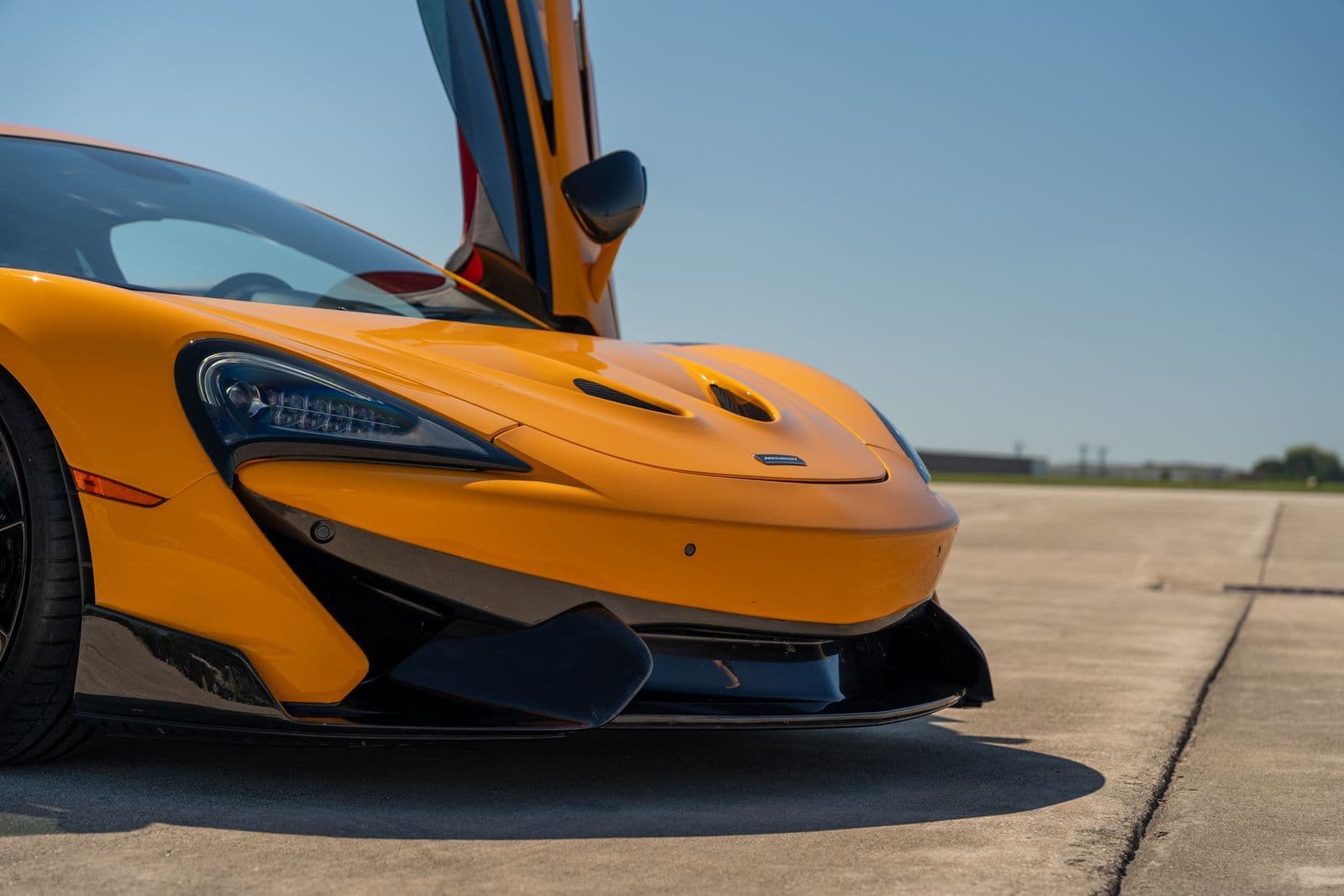
Most supercars are born from marketing plans. The McLaren F1 was born from a thought experiment: what would a road car look like if a Formula One designer refused every compromise? Gordon Murray's 1992 answer became, by wide consensus, the most revered supercar ever made — a car whose engineering choices still read as radical thirty years on, whose values climbed from famously unsellable to eight figures, and whose shadow was so long that the company it made legendary waited nearly two decades to build another road car. This is the F1's story, and the story of the marque that grew in its wake.
The F1 chased perfection, not numbers — yet collected the numbers anyway: the world's fastest production car for years, and a Le Mans winner at its first attempt. Purity, it turned out, was also quick.
One designer's refusal to compromise
Gordon Murray, fresh from designing championship-winning McLaren Formula One cars, specified the F1 around principles rather than targets: light above all (carbon-fibre monocoque — cited as a production-car first), naturally aspirated (a bespoke BMW 6.1-litre V12), no power steering, no ABS on the original car, no turbos, no wings that moved for show. The famous details serve the principles: the central driving seat, flanked by two passenger seats set back, existed for visibility and weight distribution, not theatre; the gold lining in the engine bay was chosen as a heat reflector, not jewellery. Around 106 cars were built across all variants through the 1990s — road cars, prototypes and racers — at a price that made it a commercial struggle in its recessionary decade.
The numbers it collected anyway
In 1998, an F1 prototype driven at Volkswagen's Ehra-Lessien track recorded a top speed of roughly 386–391 km/h depending on the run cited — a production-car record that stood for years and remains the benchmark for naturally-aspirated cars by most reckonings. Earlier, in 1995, the racing F1 GTR had won Le Mans outright at the model's first attempt — against purpose-built prototypes, in the wet, with F1 GTRs filling several of the top placings. That combination — record speed and endurance victory from a car conceived as a road-going ideal — is unrepeated, and it's the bedrock of the F1's standing and its stratospheric collector values today.
The long shadow, then the second act
McLaren didn't follow the F1 with another road car for years (the Mercedes-partnered SLR of the 2000s being a co-production interlude). The full second act arrived in 2010 with McLaren Automotive: the 12C, then a rapidly expanding line — 650S, 570S, 720S, 765LT, the P1 hybrid flagship, the track-focused Senna, the three-seat Speedtail that consciously revived the F1's central seat, and the recent W1 flagship continuing the "1" lineage. The house style is Murray's inheritance: carbon tubs in every car, obsessive weight and aero engineering, function-first design that makes McLaren the "engineer's choice" against Ferrari's mythology and Lamborghini's theatre. The business has been rockier than the products — ownership restructures and recapitalisations have made headlines repeatedly — but the engineering reputation has held.
What it means for buyers here
No reader needs F1 advice (the survivors trade privately at eight figures). The modern McLarens, though, are a real Australian used-market presence, and they follow this series' standing rules with one accent: these are carbon-intensive, hydraulically sophisticated cars where specialist servicing access matters even more than usual, and where the running-cost structure rewards buying on history over price. Depreciation on the volume models has been substantial — which, per the fork, makes them some of the most performance-per-dollar exotics on the market, while the limited cars behave like the heroes they are.
What this means if you're buying or selling on MotorLoop
McLaren buyers are spec-literate and condition-obsessed — a listing that documents service history at a recognised specialist, tyre and brake life, and any warranty balance answers the questions that actually decide these sales. Listing is free; the daydreamers and the serious browse used cars side by side, and a special car that isn't for sale can hold court on a showcase page.
Related
- Ferrari's road to icon status: the models that made the marque
- Lamborghini: from tractor factory to the world's most theatrical supercars
- Supercar depreciation: the heroes and the craters
FAQs
Why is the McLaren F1 so special?
It was designed as an uncompromised ideal — carbon monocoque, central driving seat, bespoke V12, obsessive lightness — and then validated itself in the real world: a production-car speed record that stood for years and an outright Le Mans win at its first attempt in 1995. Roughly 106 were built, and the combination has never been repeated.
Why does the McLaren F1 have a central driving seat?
For engineering reasons: perfect visibility, symmetrical control layout and centred driver mass, with two set-back passenger seats making it a genuine three-seater. Designer Gordon Murray chose it for function; the theatre was a by-product. McLaren's Speedtail later revived the layout as a deliberate homage.
Is the gold in the McLaren F1's engine bay real?
Yes — gold foil lines the engine bay as a heat reflector, chosen because gold is among the most effective infrared reflectors available. It's the perfect emblem of the car: what looks like extravagance is, characteristically, a functional engineering decision.