No serious carmaker has an origin story as good as Lamborghini's, and the company knows it: a wealthy tractor manufacturer, insulted by Enzo Ferrari, decides to build a better GT out of spite. The tale is part legend — but the legend is doing real work, because it announces the brand's entire personality. Ferrari descends from racing; Lamborghini descends from a gesture. Sixty years later that DNA is intact: Lamborghinis are the cars that commit hardest to spectacle, and the company's genius has been turning theatre itself into an engineering discipline.
Lamborghini's founding bet, renewed every generation: people don't buy the fastest car — they buy the most unforgettable one. Drama, engineered properly, is a product.
The tractor magnate and the grudge
Ferruccio Lamborghini made his fortune building tractors in post-war Emilia-Romagna, and owned the fast cars his wealth suggested — Ferraris among them. As the story goes, he complained to Enzo Ferrari about a clutch and was told, in effect, that a tractor maker had no business lecturing Ferrari; the details are unverifiable and much-embellished, but what's documented is the result: Automobili Lamborghini founded in 1963 at Sant'Agata Bolognese, staffed with brilliant young engineers, and launching the refined 350 GT in 1964 aimed squarely at Ferrari's grand tourers. The plan was civility. The company's fame came from abandoning it.
Miura, Countach, and the poster era
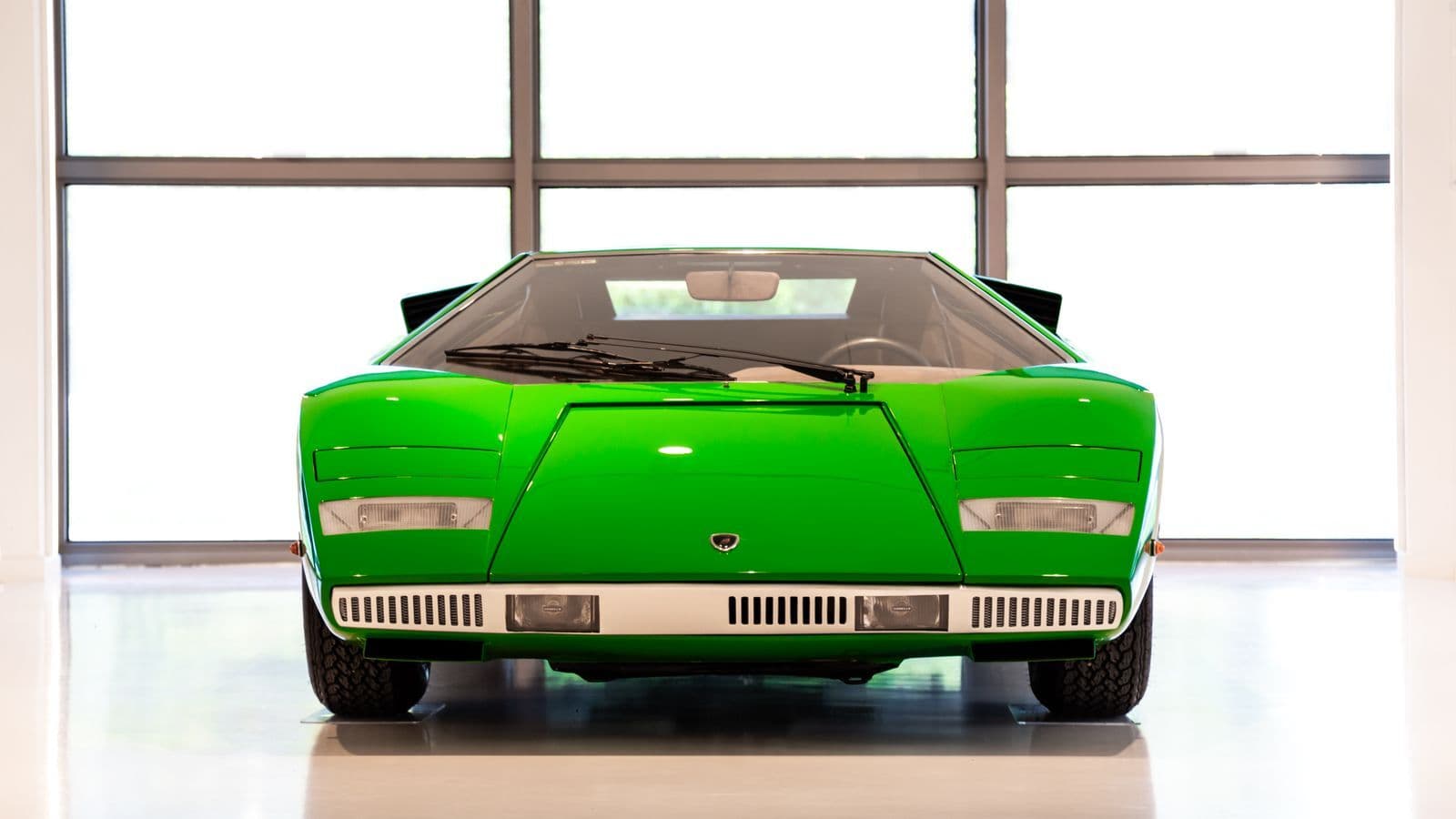
The Miura — covered earlier in this series — invented the supercar template in 1966 almost by accident. Its successor made outrage the house style: the Countach of 1974, another Marcello Gandini shape, all wedge and scissor doors, so extreme that it defined "supercar" for a generation of bedroom walls through the 70s and 80s. The scissor doors became the brand's signature ritual on every V12 flagship since; the Diablo (1990) and Murciélago (2001) carried the formula — enormous V12, outrageous body, intimidating presence — across three more decades.
The near-death decades
The theatrical company had a chaotic ledger. Ferruccio sold out in the 1970s; there followed bankruptcy proceedings, a parade of owners including Chrysler (1987) and Indonesian investors, and periods where new models were promised more than delivered. The turning point was 1998, when Audi — via Volkswagen Group — bought the company. German industrialisation of the theatrical Italian brand produced the modern era: the Gallardo (2003) and Huracán became the volume "junior" supercars that transformed the business, the Aventador (2011) kept the V12 flame, and the Urus SUV (2018) — heresy to purists, salvation to accountants — pushed annual sales past ten thousand for the first time, funding everything else.
Theatre as engineering
What separates Lamborghini's spectacle from mere styling is that the company engineers the drama: naturally-aspirated engines kept alive for their sound and response long after rivals turbocharged, the scissor-door ritual, starter buttons under fighter-jet flaps, driving modes named in Italian. The current-era proof is the Revuelto — the V12 flagship reinvented as a plug-in hybrid, its twelve cylinders retained explicitly as identity rather than necessity (a theme this series returns to in a coming piece on the V12's survival). Emissions rules bend around the theatre; the theatre doesn't bend.
Owning the theatre in Australia
Practicalities, briefly: the Gallardo/Huracán families are where realistic Australian Lamborghini ownership concentrates — higher volumes, shared-group components and established specialist support making them approachable by exotic standards, with the first-exotic playbook applying in full. V12 cars are a different tier of cost and presence; the running-cost structure applies with the volume turned up. All of them reward the same discipline: specialist inspection, complete history, honest budgeting.
What this means if you're buying or selling on MotorLoop
Lamborghinis photograph like nothing else — use it. Sellers: shoot the drama (doors up, if you have them) and the documentation, because theatre gets the click and paperwork gets the sale. And a Lamborghini that isn't for sale is exactly what MotorLoop's showcase listings were built for — listing is free, and the used-car aisles await everyone else.
Related
- The Lamborghini Miura and the birth of the supercar
- Ferrari's road to icon status: the models that made the marque
- What it really costs to run a supercar in Australia
- Showcase your car online: share the car without the hard sell
FAQs
Did Lamborghini really start because of an argument with Ferrari?
That's the legend — Ferruccio Lamborghini, tractor magnate, dismissed by Enzo Ferrari over a clutch complaint, founding his own car company in response. The anecdote is unverifiable and much-embellished, but the documented facts frame it: a wealthy industrialist founded Automobili Lamborghini in 1963 explicitly to compete with Ferrari's grand tourers.
Who owns Lamborghini today?
Audi, within the Volkswagen Group, since 1998 — the acquisition that ended decades of financial chaos (including bankruptcy and a Chrysler interlude) and industrialised the modern brand: Gallardo, Huracán, Aventador, the Urus SUV and today's hybrid V12 Revuelto all belong to the Audi era.
What's the most realistic Lamborghini to own?
The V10 junior supercars — Gallardo and Huracán — are where practical ownership concentrates: built in the thousands, supported by established specialists, and benefiting from group-shared components. They demand the standard exotic disciplines (specialist inspection, complete history) but sit a full tier below the V12 cars in running costs.