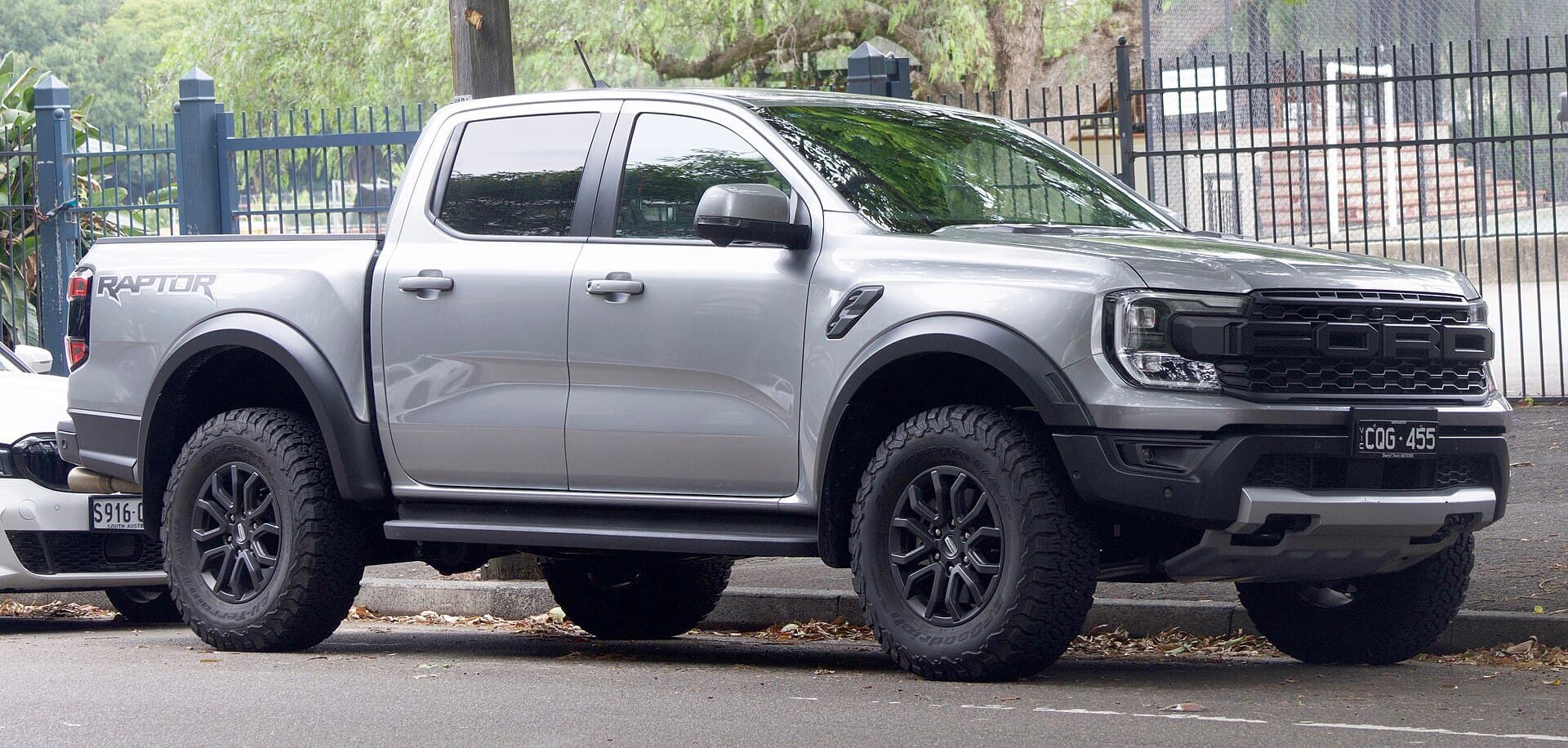
Australia's new cars are getting bigger and heavier, and the rules around them are struggling to keep up. The national parking standard still dates from 2004, and in March 2026 Standards Australia said its proposed larger bays would not go ahead in their current form. Our view: light, simple cars are more fun to drive and kinder to everything around them, and big utes and heavy EVs share the same problem.
- 10.28m²
- Average footprint of a new ute in 2024 (NTC)
- +13%
- Rise in average light-vehicle mass, 2003 to 2024
- +6%
- Odds of a pedestrian dying per extra 100 kg (Victorian study)
The parking bay that hasn't grown since 2004
Car parks in Australia are designed to AS/NZS 2890.1, the off-street parking standard. In 2023 Standards Australia put out a draft that proposed lengthening a standard bay from 5.4 metres to 5.6 metres (opens in a new tab), because the 2004 rules were written when SUVs were about 13% of the national fleet and they are now about 40%.
That revision has gone nowhere. In an update dated 24 March 2026, Standards Australia said the proposed changes "will no longer move forward in their current format" (opens in a new tab) and would be reconsidered. So the shopping-centre bay you squeeze a Ranger into tonight is still sized for the cars of two decades ago.
We don't think bigger bays are the real answer anyway. Every extra 20 centimetres of bay is land that isn't shops, homes or trees. The better question is why the cars keep growing.
How much bigger, and how much heavier
The National Transport Commission tracks every new light vehicle that joins the fleet. Its latest trends report, as CarExpert reported in December 2025 (opens in a new tab), found that utes entering the fleet in 2024 had an average footprint of 10.28 square metres, 1.6 square metres more than in 2003. Footprint is the area between the four wheels, roughly track times wheelbase. The same report found the average mass of all new light vehicles grew by 13% between 2003 and 2024.
The mix has shifted too. The Australia Institute's senior economist Jack Thrower, writing in December 2025 (opens in a new tab), put SUVs at one in 14 new sales in the mid-1990s and 56% now, with "other vehicles", mostly utes, rising from one in six sales to more than one in four. His analysis also counts nearly two light commercial vehicles for every tradie and farmer in 2024, up from about 0.7 in 1988. In our reading, a lot of utes aren't doing ute work.
The cost lands on people outside the car
Weight isn't just a parking problem. In August 2026 researchers Milad Haghani, Abbas Rajabifard, Iman Taheri Sarteshnizi and Neema Nassir published an analysis of 10,376 pedestrian crashes in Victoria from 2012 to mid-2025 (opens in a new tab) in the journal Sustainable Cities and Society. They found each extra 100 kg of vehicle weight was linked to a 6% rise in the odds of a pedestrian dying, and each extra 10 cm of height to an 11% rise. Utes and US-style pickups were associated with roughly 60% higher pedestrian fatality risk than conventional passenger cars, and the effect was stronger at lower speeds. Their simulation of shrinking the larger vehicles to a typical passenger-car size predicted about 9% fewer pedestrian deaths.
Heavier cars also work their tyres and the road harder, which we looked at in Beyond the tailpipe: tyres, weight and the EV recycling problem (opens in a new tab).
This isn't a diesel-versus-electric argument. A battery adds weight, and a dual-cab ute adds height and length. The Victorian study measured weight and height, not fuel type. In our view a heavy electric SUV and an equally heavy diesel ute ask the same questions of a car park, a road surface and a pedestrian.
France: when the tax is per kilogram
If you want to see what happens when a government decides weight matters, look at France. It charges a weight-based registration tax, the malus masse, which in 2026 starts at 1,500 kg kerb mass, according to the French government's public service site (opens in a new tab), checked on 1 March 2026. Each kilogram from 1,500 to 1,699 kg costs €10, rising in steps to €30 a kilogram from 2,000 kg. The government's own worked example, a 1,950 kg car registered in March 2026, pays €6,775 in weight tax alone. Fully electric cars are exempt depending on their registration date, and plug-in hybrids get a 200 kg reduction.
Paris went further at street level. In February 2024 Parisians voted, by 54.55% on a turnout of just 5.7%, to triple short-stay parking charges for heavy visiting cars (opens in a new tab): from €6 to €18 an hour in the centre and from €4 to €12 further out, for petrol and hybrid cars of 1.6 tonnes or more and electric cars of 2 tonnes or more, from 1 September that year.
We're not arguing Australia should copy French taxes. A tradie towing a trailer to a regional job site needs a real ute, and our distances aren't Paris. But France shows that weight can be priced directly rather than ignored, and that it draws its line at around 1.5 to 1.6 tonnes.
Light cars are simply more fun
Here's the enthusiast's case, and it's our opinion. A light car does everything with less. Less weight means the brakes, tyres and engine all have an easier job, and the steering tells you more about what the front wheels are doing. That's why, in our view, a small roadster or coupe can be more entertaining on a winding road than an SUV with twice the power. It's also why so many of the cars enthusiasts remember are small. Japan never lost the habit, as we wrote in Japan's small cars make sense when you look at the streets (opens in a new tab).
We think the trend toward bigger cars is partly fashion and partly a feeling of safety from sitting high and heavy. But the Victorian figures show the cost of that falls partly on the people outside.
What it means if you're buying or selling
- Buy the size you need, not the size you fear. If your ute never carries a load or tows, we think a smaller car will be cheaper to fuel, park and fit with tyres, and probably more fun too.
- Check the kerb weight, not just the badge. Weight is in the specifications, and it tells you more about running costs and handling than the body style does.
- Measure your garage and car park. Bays built to the 2004 standard aren't changing soon, given the review has stalled.
- Selling a light car? Sell its lightness. Easy parking and handling are real selling points to the buyers who care about driving.
You can buy, sell & show cars on MotorLoop, and it's free.
Our take
We think Australia's cars have grown past the point of sense. The numbers are clear: bigger footprints, more mass, and a Victorian study linking weight and height to pedestrian deaths. The parking bay review stalling is a small symptom of a bigger habit, which is building the world around cars rather than choosing cars that fit the world. Heavy EVs and big utes are on the same side of that line. A light, simple car parks easily, asks less of its tyres and brakes, is kinder to whoever steps off the kerb and, for those of us who enjoy the drive, is simply more fun.
Header photo: LuvsMG481 (opens in a new tab) via Wikimedia Commons, CC BY-SA 4.0 (opens in a new tab).
Related
- Beyond the tailpipe: tyres, weight and the EV recycling problem (opens in a new tab)
- Japan's small cars make sense when you look at the streets (opens in a new tab)
- Safer cars, stubborn road toll: why Australia's road deaths aren't falling (opens in a new tab)
- Japan's car-park elevators: why the rest of the world hasn't caught on (opens in a new tab)